
Daily Podcast full article
Wow! Tesla Bot Gen 3 Finally Learning to Cook a Meal!
Tesla’s Optimus Gen 3 story is moving from viral kitchen fantasy toward a more concrete question: can a mass-produced humanoid robot learn the fragile, messy chain of actions behind cooking, while Tesla still has to prove autonomy, safety, production scale and price?
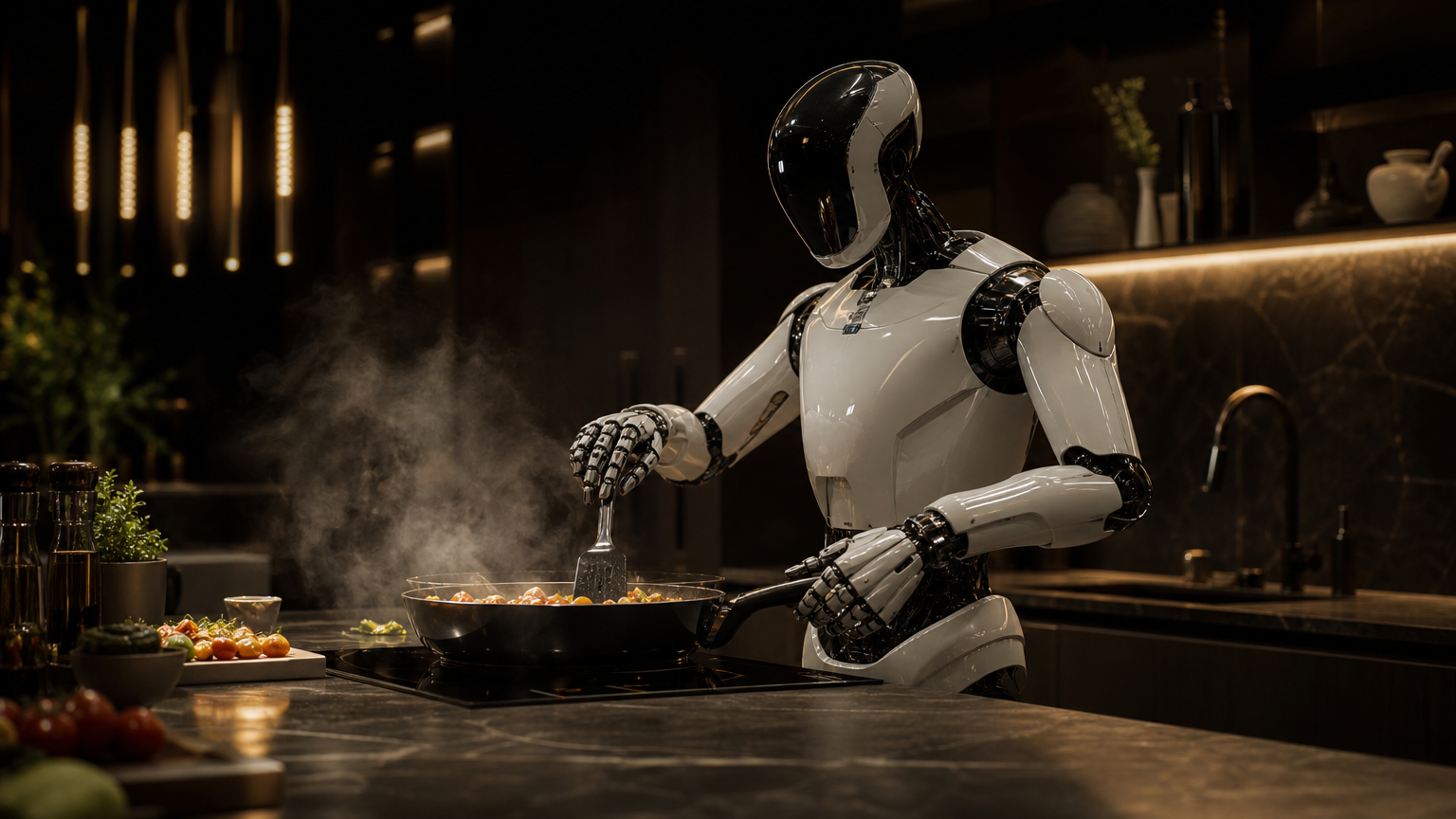
The headline is kitchen magic; the evidence is more industrial
The current Optimus Gen 3 conversation is framed by a simple image: a Tesla humanoid robot learning to cook a meal. That image matters because cooking is not a party trick. It requires vision, memory, balance, finger control, heat awareness, timing, tool use and recovery from small mistakes. The September 12 8news video summary presents Tesla Bot Gen 3 as a mass-market humanoid direction built around more dexterous hands, AI5 computing and voice-driven software for practical chores such as cooking, while also noting that errors and high early prices remain part of the near-term picture .
That distinction is the story. The latest evidence does not show a consumer robot calmly making dinner in a normal home, serving it and cleaning the kitchen without help. It shows Tesla’s Optimus narrative being pushed toward the kitchen as the benchmark for whether humanoid robotics has crossed from controlled demonstrations into useful daily work . In other words, “learning to cook” should be read as a capability frontier, not as proof that a commercial home chef has arrived.
Why cooking is such a brutal robotics test
Cooking exposes almost every weakness in a humanoid system. A robot must identify ingredients, open doors and drawers, hold fragile objects without crushing them, use tools built for human hands, judge pan position, avoid burns, control grip force, and respond if something slips, spills or is missing. 8news’s September 12 summary rightly describes cooking as more demanding than dancing or other scripted displays, because the robot must chain together many uncertain actions in a cluttered human environment .
The egg is the perfect symbol. Picking one up is already a useful demo of force control; cracking one cleanly into a pan is a much harder task. A kitchen also punishes latency. If the robot pauses for too long while holding a hot pan, misunderstands “turn it down,” or grips a wet utensil incorrectly, the issue becomes more than a software bug. It becomes a safety and trust problem.
That is why the “meal” in this story should be treated as an editorial stress test for Optimus Gen 3. If Tesla can make a humanoid robot reliable in the kitchen, the same manipulation stack could translate into factory kitting, warehouse handling, elder-care assistance and other work. If it cannot, the kitchen will reveal where the promise breaks.
The Gen 3 hand is the center of the story
The biggest technical reason this headline is plausible is the hand. The latest summaries describe Gen 3 as centered on a major dexterity upgrade, with 22 degrees of freedom in the hands and 50 actuators across both hands, a large jump from prior hardware . The September 12 8news summary also describes Tesla’s expected architecture as moving many actuators into the forearm and using tendon-like mechanisms through the wrist, a design intended to reduce hand weight while improving precision .
That matters for cooking because kitchens are full of objects that are neither standardized nor forgiving: eggs, onions, slippery handles, flexible packaging, cloth towels, heavy pans and fragile dishes. A factory robot can often be given fixtures, jigs and repeatable part positions. A home robot must work with whatever a human left on the counter.
The upgraded hand does not solve the whole problem by itself. Dexterity without perception can still fail; perception without grip control can still break objects. But the hand is the physical interface between Tesla’s AI claims and the real world. For Optimus, cooking begins at the fingertips.
AI5 and voice control are the “brain” layer, but they are not magic
The second pillar is compute. The September 12 summary says AI5 is central to whether Optimus becomes useful, because low-latency vision and decision-making are required in cluttered spaces . Optimus-focused coverage updated on September 11 similarly describes the current capability stack as Gen 3 hands, AI5 inference hardware and Grok-based voice interaction, while cautioning that autonomous productive throughput at volume remains unproven .
Voice control is particularly important for the kitchen use case. A useful home robot should not require a programmer. A person should be able to say, “make breakfast,” “use the eggs in the fridge,” or “stop, that pan is too hot,” and the system must translate language into safe physical action. The likely architecture is layered: fast onboard perception, balance and motion control, plus a higher-level language or reasoning layer for multi-step instructions .
The risk is that language systems can sound more capable than the robot body actually is. A voice assistant can confidently understand a recipe; a humanoid robot must still reach, grasp, move, pour, stir and clean. The kitchen forces AI to become embodied, and embodiment is where demos often meet resistance.
Production scale changes the meaning of “learning”
The freshest surrounding Optimus reports also shift the story from one robot to many robots. A September 10 8news article says the viral “5,000 Tesla Bot Gen 3” discussion rests on a reported large component order, while stressing that Tesla has not officially confirmed the order and that household replacement claims remain unproven . The same article frames the important development as supply-chain language: purchase orders, supplier audits, line tuning and bill-of-material pressure rather than a single show demo .
That matters for cooking because robots learn best when they generate many examples of success and failure. Optimus-focused coverage updated September 11 says first production units are being tied to an “Optimus Academy” style training loop, where manipulation data is collected to turn broad task ambitions into demonstrated skills . If Tesla can place many units in controlled internal settings, each grasp, spill, misread object and recovered motion could become part of the training flywheel.
Still, production scale is not the same as home readiness. The September 10 8news article warns that the current evidence points first to internal deployment, factory tasks, data collection and iterative improvement rather than commercial home service robots arriving at customers’ doors . That is the sober version of the kitchen story: the path to a cooking robot likely runs through factories before kitchens.
Price remains the wall between demo and household product
The subject’s mass-market framing depends on cost. The September 12 summary says Musk’s long-term ambition is a car-like price and very large annual production, but it also notes that early commercial pricing may land well above earlier $20,000-to-$30,000 expectations . Optimus-focused tracking updated September 11 likewise says the robot is not publicly for sale, with no public deposits, pre-orders or waitlists, and places consumer availability no earlier than later 2027 in its current status view .
That is crucial. A robot that can cook one dish under supervision at $100,000 is a fascinating machine; a robot that can safely prepare meals every day at car-like pricing is a consumer revolution. The gap between those two outcomes is reliability, serviceability, insurance, support, replacement parts, legal responsibility and user trust.
Cooking also raises a different cost question: how many useful hours can the robot deliver without rescue? A cheap hourly claim only works if the machine performs consistently, avoids damage, does not require constant human correction and can handle the messy variety of real homes. The latest reporting does not prove those conditions yet .
The current state: promising, not proven
As of the latest 72-hour snapshot, the best reading is this: Tesla Bot Gen 3 is being positioned as the first Optimus generation with the hardware and software direction needed for practical chores, and cooking is the most vivid test of that ambition . The hand upgrade, AI5 compute and voice interface make the kitchen narrative technically more serious than earlier humanoid hype . At the same time, the available fresh reporting still points to internal training, factory-first deployment and unresolved cost and autonomy questions .
So yes, Tesla Bot Gen 3 may finally be learning to cook a meal. But the word “learning” is doing the work. The breakthrough will not be a polished video of a robot touching a pan. It will be repeated, safe, autonomous performance across ordinary kitchens, with ordinary ingredients, ordinary mess and ordinary human impatience.
For now, the kitchen is less a destination than a debugging environment. Tesla does not only have to teach Optimus a recipe. It has to debug the robot, the supply chain, the safety case and the economics of domestic labor at the same time.
Sources from the last 72 hours
- [1]Wow! Tesla Bot Gen 3 Finally Learning to Cook a Meal! · Tesla · 8news.aiSep 12, 2026, 11:30 AM UTC
- [2]5,000 Tesla Bot Gen 3 Ready to Replace Housekeepers for $1/Hour! · 8news.aiSep 10, 2026, 5:32 PM UTC
- [3]Tesla Optimus Capabilities: What Can It Actually Do? (2026)Sep 11, 2026, 12:00 AM UTC
- [4]Tesla Optimus Latest Version 2026: The Official Humanoid RobotSep 11, 2026, 12:00 AM UTC
- [5]Tesla Optimus Tracker: Production Milestones & Latest News (2026)Sep 12, 2026, 12:00 AM UTC
AI-generated article based on recent web research, then preserved as a dated editorial snapshot.
Comments
Be the first to comment.