
Daily Podcast full article
5,000 Tesla Bot Gen 3 Ready to Replace Housekeepers for $1/Hour!
A reported 5,000-unit Tesla Optimus Gen 3 supply-chain order has revived the bold “$1/hour housekeeper” narrative, but the freshest reporting points to a more cautious reality: Tesla may be moving from prototypes to batch manufacturing, while home deployment, verified costs and public availability remain unconfirmed.
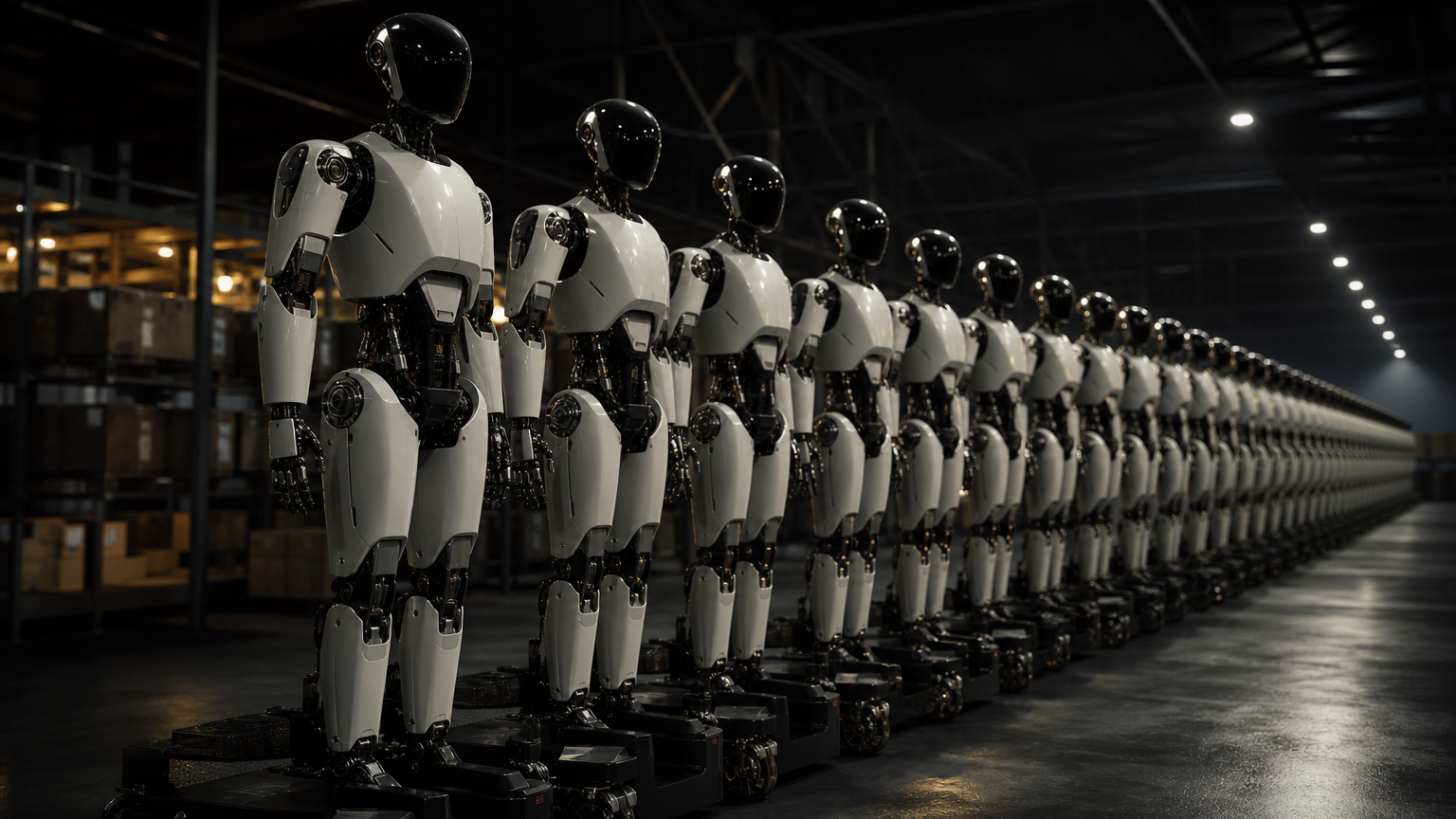
The claim that moved the story
The current Tesla Bot Gen 3 story begins with a striking number: roughly 5,000 Optimus units. Fresh reporting says Tesla has placed a large component order with key suppliers for about that quantity, making it the first reported procurement step in the thousands rather than in the hundreds . Chinese supply-chain coverage similarly describes a September batch order of around 5,000 Optimus units, with allocations split among suppliers according to their share of the parts program .
That is why the headline “5,000 Tesla Bot Gen 3 Ready to Replace Housekeepers for $1/Hour!” has spread so quickly. It combines three ideas into one viral promise: a meaningful production batch, a next-generation humanoid robot and a household labor cost so low that it sounds less like a product launch than a labor-market shock. The first idea has support in current reports; the second is consistent with coverage describing Optimus V3 or Gen 3 production intent; the third remains unproven in the latest available reporting .
What appears to be new
The most important development is not that Tesla has a humanoid robot project. It is that the project is now being discussed in supply-chain terms: purchase orders, supplier audits, weekly capacity targets, factory-line tuning and bill-of-materials pressure. AIStockWire reported that Tesla has not confirmed the 5,000-unit order, but that the claim was attributed to supplier feedback around a Jiemian News report dated September 7, 2026 .
Sohu’s September 8 account says the order would follow earlier trial orders of only several hundred units and would represent the first move into thousand-unit procurement . Benzinga also summarized the Jiemian-based reporting as Tesla’s first large-scale component order for roughly 5,000 Optimus robots, framing it as a shift from proving humanoid technology to proving manufacturing scale .
That distinction matters. A humanoid robot that can wave, fold laundry in a demo or carry a box under controlled conditions is one thing. A humanoid robot that can be produced repeatedly, repaired economically and trained across messy real-world tasks is another. The latest reports suggest Tesla is testing the second problem.
The Fremont production-line clue
Several current reports point to Fremont as the near-term manufacturing focus. Sohu reported that Tesla’s Fremont humanoid-robot line began equipment debugging in July and completed preliminary trial production in mid-August before the reported batch order was released . Sina’s September 8 roundup, citing Chinese media and suppliers, also described the Fremont line as having started debugging in July and reached an initial completion stage in mid-August .
The same timeline is important because it offers a plausible reason for the order size. If yields are improving, Tesla can justify ordering parts in larger lots; if yields are still unstable, a 5,000-unit parts order can function as a stress test for both the robot line and the vendor network. Sohu characterized the current phase as “ramp verification,” not a normal consumer-product launch .
That language should temper the “ready to replace housekeepers” claim. The freshest reports point first to internal deployment, factory tasks, data collection and iterative improvement, not to commercial home service robots arriving at customers’ doors .
5,000 now, 15,000 this year?
The 15,000-unit figure is more complicated than the headline suggests. Some coverage says the reported 5,000-unit order has been interpreted as setting a baseline of about 15,000 deliveries this year . Optimus-tracking summaries and market reports have also repeated that framing, tying it to supplier guidance that reportedly called for capacity of about 1,000 units per week by September and 2,000 to 2,500 units per week by year-end .
But AIStockWire draws a sharper line between supplier capacity and actual production. It reports that the September story points to an internal 2026 shipment target of 10,000 to 20,000 Optimus units, while warning that no source definitively establishes 15,000 as a confirmed Tesla production number . It also notes that Tesla has not reported delivering an Optimus robot to an outside customer .
The safest reading is therefore this: 5,000 is the reported initial batch order; 10,000 to 20,000 is the reported internal planning range; 15,000 is a circulating midpoint or baseline, not an official Tesla commitment .
The $1/hour housekeeper problem
The “$1/hour” part of the story is where the evidence thins out. The latest reports do not verify that Tesla can operate Optimus Gen 3 in a home for $1 per hour, nor do they verify that the robot is ready to replace professional housekeepers . Instead, the freshest reporting emphasizes component orders, production ramps, supplier readiness and factory deployment .
There is also a cost reality behind the dream. Sohu’s September 8 report says outside estimates still put Optimus V3 manufacturing cost above $60,000 before significant volume scale, and it identifies the dexterous hand, actuators and related systems as major cost centers . Another supply-chain analysis published September 8 says the companies most likely to benefit are those already proven in Tesla’s automotive supplier system, because quality, cost and global delivery discipline matter more than “robot concept” branding .
That does not kill the long-term housekeeper thesis. It simply moves it from “ready now” to “possible only after scale, reliability and service economics are solved.” A robot can be cheap per hour only if it works many hours, needs limited maintenance, avoids damage in unpredictable homes and can perform useful tasks without constant human rescue. The current reporting does not show that those conditions have been met .
Why suppliers matter more than demos
Optimus is now being judged less by stage performances and more by the supply chain behind its joints, hands, motors and sensors. Sohu reported that the new order may correspond to an internal yearly delivery range of 10,000 to 20,000 units and that most units are expected to be used first for Tesla’s own factory work, data collection and function iteration .
The September 8 supplier-focused analysis argues that the likely early winners are existing Tesla automotive suppliers rather than companies newly trying to market themselves as robotics plays . It names firms such as Tuopu Group, Sanhua Intelligent Controls and Joyson Electronics as examples of suppliers with automotive manufacturing discipline and North American or Mexican production relevance .
This matters because humanoid robots are not just AI models with legs. They are electromechanical products with thousands of parts, tight tolerances and difficult reliability requirements. If Tesla is truly moving toward thousands of units, the real test is repeatability.
Market reaction and investor caution
The reported order quickly spilled into markets. Chinese robotics-related shares and ETFs moved after reports that Tesla had placed a large Optimus order, with coverage highlighting gains among component and automation names . Benzinga connected the Tesla and XPeng humanoid-robot production stories to broader investor interest in robotics hardware, sensors, semiconductors and factory automation ETFs .
Still, the sources themselves contain caution signs. Tesla has not officially confirmed the order . The 15,000-unit claim is not uniformly described across reports . The household replacement angle is not supported by current deployment evidence . The cost curve is still a forecast, not a verified consumer-service price .
Bottom line
The freshest evidence supports a meaningful Tesla Optimus Gen 3 manufacturing story, not a confirmed home-robot revolution. A reported 5,000-unit supply-chain order would be a serious escalation from prototype batches, and it may indicate that Tesla is preparing to test Optimus at a scale large enough to expose manufacturing, software and reliability bottlenecks .
But “ready to replace housekeepers for $1/hour” remains a headline claim rather than a verified commercial fact. The robot may be moving closer to factory deployment and fleet learning, while the home-cleaning use case still depends on price, safety, dexterity, autonomy, maintenance and real-world reliability that the latest reports have not yet proven .
In short: 5,000 Tesla Bot Gen 3 units may be the first real sign of a production ramp. The $1/hour housekeeper is still the promise at the far end of that ramp.
Sources from the last 72 hours
- [1]Tesla (TSLA) Optimus: reported order for 5,000 robotsSep 8, 2026, 2:29 AM UTC
- [2]特斯拉供应链传出Optimus约5000台订单,产线进入爬坡验证Sep 8, 2026, 1:05 AM UTC
- [3]Tesla and XPENG Are Taking Humanoid Robots to the Factory: 3 ETFs to Watch as Production ScalesSep 8, 2026, 6:11 PM UTC
- [4]Tesla, XPENG Push Humanoid Robots Toward Mass ProductionSep 8, 2026, 3:08 PM UTC
- [5]马斯克旗下公司 24 小时要闻汇总|马斯克|特斯拉|亚马逊|奥地利航空|cybercab|optimus|fsd_新浪新闻Sep 8, 2026, 2:57 AM UTC
- [6]特斯拉Optimus量产爬坡至5000台:谁会是中国供应链里的"真受益者"?Sep 8, 2026, 2:20 AM UTC
AI-generated article based on recent web research, then preserved as a dated editorial snapshot.
Comments
Be the first to comment.