
Daily Podcast full article
Elon Musk Reveals New Starbase Louisiana Construction Has Begun!
SpaceX’s Louisiana spaceport is no longer just a rendering and a political announcement: the first visible step is geotechnical investigation in Vermilion Parish. The current record points to soil borings, shallow test pits and design work, not launch-pad construction yet, but it is still the moment when Starbase Louisiana begins moving from ambition into engineering reality.
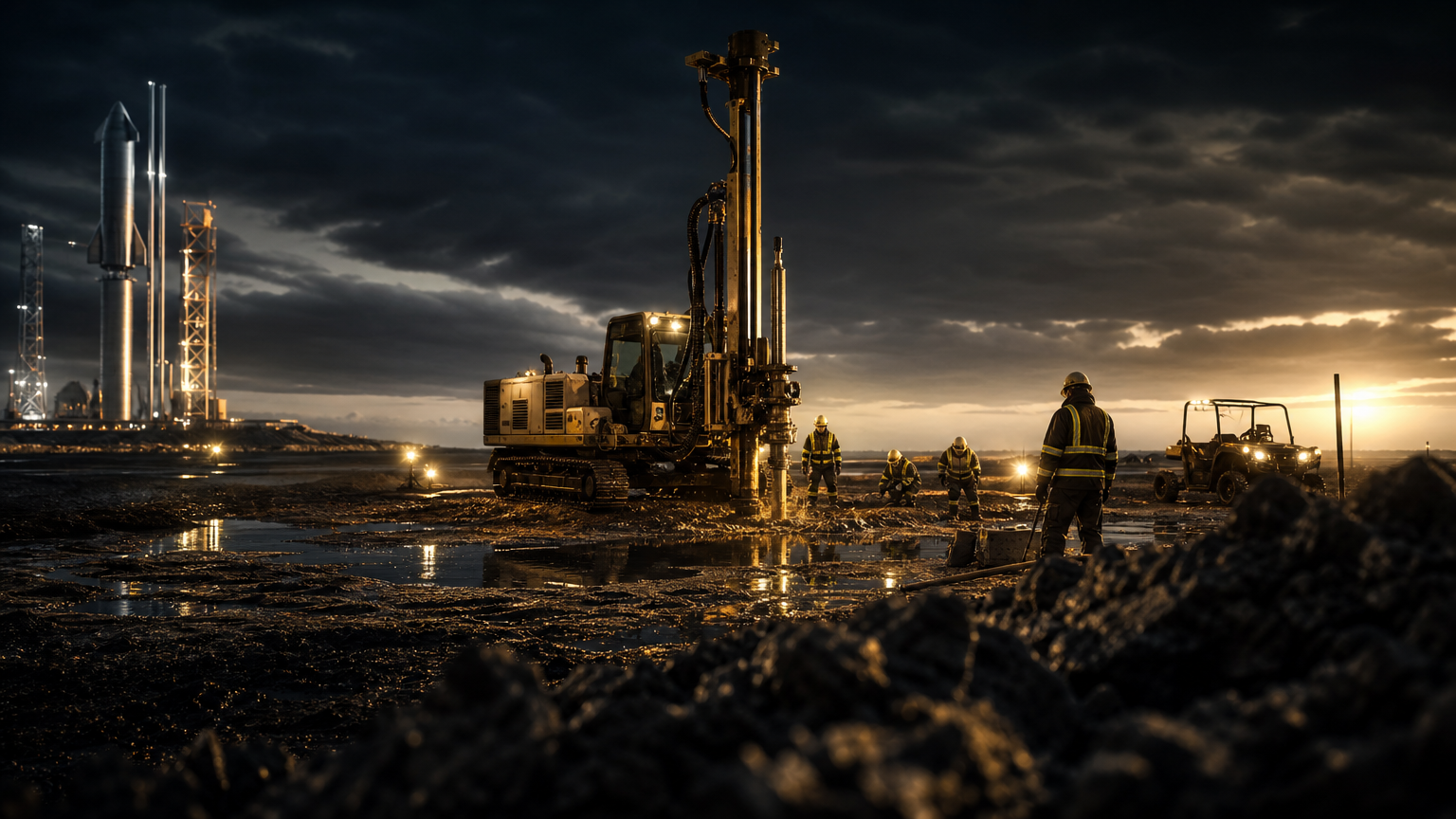
The headline is construction, but the work is ground truth
The working headline matches the subject exactly: Elon Musk Reveals New Starbase Louisiana Construction Has Begun! The important editorial distinction is what “construction” means at this stage. The current evidence does not show crews pouring concrete for a Starship pad, erecting a tower or building a propellant farm. It shows the first enabling phase: SpaceX is investigating the land beneath the proposed Starbase Louisiana site so engineers can design foundations, infrastructure corridors and heavy-load systems for a coastal launch complex .
That difference matters because Pecan Island and the surrounding Vermilion Parish coast are not ordinary industrial real estate. The area is low, wet, storm-exposed and geologically complex. Before a project can carry Starship-class loads, methane production equipment, tanks, towers, roads, utilities and possible port infrastructure, engineers need hard data on subsurface conditions. In plain terms, SpaceX has to debug the soil before it can debug the launch system.
The freshest permit-tracking snapshot says three total regulatory filings have appeared since the SpaceX announcement, with one approved boring permit described as active, one additional boring permit cancelled the next day, and a third filing for shallow test pits still pending at the time of the update . The same source emphasizes that no actual construction permits have been applied for yet, describing the current activity as planning and design rather than launch-site construction .
What SpaceX is testing in Vermilion Parish
The early work focuses on subsurface investigation. The 8news background article reports that SpaceX filed three permits in Vermilion Parish less than two weeks after the project was confirmed, including soil sampling at 20 locations and drilling as deep as 230 feet . It also describes a third permit covering 19 shallow test pits, intended to assess ground conditions closer to the surface .
A permit-map update from the coastal observer account Coastal gives more granular detail: the 20 square points shown on the map represent proposed soil borings to depths of 100 to 230 feet, while the 19 smaller points represent proposed test pits using bucket excavation and sampling to about 10 feet . That mix of deep borings and shallow pits is a classic early-stage infrastructure signal. Deep borings help engineers understand bearing layers, settlement risk, groundwater conditions and the kind of foundation system a launch complex might require. Shallow pits help characterize near-surface soils that affect roads, pads, trenches, drainage and temporary construction access.
For a Starship site, that is not academic paperwork. Starship operations would involve extreme static and dynamic loads: launch towers, hold-down structures, deluge or sound-suppression systems, cryogenic tank farms, high-volume methane and oxygen logistics, power systems and heavy transport routes. If the soil compresses unevenly, floods too easily or requires major stabilization, the entire site plan changes. The Louisiana coast may offer geographic advantages for flight paths and barge logistics, but the ground has to earn its place in the design.
What has not begun yet
The strongest current interpretation is that Starbase Louisiana has entered the site-investigation phase, not full construction. Coastal’s permit summary explicitly says there are no actual construction permits yet and that the observed filings are for planning and design . That is the key corrective to the viral shorthand that “construction has begun.”
The phrase is still defensible if used carefully. In large infrastructure projects, geotechnical exploration is often the first physical phase of development. It places equipment on site, produces engineering data and precedes foundation design. But it is not the same as breaking ground on the launch pad itself. A more precise formulation would be: SpaceX has begun early fieldwork for Starbase Louisiana.
That nuance is especially important because the larger timeline still points to later construction and operations. A September 8 report summarized the public plan as a $100 billion rocket center in Vermilion Parish, with construction expected to start in 2027 and launches targeted for 2029 . In other words, the current soil work fits the pre-construction calendar rather than contradicting it.
The bigger plan behind the borings
Starbase Louisiana is not being pitched as a small auxiliary pad. It is presented as a massive Starship hub in coastal Vermilion Parish, connected to SpaceX’s plan for much higher launch cadence. The latest general reporting still describes the project as a $100 billion facility and SpaceX’s second Starbase campus, with the Louisiana location becoming the company’s fourth U.S. launch site .
The public concept calls for a high-cadence Starship operation that could eventually support thousands of flights per year . Earlier project summaries also describe five launch complexes with two pads each, plus propellant production, power generation, vehicle processing and deep-water shipping capabilities . If built as described, this would not simply duplicate Boca Chica. It would be an industrial launch city designed around manufacturing, fueling, processing and maritime logistics.
That is why the soil work is strategically important. A site with multiple Starship towers cannot be engineered by copying a generic coastal foundation template. Each tower, tank farm, road and utility corridor interacts with groundwater, storm surge, subsidence, wetlands, access limitations and coastal regulation. The permit filings are therefore not a ceremonial step. They are the first technical test of whether the ambitious map can be translated into a buildable plan.
Freshwater Bayou and the danger of false signals
One detail in the current discussion deserves caution: visible marine work nearby is not necessarily Starbase work. Coastal’s update notes that posts about dredge barges and support equipment in Freshwater Bayou have attracted attention, but says those operations are routine U.S. Army Corps of Engineers dredging to maintain required channel depth and are not placing dredged material on Starbase .
That distinction matters because Louisiana’s waterways will likely become central to the project if SpaceX moves Starship hardware and large infrastructure modules by barge. Freshwater Bayou could become important to future logistics. But current dredging activity should not be misread as proof that SpaceX has already started port construction. In a story this large, nearby industrial motion can easily be mistaken for project progress.
Regulation is now part of the engineering story
Starbase Louisiana sits at the intersection of aerospace expansion, coastal land use and environmental review. The first permits are narrow, focused on understanding the ground. The bigger approvals will be broader: launch licensing, environmental analysis, wetlands impacts, coastal restoration, transportation, power, fuel production and safety zones.
The current filings show that SpaceX is moving quickly after confirmation of the Louisiana project, but they also show how much of the process remains ahead. Soil sampling can inform a foundation design; it cannot authorize launches. Test pits can support site planning; they cannot settle questions about flight rate, environmental mitigation, public access or emergency management.
This is where the Louisiana plan may face its hardest test. SpaceX’s operating style favors iteration and rapid buildout. Coastal permitting and federal launch review move on documentation, impact analysis and public process. The company’s challenge is to keep the engineering clock moving without outrunning the regulatory clock.
The Musk ecosystem backdrop
The Starbase Louisiana update landed during a busy week for Musk-linked transportation projects. Tesla’s Cybercab also moved into the regulatory spotlight after deployment in Austin, with NHTSA records summarized on September 9 showing an open Audit Query into Tesla’s certification of a Cybercab vehicle lacking conventional manual controls such as a steering wheel, pedals and mirrors . That parallel matters because both stories involve the same pattern: ambitious hardware entering the real world, followed immediately by scrutiny over whether existing rules are ready for the design .
For Starbase Louisiana, the equivalent question is not whether a car can comply without a steering wheel. It is whether a coastal parish can absorb a launch complex designed for a scale of Starship activity that has never existed before. In both cases, engineering ambition has moved beyond slide decks and into audits, permits and physical constraints.
Why this first phase matters
The beginning of soil work may look modest beside the promise of a $100 billion launch city. Yet it is exactly where a serious infrastructure project must begin. The ground investigation can reveal whether deep foundations are required, how much stabilization may be needed, where heavy infrastructure should be avoided and whether the apparent site layout survives contact with geology.
The most accurate current reading is therefore neither hype nor dismissal. Starbase Louisiana has not begun launch-pad construction. But SpaceX has begun the practical work that precedes it: gathering the geotechnical data needed to design the pads, towers, roads, tanks and support systems that would make the Louisiana Starbase real .
For a project that aims to turn marshland into one of the world’s busiest launch hubs, that is a consequential threshold. The renderings were the vision. The permits are the first engineering receipt. The next milestone will be whether these borings and test pits lead to formal construction applications, environmental filings and a build schedule that can survive both Louisiana soil and federal review.
Sources from the last 72 hours
- [1]Elon Musk révèle le début de la construction de la nouvelle Starbase en Louisiane ! · Tesla · 8news.aiSep 9, 2026, 7:00 PM UTC
- [2]Coastal: "I've updated and cleaned up my Starbase LA permit map to better visualize the re" | ZamantikaSep 8, 2026, 12:00 PM UTC
- [3]SpaceX to Build $100B Rocket Center in Deep Red Louisiana, May Create 10,000 JobsSep 8, 2026, 9:00 AM UTC
- [4]NHTSA Investigation AQ26002 — 2026 Tesla Robotaxi (cybercab) — RecallGazetteSep 9, 2026, 12:00 AM UTC
AI-generated article based on recent web research, then preserved as a dated editorial snapshot.
Comments
Be the first to comment.