
Daily Podcast full article
Tesla’s Cheap LFP Battery Looks Like the Long-Life Pick
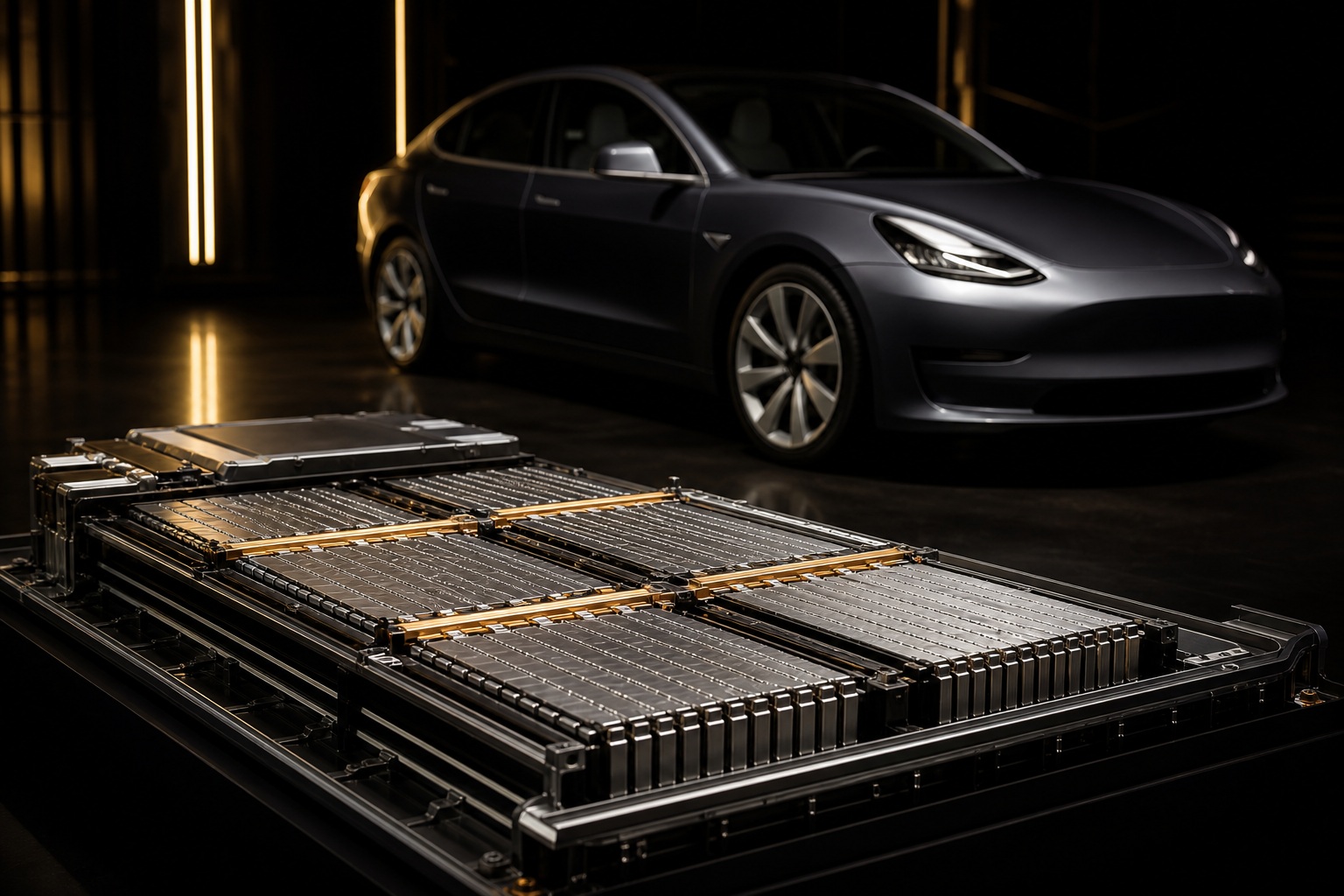
Fresh attention around Tesla’s lower-cost LFP packs is less about a mysterious new ingredient than a practical combination: stable lithium-iron-phosphate chemistry, conservative power demands, usable battery management and real-world testing that separates measured battery health from dashboard range anxiety.
The headline number needs a careful reading
The viral claim is simple: Tesla’s cheaper LFP battery keeps “95%.” The more precise figure in the current 8news/Tesla Car World item is that Model 3 cars using CATL’s 60.5 kWh LFP pack averaged 93.34% battery health after about 100,000 km, while several non-Tesla models in the same ranking were above 95%. That distinction matters. The story is not that every LFP Model 3 will show exactly 95%, but that the cheapest chemistry in the Model 3 family appears to age better than Tesla’s more expensive nickel-based alternatives in this Swedish used-car sample.
The data set cited in the fresh summary came from Swedish used-EV retailer Carla, using 9,954 battery tests conducted with Aviloo diagnostics between 2022 and 2026. The important methodological point is that Aviloo-style testing is meant to estimate actual battery state of health, not simply infer degradation from the car’s displayed range. That helps explain why the result has attracted attention: used-EV buyers want a number they can compare across vehicles, not only a guess-o-meter reading shaped by software, temperature and driving style.
LFP wins inside the Model 3 comparison
The strongest part of the evidence is not the headline ranking; it is the within-model comparison. According to the fresh 8news item, the CATL LFP Model 3 retained 93.34% after roughly 100,000 km. Comparable Model 3 versions using LG Chem NMC averaged 91.5%, while Panasonic NCA packs averaged 89.8% for the 77.8 kWh version and 88.2% for the 52.4 kWh version. That is a spread of more than five percentage points between battery configurations in cars that share the same basic vehicle platform.
That does not prove that chemistry alone explains everything. Cars with different packs can have different owners, duty cycles, charging patterns, climates and software histories. But it does make the LFP result harder to dismiss as a coincidence. If a lower-cost pack keeps a few extra percentage points of usable capacity after six figures of kilometers, it changes how buyers should think about “premium” batteries. More range on day one is not always the same as better retained range after years of use.
So what is the “secret”?
The short answer is chemical stability. LFP stands for lithium iron phosphate. It avoids nickel and cobalt, and it is generally less energy-dense than NMC or NCA chemistry. That is why LFP has often been associated with standard-range cars: it is cheaper and durable, but it usually cannot deliver the same pack-level range for the same weight and volume.
The durability advantage comes from how comfortably LFP tolerates ordinary cycling. The fresh 8news summary says LFP cells are generally more tolerant of high states of charge and frequent charging to 100% than nickel-based chemistries, while many NMC and NCA packs are typically managed with lower daily charge limits. In plain English: LFP is less glamorous, but it is hard to stress. It is the work boot of EV battery chemistry.
That does not mean the pack is magic. A battery held hot and full for long periods can still age. A car repeatedly run to very low charge, then fast-charged hot, can still suffer. But LFP gives the battery-management system more margin. In a standard-range Model 3, the pack is also not being asked to deliver supercar-level output in the way a Performance model’s pack might. Lower power demands, conservative software and a chemically stable cathode all point in the same direction.
Why 100% charging is not the whole story
Tesla owners often summarize LFP advice as: charge it to 100%. That is partly practical, not just chemical. LFP voltage curves are flatter, so the car’s battery-management system benefits from periodic full charges to recalibrate the state-of-charge estimate. That helps the driver know how much energy is available.
But the current owner discussion around Tesla batteries shows why the message can get muddled. In a weekend TeslaSupport thread about a Model 3 Performance battery-health reading, commenters quickly distinguished nickel-based Performance packs from LFP standard-range packs and debated whether 100% charging is about health or battery-management calibration. One commenter put the key nuance bluntly: charging LFP to 100% helps the BMS know what is in the pack, but no lithium-ion battery likes being stored hot and full for long periods.
That is a useful correction. For daily life, LFP gives owners more flexibility. For maximum longevity, flexibility is not the same as permission to abuse the pack. Charge to 100% when useful, especially before a trip or when the car requests calibration, but avoid letting it bake at 100% for days in extreme heat.
Owner anecdotes support the anxiety, not the proof
Fresh Tesla owner forums are full of battery-health reports because capacity has become a used-car value signal. One Aug. 16 Model 3 thread included owners reporting service-menu battery-health results such as 96% on a 2025 standard-range Model 3 at 20,000 km and 96% on a 2024 Model 3 RWD Long Range at 20,000 miles. These anecdotes are not controlled evidence, but they show how quickly owners compare battery-health percentages once the number is visible.
Another Aug. 16 thread from a 2021 Model 3 owner at about 195,000 miles focused not on chemistry triumphalism, but on the cost and uncertainty of battery replacement outside warranty. That is the other side of the LFP conversation: most packs may age gradually, but a used EV buyer still wants to know whether the specific car in front of them has a healthy pack, an active warning, a recent replacement or an expensive repair ahead.
What it means for buyers
For a used Tesla shopper, the lesson is not “always buy the LFP car.” It is more specific.
If two Model 3s meet your range needs, the LFP version deserves a premium in your mental scoring because the Swedish data suggests strong retained capacity. If you regularly need the longest highway range, fastest charging at low states of charge or all-wheel-drive performance, a nickel-based Long Range or Performance car may still be the right tool. But you should price in the fact that its chemistry and use pattern may show more degradation.
The best purchase process is therefore simple: identify the pack chemistry, check battery-health evidence, look for battery or thermal alerts, review charging habits where possible, and compare real usable range rather than advertised range. The LFP “secret” is not a hidden breakthrough. It is the compounding effect of a robust chemistry, a modest performance envelope and software that keeps the pack operating inside safer limits.
The cheap pack did not win because cheap is better. It won because, for many standard-range drivers, durability matters more than maximum energy density. That is the real story behind Tesla’s LFP surprise.
Sources from the last 72 hours
- [1]Tesla’s New Cheap LFP Battery Keeps 95% — What’s the Secret? · Tesla · 8news.aiAug 16, 2026, 11:29 AM UTC
- [2][Removed]Aug 16, 2026, 12:00 AM UTC
- [3]High voltage system 195k milesAug 16, 2026, 12:00 AM UTC
- [4]reddit.com
AI-generated article based on recent web research, then preserved as a dated editorial snapshot.
Comments
Be the first to comment.