
Full article — scored 10/10
Bitcoin's Volatility Hits Historic Low Driven by Long-Term Holders
Bitcoin’s latest volatility collapse is not being explained primarily by a larger market capitalization, weaker turnover or a quiet derivatives tape. Fresh Glassnode-linked analysis points instead to the ownership structure of the network: long-term holders are keeping enough supply inactive that one-month realized volatility has fallen into a historically low regime, even as Bitcoin trades around the high-$70,000 area and tests whether consolidation can become a sustained advance [1].
A quiet Bitcoin market with an unusual cause
Bitcoin is again forcing traders to separate price level from market behavior. The asset was quoted at $78,449.49 in Bitcoin.com’s latest write-up on the subject, after slipping below $79,000 following a failed attempt to remain above $80,000 . The Block separately reported that Bitcoin was trading near $78,000 after briefly moving above $82,000 last week, while Bitfinex analysts described the setup as constructive but not yet confirmed as a sustained breakout .
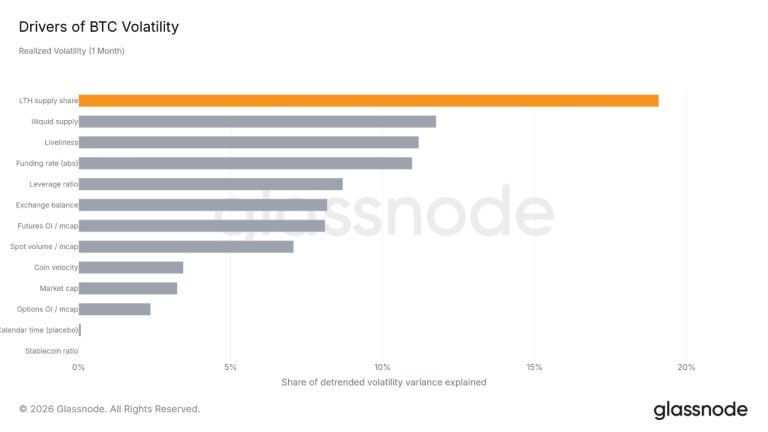
The important point is not simply that Bitcoin has stopped moving aggressively. It is why the market has become so quiet. Glassnode’s Sept. 8 analysis, as reported by Bitcoin.com, examined one-month realized volatility and compared 13 variables according to how much of Bitcoin’s detrended volatility variance each could explain . The result put long-term holder supply at the top of the table, ahead of market capitalization, spot volume, exchange balances, futures open interest and other trading-linked metrics .
That finding shifts the discussion away from the usual assumption that Bitcoin is calmer mainly because it is larger. A bigger market can absorb order flow more efficiently, but Glassnode’s comparison indicates that the identity and behavior of the coin holders matter more in the current episode . In plain terms, Bitcoin is less volatile because many coins are sitting with owners statistically less likely to spend them quickly, not because all speculative forces have disappeared.
What “realized volatility” is measuring
One-month realized volatility looks backward. It measures how much actual daily returns have moved over the preceding month, rather than estimating future volatility from options prices. That distinction matters because it makes the latest reading a description of recent price behavior, not a guarantee about the next move.
Bitcoin.com summarized Glassnode’s framing by saying one-month realized volatility is historically low, and The Block said Bitcoin volatility remains historically low with long-term holder supply emerging as the strongest factor in explaining changes in that measure . 24/7 Wall St. similarly described Bitcoin’s one-month realized volatility as near historic lows while noting that the decline was being driven more by long-term holders keeping coins off the market than by market cap, open interest or funding rates .
The data is therefore more diagnostic than predictive. It tells investors that realized price movement has been compressed. It does not say whether the eventual release of that compression will be upward or downward. Bitcoin.com made the same caution explicit, noting that unusually low volatility has preceded significant advances in earlier cycles but has not produced a dependable forecast .
Holder supply beats market capitalization
Glassnode’s ranking is the heart of the story. Bitcoin.com reported that long-term holder supply explained nearly 19% of the detrended one-month volatility variance in the variables Glassnode reviewed . Illiquid supply followed at roughly 12%, while liveliness, a measure tied to older-coin spending behavior, ranked near 11% . Market capitalization explained only slightly more than 3% of the variation, and coin velocity produced a similar result .
Bloomingbit’s report on the same Glassnode post reached the same conclusion: long-term holder supply showed the closest relationship with changes in Bitcoin’s realized volatility, while illiquid supply followed and market capitalization accounted for only about 3% . The Block also reported that long-term holder supply ranked well ahead of market cap, open interest, funding rates and trading activity, with illiquid supply second and liveliness plus absolute funding rates close behind .
The implications are significant. If the largest explanatory variable is holder duration, the market’s calm is not merely a function of less leverage or a weaker trading session. It is a structural feature of who controls the circulating supply. Spot volume explained about 7% in Bitcoin.com’s summary, while leverage, exchange balances and futures open interest came in around 8% to 9% . Those measures still matter, but they were not the leading explanation in Glassnode’s comparison.
Why long-term holders suppress day-to-day movement
Glassnode generally classifies coins held for at least 155 days as long-term holder supply, according to Bitcoin.com . That definition does not prove every such coin is permanently dormant, but it marks a cohort that is statistically less likely to spend in the short term. When more supply sits with that group, fewer coins remain readily available for active trading.
Bitcoin.com reported that this cohort set another all-time high on July 21 after reaching approximately 16.64 million BTC, or about 83% of circulating supply, in June . The same report said renewed accumulation by long-term holders can reduce the amount of BTC available for active trading, because the cohort has absorbed coins distributed by other market participants and shifted supply toward owners less likely to spend quickly .
That helps explain why low volatility can coexist with a high nominal price. Bitcoin can trade near $78,000 without producing wild daily swings if marginal supply is thin and buyers and sellers are balanced. But the same setup can be fragile. A smaller liquid float can dampen movement while demand is steady, yet magnify movement if demand changes abruptly or dormant coins return to circulation .
The profit threshold now matters
The holder story is also interacting with profit distribution. The Block reported that more than 71% of Bitcoin supply is now in profit, approaching a historical mean of 74.7% that Bitfinex analysts said has typically been associated with bear-to-bull transitions when crossed . 24/7 Wall St. also put the profitable supply figure at about 71% and stressed that the level alone does not confirm a new uptrend .
That nuance is important. A larger share of profitable supply can support confidence, but it can also create a pool of potential sellers when price revisits prior highs. The Block cited Bitfinex analysts saying that identical nominal price levels now trigger a greater volume of profitable coins, creating deeper latent sell-side liquidity when the market tests previous local highs . In other words, the same $82,000 area may now carry a different market structure than it did earlier because more holders are in profit.
The current range reflects that tension. Bitcoin briefly topped $82,000 last week, while 24/7 Wall St. noted a September 3 high of $82,283 before the asset fell back below that level . Bitcoin.com’s separate technical update placed Bitcoin between $78,060 and $78,500 on Tuesday morning around 8 a.m. EDT, with short-term sellers holding an edge while longer-term technical measures remained constructive .
Correlations are changing, too
The low-volatility picture is not unfolding in isolation. Bitcoin.com reported that Glassnode said Bitcoin was trading differently than in March, with its 90-day correlation to the Nasdaq-100 falling from 0.57 to 0.22 while its correlation with gold rose from 0.21 to 0.57 . That shift supports the idea that Bitcoin’s recent behavior is being shaped by more than a simple “risk asset” template.
A weaker Nasdaq correlation and stronger gold correlation do not turn Bitcoin into gold. They do suggest that the market’s drivers are rotating. If long-term holder supply is the main explanatory variable for realized volatility, and if correlation patterns are also shifting, then traders may need to watch on-chain ownership structure as closely as they watch macro headlines or equity-market direction.
The Block reported that crypto market capitalization excluding Bitcoin, Ether and stablecoins had risen by $51.2 billion since the start of September, moving above mid-August levels, while ETF inflows and stablecoin growth were also providing support . Bitfinex analysts cited by The Block said the immediate test was whether ETF inflows stay positive through the September 9 Treasury buyback and the September 11 CPI report even with the two-year yield above 4.34% .
Calm is not the same as safety
The risk-management lesson is straightforward: low volatility can reduce noise, but it can also breed complacency. Bitcoin.com said the findings carry risk-management implications rather than a directional signal . If supply remains locked with long-term holders, range trading can persist. If those holders begin distributing, or if a macro catalyst suddenly changes demand, the same thin tradable supply that muted volatility can accelerate the next move.
Derivatives still matter in that second phase. Bitcoin.com noted that funding rates, leverage and futures positioning could amplify an adjustment if demand changes sharply or dormant coins return to circulation . That means the current market is not a low-risk market simply because realized volatility is low. It is a market where the trigger may be harder to see if the main source of calm is inactive supply.
For now, the cleanest reading is that Bitcoin is in a compressed, holder-driven consolidation. Long-term holder supply is the strongest explanatory factor in Glassnode’s volatility analysis; illiquid supply and older-coin behavior reinforce that picture; market capitalization and trading activity explain less than many observers might expect . The next break may still be decided by ETF flows, macro data or a renewed test of the $82,000 area, but the reason Bitcoin has gone quiet is increasingly clear: the coins that matter most are not moving.
Developments
- Bitcoin's Low Volatility Driven by Long-Term Holders, Could Spike SuddenlyAMBCrypto · Sep 8, 2026, 10:00 AM UTC · 8/10
- Bitcoin Volatility Remains Low as Long-Term Holders Abstain from SellingCrypto Briefing · Sep 8, 2026, 9:52 AM UTC · 8/10
Sources from the last 72 hours
- [1]Bitcoin Volatility at Historic Low as Long-Term Holders DominateSep 9, 2026, 1:30 AM UTC
- [2]Bitcoin volatility remains subdued as supply in profit nears historical bear-to-bull transition level: analystsSep 8, 2026, 12:08 PM UTC
- [3]Bitcoin Volatility Near Historic Lows, With Long-Term Holder Supply a Key FactorSep 8, 2026, 9:02 AM UTC
- [4]Bitcoin Volatility Is Near Historic Lows With 71% of Supply in Profit. What That Actually DescribesSep 8, 2026, 9:25 PM UTC
- [5]Bitcoin Price Loses Steam as Bears Circle Critical $78K FloorSep 8, 2026, 1:02 PM UTC
AI-generated article based on recent web research, then preserved as a dated editorial snapshot.