
Full article — scored 9/10
Congo reports Ebola outbreak with over 6,000 cases and nearly 3,000 deaths
Congo’s Ebola outbreak has crossed a grim threshold: 6,041 confirmed infections and 2,911 deaths, according to the latest toll cited by authorities. The surge has made this the country’s largest Ebola epidemic on record and has placed response teams under extreme pressure in eastern provinces already strained by insecurity, displacement and public distrust.
A record outbreak reaches a new threshold
Congo’s authorities say the country’s Ebola outbreak has surpassed 6,000 confirmed cases, with 2,911 deaths, marking the most severe Ebola epidemic ever recorded in the Democratic Republic of the Congo and one of the fastest-growing in Ebola history . The latest figures put the confirmed case count at 6,041 and the number of recoveries at 1,366, a sign that treatment centers are saving lives even as the outbreak continues to expand .
The announcement crystallizes the scale of a crisis that has escalated with unusual speed since the epidemic was declared in mid-May . Officials believe transmission may have begun earlier, possibly in February, which would help explain why the virus was already embedded in communities by the time formal response measures accelerated . The result is a public health emergency that is no longer confined to a narrow cluster of health zones, but has moved across a broad belt of eastern and northern Congo.
The outbreak is being driven by the Bundibugyo virus, a rare Ebola species that presents a particularly difficult challenge because there is no approved vaccine or specific approved treatment for it . That distinction matters. Congo has fought Ebola before, including outbreaks caused by the more common Zaire species, for which vaccines and therapeutics have reshaped the response toolkit. In this epidemic, responders are working with fewer proven biomedical tools while relying heavily on surveillance, isolation, infection prevention, safe burials and community engagement.
Why this outbreak is different
The numbers alone make this outbreak historic for Congo. The epidemic has already surpassed the country’s previous worst outbreak, the 2018-2020 crisis, which recorded 3,317 cases . It has also overtaken that episode in deaths, with 2,911 fatalities now reported out of 6,041 confirmed infections . That implies a crude fatality burden of nearly one death for every two confirmed cases, although such ratios can shift as cases are detected earlier, treatment improves or delayed death reports are reconciled.
The current crisis is not yet the deadliest Ebola outbreak worldwide. The 2014-2016 West Africa epidemic killed more than 11,000 people, mainly in Guinea, Liberia and Sierra Leone . But the World Health Organization has warned that the Congo outbreak remains out of control and could surpass that catastrophe if transmission continues at the current pace . That warning is especially serious because the outbreak is expanding in a conflict-affected region where conventional public health operations are difficult to sustain.
The geography of transmission has widened rapidly. Response teams are working in six affected provinces, with particular focus on Ituri, North Kivu and Haut-Uele . Other reporting identifies spread across eastern and northern Congo, including many health zones where surveillance and contact tracing are under strain . In practical terms, every additional health zone creates new logistical demands: more staff, more laboratory capacity, more ambulances, more protective equipment, more safe-burial teams and more community mediators.
The human toll behind the case count
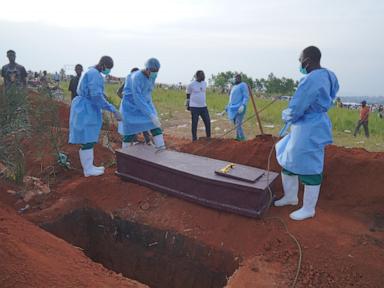
The death toll of 2,911 is not just a statistic. In Ebola outbreaks, each death can also become a transmission risk if the body is handled without strict precautions . Traditional washing, preparation and funeral gathering practices can expose families and mourners to infectious fluids. That is why authorities have mandated that burials of suspected victims be handled wherever possible by trained teams, even though such measures can generate anger or resistance among grieving families .
The emotional complexity of the response was underscored by an attack on an Ebola team near Mambasa in Ituri province, where responders had gone to secure a body . According to the Associated Press account carried by ABC News, young people armed with machetes stormed the funeral site, forcing the team to flee and injuring one member . Such incidents demonstrate that epidemic control is not only a medical exercise. It depends on trust, protection for health workers and the ability to explain why painful measures are necessary.
There are also signs of hope. Five Ebola survivors were discharged in Béni after receiving care at treatment centers, including facilities linked to Doctors Without Borders and Béni Hospital . One of the survivors was a healthcare worker, a reminder that medical personnel are both essential to the response and vulnerable to infection . The discharge ceremonies gave response teams a rare public moment of encouragement, but they came as authorities confirmed that national case counts had passed 6,000 .
More than 1,360 people have recovered, which officials described as encouraging . That figure matters because survivors can become powerful voices in community outreach. In past Ebola responses, recovered patients have often helped counter fear, demonstrate that early treatment can improve survival and persuade symptomatic people to seek care rather than hide at home.
Insecurity, displacement and mistrust are driving the emergency
The outbreak is spreading under exceptionally difficult conditions. Authorities and aid workers cite insecurity, displacement, a health workers’ strike and intense population movement as factors complicating containment . Eastern Congo has endured years of armed violence, and some of the affected areas are places where the state has limited reach and where communities have deep reasons to distrust official actors .
Displacement sites are particularly worrying because residents often live in crowded and precarious conditions . When families lack space, clean water, reliable sanitation and access to routine care, isolation becomes harder and early symptom reporting can be delayed. Population movement also weakens contact tracing. A person exposed in one area may travel to another before symptoms emerge, creating a new chain that responders may not immediately detect.
Health worker labor unrest has added another layer of difficulty . Ebola response depends on trained personnel willing to take risks: clinicians, hygienists, ambulance drivers, laboratory workers, contact tracers, vaccinators, burial teams and social mobilizers. If any part of that chain breaks down, delays can ripple through the system. A late test result, a missed contact or an unsafe funeral can seed additional infections.
Funding gaps and overstretched services are also a concern. Channels Television reported that the response, already underfinanced, has struggled to keep pace with the explosion in cases . That matters because Ebola containment is resource-intensive. It requires not only emergency treatment units but sustained work at household level: finding contacts, monitoring symptoms, providing food or support so families can comply with isolation, and maintaining infection control in health facilities where suspected patients first arrive.
The vaccine dilemma
Congo has begun vaccinating health and other front-line workers with Ervebo, a vaccine proven effective against past outbreaks caused by the Zaire species of Ebola . But this outbreak is caused by Bundibugyo virus, and no vaccine is approved specifically for that species . Several vaccines and treatments are being tested or assessed for possible effectiveness against Bundibugyo .
That makes the vaccination strategy both urgent and uncertain. Prioritizing frontline workers is logical because they face repeated exposure and because infections among health personnel can cripple the response. But if a vaccine’s protection against Bundibugyo is not yet established, vaccination cannot substitute for the basics: protective equipment, strict triage, rapid testing, isolation of suspected cases and safe care protocols.
Clinical trials are therefore central to the next phase of the response. If a vaccine or treatment candidate demonstrates effectiveness against Bundibugyo, the response could change significantly. Until then, health teams must treat the outbreak as a race between expanding transmission and the slow work of building enough trust and capacity to interrupt it.
Regional and global risk
The immediate burden is inside Congo, but cross-border risk remains part of the concern. Uganda declared itself free of Ebola last month, yet the World Health Organization has said the risk of further cross-border spread remains . The concern is not hypothetical: eastern Congo is linked to neighboring countries by trade, family ties, displacement routes and health-seeking movement.
For the wider world, the main lesson is that Ebola threats do not remain isolated when surveillance is weak and movement is high. The global risk may be lower than the local and regional risk, but delayed detection can quickly change the picture. Airports, border posts and health facilities outside the epicenter need clear protocols for identifying travelers with compatible symptoms and exposure histories.
Still, panic is counterproductive. Ebola does not spread like airborne respiratory viruses; it typically requires direct contact with bodily fluids of a symptomatic person or contaminated materials. That means disciplined public health measures can work. The challenge in Congo is that those measures must be applied across insecure, mobile and mistrustful settings while case numbers are already high.
What to watch next
The most important indicator in the coming days will be whether new cases continue to appear outside known contact lists. Africanews reported that most cases and deaths are occurring outside the network of monitored contacts and within communities . That is a warning sign because it suggests hidden transmission chains. Bringing more cases inside the surveillance net is essential if authorities are to slow the epidemic.
The second indicator is geographic spread. The virus recently spilled into two new health zones, according to authorities cited by the Associated Press . If the number of affected zones keeps expanding, the response will become more expensive and harder to coordinate. If expansion slows, it may suggest that surveillance, isolation and community engagement are beginning to bite.
The third indicator is the protection of response teams. The attack near Mambasa shows that responders need security as well as medical supplies . Without safe access, there can be no reliable testing, safe burial or contact follow-up.
Congo’s latest toll is therefore more than a grim milestone. It is a measure of how fast an Ebola outbreak can grow when a rare virus meets insecurity, displacement, fragile health systems and mistrust. The recoveries in Béni show that survival is possible. But the scale of the epidemic shows that containment will require a far larger, safer and more trusted response than the one now struggling to keep up.
Sources from the last 72 hours
- [1]Congo authorities report more than 6,000 confirmed Ebola cases and nearly 3,000 deathsAug 31, 2026, 12:54 PM UTC
- [2]More than 6,000 people infected with Ebola in Congo, government figures showAug 31, 2026, 1:14 PM UTC
- [3]Five Ebola survivors discharged as DRCongo’s case count breaks 6,000Sep 1, 2026, 12:00 AM UTC
- [4]DR Congo Records 6,000 Ebola Cases, Nearly 3,000 FatalitiesAug 31, 2026, 12:00 AM UTC
- [5]DRC Ebola outbreak surges past 6,000 cases as death toll nears 3,000Aug 31, 2026, 12:00 AM UTC
AI-generated article based on recent web research, then preserved as a dated editorial snapshot.