
Full article — scored 9/10
Nepal Floods Kill 797, Victims Buried Amid Ongoing Search and Rescue
Nepal’s Himalayan flood disaster has entered a grim new phase: a confirmed cross-border toll of 797 dead, mass temporary burials for unidentified victims, and a widening rescue effort focused on river valleys, isolated settlements and hydropower tunnels where workers may still be trapped.
A death toll that keeps moving
The Nepal-Tibet flood disaster has become a race between rescue, recovery and identification. The consolidated count that brought the catastrophe to global attention stood at 797 dead: 781 bodies recovered in Nepal and 16 deaths confirmed across the border in Tibet, while more than 3,000 people were still unaccounted for . That figure was already a snapshot in a fast-moving emergency. By Monday, Nepali authorities were reporting a still higher national toll, with 903 bodies recovered in Nepal and 4,247 people missing, while China’s latest published figures for Tibet remained 16 dead and 546 missing .
The shifting numbers are not simply bureaucratic revisions. They reflect the geography of the disaster. A violent surge of water, ice, rock, mud and debris swept down from the high Himalayas on Wednesday, August 26, crossing the Nepal-China border region and scouring settlements along river systems below . Bodies have been recovered far downstream, including in Nepal’s Chitwan district, where some remains were believed to have been carried hundreds of kilometers from the epicenter by the Bhotekoshi River system before being found . Officials in India also reported recovering bodies from rivers flowing out of Nepal, though those deaths were not included in the main Nepal-Tibet toll cited by several agencies .
What makes the toll especially difficult to fix is the huge gap between the number of confirmed dead and the number of missing. Nepal’s disaster agency first reported 2,502 people missing on its side of the border when the death toll stood at 781 . Within a day, the missing list in Nepal had expanded to 4,247, including hundreds linked to hydropower projects in Rasuwa and Nuwakot districts . In Tibet, Chinese state media reported 546 missing, including 261 foreign nationals .
Burials before names
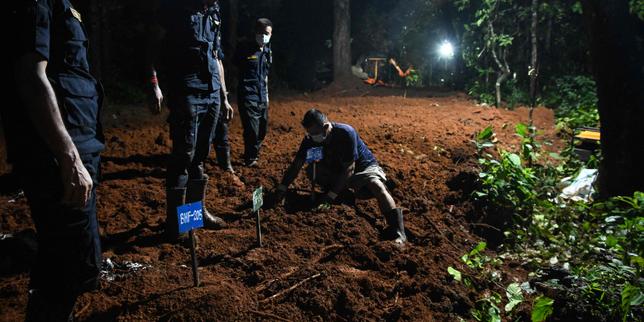
In Chitwan, the disaster is being counted not only in official figures but in trenches. As forensic teams struggled to process decomposing bodies in humid conditions, authorities carried out temporary burials for unidentified victims after taking DNA samples . Around 250 bodies were awaiting identification in the district, and about 100 victims were temporarily buried on Saturday, according to officials cited by the Associated Press . Another group of bodies was being sampled for DNA before likely burial, as authorities tried to balance public health, religious sensitivities and the rights of families still searching for loved ones .
The burials have created a painful dilemma. Many of the dead are believed to be Hindu, and Hindu custom usually favors cremation rather than burial. Yet the scale and condition of the remains have made immediate cremation risky for later identification. Temporary burial, if carefully mapped and documented, allows officials to preserve the possibility that families can later reclaim remains once DNA comparisons are completed . It is a technical solution to a profoundly human problem: families need a name, a body and a ritual, while investigators need time.
That tension is visible in the identification process. Families have been watching images of recovered bodies at community centers and hospitals, searching for clothing, jewelry or other signs that could identify someone missing . But many remains are too damaged for visual identification, and officials have warned that DNA will be essential in many cases . The result is a mourning process suspended between certainty and doubt.
Search and rescue turns to tunnels
The main focus on Monday had shifted toward hydropower sites, where hundreds of workers were feared trapped in tunnels and underground structures. Nepali officials said 933 workers linked to 11 hydropower projects were unaccounted for in Rasuwa and Nuwakot, two of the districts hit hardest by the flood . Rescue teams, assisted by specialists from China and India, worked through mud and debris to reach blocked tunnel entrances .
The tunnels matter because they may contain survivors. Hydropower infrastructure in Nepal’s mountain valleys relies on large underground passages used to divert water and provide access to machinery. Some are big enough for vehicles, and experts said people may have had space to shelter inside if they escaped the initial surge . At the Upper Trishuli-1 Hydropower Project in Rasuwa, hundreds were missing, and around 300 were believed by one industry official to be trapped inside a project tunnel .
The work is slow and dangerous. Nepal’s army said teams were using controlled blasts, excavators and searchlights to clear water, mud and rocks, and three bodies had already been recovered from two tunnels that rescuers managed to enter . At Upper Trishuli 3A, teams broke through into the upper part of a mud-filled tunnel, pumped air inside and prepared to use cameras and excavation equipment to look for survivors . In one attempt, rescuers descended by rope and called into a tunnel but heard no response, while the operation continued .
The disaster’s likely trigger
Authorities and scientists have pointed to a high-altitude collapse as the trigger. Chinese reporting cited experts who concluded that a glacier on the southern slope of Lirung Peak fractured at about 10:52 a.m. Beijing time on August 26, setting off an ice-rock avalanche . Reuters described the disaster as an unprecedented deluge of ice, rock, mud and debris on the Nepal-Tibet border, blamed on a glacier collapse . The U.S. Geological Survey also said the disaster was sparked by a glacial collapse, according to AFP reporting carried by CNA .
The distinction matters. A normal monsoon flood rises; this event behaved more like a mountain tsunami. A sudden mass failure high in the mountains can pulverize ice and rock, entrain water and sediment, and then accelerate down steep valleys. By the time such a flow reaches settlements, border posts, roads and hydropower infrastructure, it can strike with little warning and tremendous destructive force. Satellite and video analysis cited by ABC News found destruction at least 62 miles downriver from the border in Nepal .
Climate is part of the background, though the exact mechanics of this collapse still require careful scientific reconstruction. CNA reported that while the precise cause of the collapse remained unclear, climate change is causing glaciers to melt worldwide, raising the risk of such disasters . Nepal’s foreign minister said Nepal is among the major victims of the changing climate and its impacts . The Himalayas are especially exposed because steep terrain, unstable slopes, glacial ice, intense rainfall and expanding infrastructure often converge in the same narrow valleys.
Tibet’s harder-to-see losses
The disaster also hit Tibet, where Gyirong County and the Gyirong Port border area were among the worst affected. Chinese state media said 16 people had died in Tibet and 546 were missing, including 261 foreign nationals from 23 countries . The missing foreigners included 104 Nepalis, 49 Indians, 33 Latvians and 18 Americans, according to CCTV figures cited by CNA . Chinese officials said foreign tourists were no longer stranded in Gyirong County after several rounds of checks, but the large missing list showed how incomplete the picture remained .
Access is a central problem. Roads and communications around Gyirong Port were cut, and rescuers on the Chinese side were still trying to reach heavily damaged areas days after the flood . CCTV reported that Chinese relief supplies, including tents, blankets, sleeping bags, rations and medical items, had reached Kathmandu, along with four Chinese tunnel-rescue experts . On Monday, Chinese crews were also working to rebuild road access toward Gyirong Port, but AP reported that floodwater and rains were still hampering efforts near the border .
For families, the border adds another layer of uncertainty. Some of the missing were tourists, pilgrims or foreign workers moving through the Nepal-Tibet corridor. Others were local residents or Nepali workers. In a disaster that erased roads, bridges, checkpoints and communications, even confirming where someone was at the moment of impact can take days.
An expanding humanitarian crisis
Rescue is only one layer of the emergency. Relief teams are trying to reach communities cut off by damaged roads, landslides and swollen rivers. Helicopters have been used to reach stranded people, while ground teams continue to search settlements, slopes and riverbanks . CNA reported that rescue teams had reached most areas by road or helicopter as communications slowly improved, after police initially relied on drones to carry messages into cut-off places .
The humanitarian needs are broad: shelter, food, clean water, medical care, body storage, forensic support and road clearance. Kathmandu has appealed for international support and said it needed more than a thousand freezer units to store bodies . The United States announced $3.6 million in emergency humanitarian assistance, including emergency food for up to 10,000 affected households, according to a State Department spokesperson cited by ABC News . Reuters reported that the Red Cross estimated more than 90,000 people were likely affected by the disaster .
The economic damage is also expected to be severe. The flood struck hydropower infrastructure, roads and border trade routes in a country already under pressure. Nepal warned that reconstruction could run into billions of dollars . Hydropower is not only an energy source but a pillar of Nepal’s development strategy, and damage to tunnel systems, access roads and plants will slow recovery in mountain districts that were already difficult to reach.
The coming days
The headline number of 797 dead captured the first consolidated scale of the Nepal-Tibet catastrophe, but it no longer captures its full uncertainty. The more important numbers now are the thousands still missing, the hundreds feared trapped around hydropower sites, and the unidentified bodies waiting for DNA comparison . Each recovered body changes the toll; each rescued survivor changes the meaning of the search.
For now, Nepal is doing three things at once: burying the dead without closing the door on identification, pushing rescue teams into mud-blocked tunnels and valleys, and preparing for a reconstruction burden that may outlast the emergency phase by years. The disaster began as a sudden collapse high in the Himalayas, but its consequences are now spreading through families, border communities, energy systems and the politics of climate risk .
Sources from the last 72 hours
- [1]Nepal-Tibet flood death toll rises to 797, officials say, more than 3,000 missingAug 30, 2026, 3:31 PM UTC
- [2]Nepal teams seek hundreds trapped in hydropower tunnels after deadly floodsAug 31, 2026, 12:25 AM UTC
- [3]China says 16 dead, 546 missing in Tibet mudslide: State mediaAug 30, 2026, 12:00 AM UTC
- [4]Temporary burial of flood victims in Nepal creates Hindu concernsAug 30, 2026, 12:45 PM UTC
- [5]Nepal toll surges as rescuers struggle through 'unimaginable' disasterAug 31, 2026, 4:28 AM UTC
- [6]Rescue efforts intensify after Nepal-Tibet flooding as deaths climb past 900Aug 31, 2026, 5:07 AM UTC
AI-generated article based on recent web research, then preserved as a dated editorial snapshot.