
Full article — scored 9/10
President Trump Signs Executive Order to Create US Space Academy
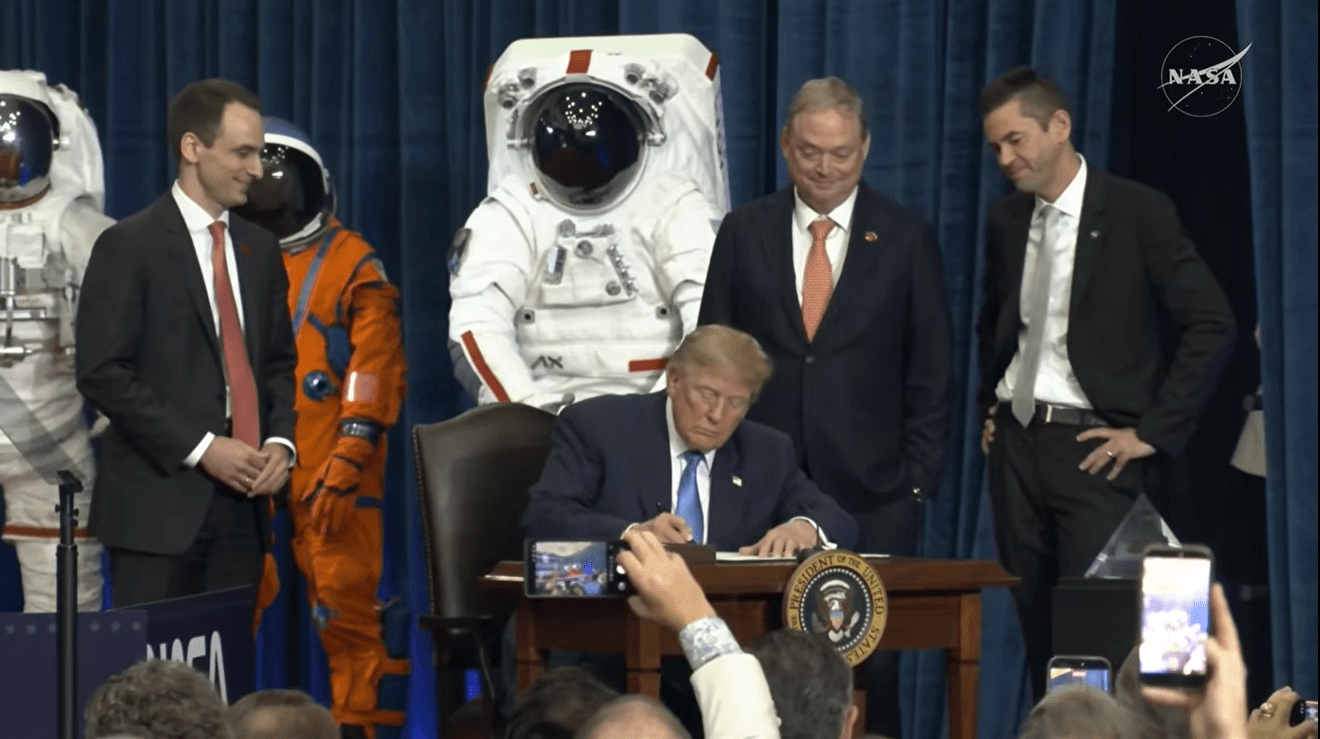
President Donald J. Trump signed an executive order at NASA’s Johnson Space Center to begin creating a U.S. Space Academy, a proposed NASA-led federal institution intended to train future astronauts, engineers, operators, civil servants, military personnel and commercial-space leaders while a presidential commission works out the legal, academic and operational details.
A new federal space academy begins with a commission
President Donald J. Trump signed an executive order on August 28, 2026, launching the process to create the United States Space Academy, a proposed federal academy focused on the space workforce, national security, scientific discovery and commercial space growth . The signing took place at NASA’s Johnson Space Center in Houston, where Trump also presented the Congressional Space Medal of Honor to the Artemis II crew .
The order does not instantly open a campus or enroll cadets. Instead, it creates the Presidential Commission on the United States Space Academy and directs that body to design the institution’s framework, including governance, curriculum, graduate obligations, admissions prerequisites, possible pilot programs, legislative steps and implementation timelines . In practical terms, the announcement is the starting gun for a federal planning process that could lead to a new academy modeled partly on existing service academies but defined by a broader space mission.
NASA’s announcement described the Space Academy as the nation’s first such institution and said it would combine technical education with leadership development, discipline and a commitment to public service . The White House order frames the academy as a way to prepare “astronauts, scientists, engineers, operators, entrepreneurs, civil servants, and warfighters” for a domain it calls critical to national security, economic growth and technology leadership .
What Trump ordered
The executive order establishes the Presidential Commission on the United States Space Academy, with NASA Administrator Jared Isaacman serving as chair and NASA Deputy Administrator Matt Anderson serving as executive director . The order also names the Assistant to the President for Science and Technology and the Assistant to the President for Economic Policy as vice chairs, and it includes senior national security, budget and Air Force officials among the commission’s members or participants .
The commission’s central job is to submit a report to the president within 120 days of the order, meaning the deadline falls in late December 2026 if counted from the August 28 signing date . That report must recommend how the Space Academy should be governed, what degrees or programs it should offer, what forms of experiential training and leadership development it should include, and what service obligations graduates may owe afterward .
The order specifically tells the commission to examine applicant prerequisites such as citizenship status, security clearances, government employment or military status . It also requires a process for choosing the academy’s permanent physical location, rather than naming a site immediately . That choice could become politically sensitive because federal academies bring prestige, jobs, construction, research partnerships and long-term institutional influence to their host regions.
The White House fact sheet emphasized that the academy is proposed as a NASA-led federal academy and would prepare graduates for careers supporting the military, civil and broader space enterprise . The same fact sheet said NASA would implement approved recommendations only after presidential approval and any necessary legislative action . That caveat matters: the order starts the design process, but Congress may still need to authorize parts of the academy, fund it and define any service commitments.
Why Johnson Space Center mattered
The location of the signing was symbolic even though the permanent campus was not chosen. Johnson Space Center is NASA’s human spaceflight hub, home to astronaut training and mission control, and the event linked the academy proposal to Artemis II, whose crew was being honored at the same ceremony . NASA said the executive order was signed in Houston as Trump presented the Artemis II astronauts with the Congressional Space Medal of Honor .
Trump used the event to argue that America’s expanding ambitions in orbit, around the Moon and beyond require a larger pipeline of specialized talent . NASA’s release quoted him saying that growth in the Space Force, the commercial space industry and lunar ambitions make it necessary to educate a generation of service members, engineers and civil operators . CBS News reported that Trump compared the academy with West Point, Annapolis, the Air Force Academy and the Coast Guard Academy, while saying the new institution would attract, train and graduate top talent .
Yet the Space Academy described in the order is not simply a military academy for the Space Force. The White House text says the proposed academy is NASA-led and designed to develop a professional corps for the broader space domain . Space.com noted that Trump said it would serve the U.S. Space Force, NASA and the civilian spaceflight industry, while the order’s NASA-centered structure suggests a hybrid institution rather than a conventional branch academy .
The academy’s mission: technical depth plus public service
The most important policy signal in the order is the combination of technical training and public-service obligations. The Space Academy is envisioned not merely as another STEM university but as a federal pipeline for roles in space exploration, defense, operations, research, engineering and commerce . The order tells the commission to recommend both academic programs and experiential training, which could mean flight operations, mission design, propulsion, robotics, orbital mechanics, cybersecurity, space medicine, nuclear power systems, lunar infrastructure or other mission-linked disciplines .
The commission is also directed to recommend service obligations for graduates, including service in the Armed Forces and civilian federal service . That is a defining question. Existing U.S. service academies exchange tuition-free education for years of military service; a NASA-led space academy may need a more complex model because graduates could serve in uniform, at NASA centers, in federal research labs, in regulatory agencies or potentially in industry partnerships that support national missions.
The fact sheet’s language points to that wider design. It says the academy would prepare graduates for careers supporting America’s military, civil and broader space enterprise . That phrase captures the central challenge: the federal government wants talent for national missions, but the modern space economy is no longer only a government enterprise. Launch providers, satellite operators, lunar logistics companies, space communications firms and defense contractors all compete for the same technical workforce.
The open questions
The order leaves several major issues unresolved. The first is location. CBS News reported that the administration had not chosen a site and that Trump said he would choose one “very shortly,” adding that Senator Ted Cruz of Texas was lobbying for Texas . The White House order, however, assigns the location question to the commission, which must recommend a selection process rather than simply announce a winner .
The second issue is governance. The commission must consider the academy’s organizational structure, authorities, accreditations and relationships with executive departments and agencies . It must also evaluate the option of establishing the academy within NASA . That wording implies that NASA leadership is the default political center of gravity, but the final structure could require coordination with the Space Force, the Department of War, the Air Force, the Office of Management and Budget and Congress.
The third issue is cost. The executive order says implementation must be consistent with applicable law and subject to available appropriations . That means the academy’s scale depends not only on presidential direction but also on budget negotiations. A full residential academy with laboratories, dormitories, faculty, security infrastructure and flight-training partnerships would require a different level of funding than a pilot program, fellowship model or academy-within-existing-campus structure.
The fourth issue is access. The order asks the commission to examine prerequisites including citizenship, clearances and government or military status . CBS News noted that it remains unclear what kind of access the civilian spaceflight industry would have to the federal academy . That question is central because the administration is presenting the academy as a workforce answer for government and commercial space alike.
A workforce policy wrapped in space strategy
The Space Academy proposal arrives as the White House is presenting space as a strategic arena that blends exploration, defense, industrial policy and technology competition. The fact sheet says space competition is intensifying and argues that the United States must recruit, train and retain top talent to maintain leadership in exploration and technology while defending national interests . It also describes the academy as part of a broader Trump space agenda that includes the Space Force, Artemis, commercial-space regulatory policy and recent transportation-policy actions .
NASA Administrator Jared Isaacman framed the academy as a talent engine for future exploration and infrastructure. NASA’s release quoted him saying the academy could educate engineers, scientists, technicians, operators and astronauts needed for lunar return, a Moon Base, nuclear power, the orbital economy and future science missions . That statement shows how NASA wants the academy to be understood: not as a ceremonial announcement, but as an institution tied to concrete mission demand.
Still, the next 120 days will determine whether the proposal becomes a detailed plan or remains an aspirational headline. The commission must translate a broad presidential concept into a workable institution: Who gets admitted? Who teaches? Which agency owns the campus? What degrees are accredited? How long do graduates serve? How much does it cost? What does Congress have to pass? Those questions are now formally on the federal agenda .
What happens next
The immediate next step is the commission report due within 120 days of the August 28 order . After that, the president would review the recommendations, and NASA would coordinate implementation with relevant agencies if the recommendations are approved and if any required legislation or appropriations are secured .
For now, the U.S. Space Academy is best understood as a presidentially ordered design project with high political visibility, not yet a functioning academy. Its supporters will present it as a necessary answer to a workforce bottleneck in an era of lunar missions, military space operations and commercial expansion. Its skeptics are likely to focus on cost, overlap with existing academies and universities, unresolved governance and the challenge of balancing civilian, military and private-sector needs.
What is clear is that the August 28 order gives the idea an official structure. The academy’s future now depends on the commission’s recommendations, the administration’s follow-through and Congress’s willingness to authorize and fund whatever version of the U.S. Space Academy emerges from the process.
Sources from the last 72 hours
- [1]President Trump Signs Executive Order to Create US Space AcademyAug 28, 2026, 12:00 AM UTC
- [2]Establishing the United States Space AcademyAug 28, 2026, 12:00 AM UTC
- [3]Fact Sheet: President Donald J. Trump Establishes a Commission to Design the United States Space AcademyAug 28, 2026, 12:00 AM UTC
- [4]Trump signs executive order to create a U.S. Space AcademyAug 28, 2026, 7:11 PM UTC
- [5]'It's going to be beautiful': President Trump signs order to create US Space AcademyAug 28, 2026, 12:00 AM UTC
AI-generated article based on recent web research, then preserved as a dated editorial snapshot.