
Full article — scored 10/10
Nepal–Tibet glacier collapse leaves at least 165 dead as rescuers race flood and mud
A high Himalayan glacier and rock collapse appears to have unleashed a sudden, debris-laden flood through the Lhende Khola, Bhote Koshi and Trishuli river systems, killing at least 165 people and leaving roughly a thousand or more unaccounted for across Nepal and Tibet as officials confront a cross-border warning gap.
A disaster measured in minutes
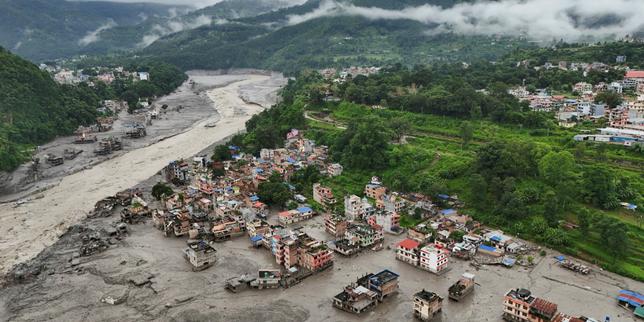
The catastrophe that struck the Nepal–Tibet border on Wednesday morning is now being described less as a conventional monsoon flood than as a cascading cryosphere disaster: ice, rock, sediment and water moving from high mountain slopes into narrow valleys with almost no time for people below to react. By Thursday morning reporting, police in Nepal had recorded at least 162 deaths after flash floods swept through border communities, while Chinese state media reported three deaths in Tibet, bringing the confirmed toll to at least 165 . The number of people still unaccounted for remained unstable: AP reported 403 missing in Nepal and 558 in Tibet, while The Guardian cited Nepal’s tourism ministry as saying 468 tourists and travellers were unaccounted for on the Nepali side, alongside 558 missing in Tibet .
That gap between official lists is itself part of the story. The flood hit a corridor where local residents, customs workers, security personnel, truck drivers, hydropower employees, trekkers and pilgrims were all present. The Kathmandu Post reported that the flood first struck Timure, near the Rasuwagadhi border crossing, after an avalanche blocked the Lhende tributary of the Bhote Koshi; much of the settlement was swept away before the surge pushed downstream . The same report said hundreds of individuals, including foreign visitors and security personnel, were missing, and that more than 300 vehicles and trucks waiting at the customs checkpoint had been washed away .
The affected region is not a remote blank space on a map. It is a living and working landscape, a border trade route, a hydropower corridor and a gateway for travel to Tibet, Mount Kailash and Mansarovar, destinations with deep religious importance for Hindus and Buddhists . That mix of ordinary settlement and seasonal movement helps explain why the missing include Nepalis, Chinese citizens and foreign nationals from India, the United States, Australia, Britain, Canada and other countries .
What scientists think happened
The earliest reports raised the possibility of an earthquake. That interpretation has shifted sharply. The U.S. Geological Survey initially recorded a magnitude 4.4 earthquake-like event north of Kathmandu, but later updated its analysis to say the signal was a magnitude 5.2 glacial collapse and debris flow, and that no earthquake had occurred . In other words, the collapse appears to have generated the seismic signal, not the other way around.
The physical sequence under investigation is frighteningly plausible in Himalayan terrain. ICIMOD, the Kathmandu-based International Centre for Integrated Mountain Development, said a major flash flood struck Rasuwa district on Wednesday morning, sending water, sediment and boulders through the Bhote Koshi and Trishuli systems . Its scientists and partners in Nepal and China are examining whether an ice-rock avalanche from a high-altitude zone entered the Lende or Lhende Khola, creating a sudden surge downstream . ICIMOD also warned that experts were assessing whether debris had temporarily blocked the river at a narrow section, forming a landslide dam that could create a secondary hazard if impounded water were suddenly released .
Reuters, citing satellite imagery from Planet Labs and expert review, reported that the lower part of a glacier may have broken off at about 5,200 metres and crashed roughly 1,200 metres to the valley floor, entraining rock and sediment as it moved . Nepal’s disaster authority, after analysing Planet Labs images, placed the apparent avalanche about 20 kilometres northeast of the Rasuwagadhi border crossing, in Tibet, and said imagery from August 25 and 26 showed both the avalanche and the resulting flooding in the Lhende river . The location matters: a failure high above the border can become a destructive wall of mud and water before national authorities downstream can even understand what has happened.
The known hydrological signals point to an exceptionally fast wave. ICIMOD said water levels on the Trishuli at Galchhi reportedly rose by as much as nine metres within 30 minutes, while levels at Malekhu rose by seven metres over a similar period . That kind of rise is not simply “flooding” in the familiar sense. It is a moving mass of water, boulders, pulverized ice, soil, trees, vehicles and building debris.
Villages, roads and power projects in the path
Survivor accounts and local reporting suggest the flood arrived as people were starting the workday. The Kathmandu Post quoted Rasuwa customs chief Rajendra Dhungana as saying he first felt shaking, then saw a wall of water bearing down on Timure bazaar; he described the market as disappearing within moments . Downstream, the flood moved toward Syaphrubesi and into Nuwakot and Dhading districts, damaging or destroying homes, animals, roads, bridges and public infrastructure .
The damage is also strategic. The Kathmandu Post reported that nine hydropower projects, nine commercial bank branches, 19 motorable bridges and 40 kilometres of highway were destroyed, while AP described roads torn apart, buildings buried in wet-cement-coloured mud and travel halted in some areas . Those losses will complicate rescue and recovery: washed-out bridges slow evacuations, damaged power plants cut electricity, and buried roads turn a search operation into a logistical struggle.
In Tibet, Chinese state media reported that mudslides caused by the glacial collapse left three dead and 558 missing, with CCTV saying 260 of the missing were foreigners and two villagers had been rescued . The Guardian reported that Tibetan authorities had mobilised nearly 800 emergency workers, 150 vehicles, sniffer dogs and speed boats, while China’s president Xi Jinping called search and rescue the most urgent task . On the Nepali side, helicopters were used to bring out survivors, and people gathered near army facilities in Nuwakot and Dhading seeking information about missing relatives .
International assistance began to take shape quickly. The Guardian reported that UN teams and partners were mobilising supplies and personnel in Nepal, and that the U.S. government said it would provide $500,000 in emergency assistance . Australia’s foreign minister said at least 34 Australians on pilgrimages and hiking tours were missing, while Malaysia’s foreign ministry said 55 Malaysians in Kathmandu were unreachable amid severe infrastructure disruptions . These figures may change as communications return, but they underline the global reach of a disaster in what may appear to outsiders as a local mountain valley.
The warning gap
The most urgent policy question is not only why the glacier failed, but why so many people had so little warning. ICIMOD said local reports placed the rapid rise in the Bhote Koshi basin at around 9:00 a.m. local time on August 26 . The Kathmandu Post reported that Nepal’s Flood Forecasting Division received information about the flood at 8:56 a.m. and issued downstream warnings within four minutes, but by then the flood had already reached large parts of Rasuwa . Automatic monitoring stations in the upper Bhotekoshi were reportedly swept away before they could transmit alerts .
This is a cruel failure mode: the very instruments designed to detect danger were destroyed by the first force of the event. Officials told the Kathmandu Post that alerts sent to Nuwakot and other downstream areas may have saved hundreds of lives, but that Rasuwa itself did not receive warning in time . For a river system that crosses from Tibet into Nepal through steep terrain, minutes matter more than administrative boundaries.
The flood also exposed the limits of paper agreements. Nepal and China signed a 2019 memorandum on disaster risk reduction and emergency response, and officials from Nepal’s Department of Hydrology and Meteorology and the China Meteorological Administration held a virtual meeting after Wednesday’s disaster, after which China agreed to inform Nepal when water flows begin rising on its side of the border . But the central lesson is harsh: a mechanism that works after the flood has already entered Nepal is not an early-warning system for the communities nearest the border.
A Himalayan warning
Scientists are careful not to assign this single event entirely to climate change before the physical chain is fully reconstructed. ICIMOD said climate change is altering glaciers, snow conditions, permafrost and mountain slopes across the Hindu Kush Himalaya, but cautioned that it is too early to determine its role in this specific disaster . That caution is important. So is the broader pattern.
The Lhende Khola system has flooded twice in 14 months, and AP reported that a similar flood in the region last year was caused by a glacial lake in Tibet overflowing during high temperatures . ICIMOD specialists framed the latest event as an example of cascading hazards, where a cryosphere event can become a settlement-level flood within hours . Reuters quoted experts who saw satellite evidence of snow loss and bare ice in the 24 hours before the disaster, while also noting that the exact trigger remained under investigation .
For Nepal and Tibet, the immediate priorities are rescue, body recovery, medical care, shelter, road reopening and credible information for families. But the longer-term challenge is already visible in the mud. High mountain hazards are moving faster than many monitoring systems, diplomatic channels and local evacuation plans. The disaster on the Nepal–Tibet border shows that a glacier collapse can be seismic, hydrological, humanitarian and geopolitical all at once. The next warning system will have to be built for that reality, not for a slower world.
Sources from the last 72 hours
- [1]Glacial collapse caused huge flood leaving hundreds dead or missing in Nepal and TibetAug 27, 2026, 3:53 AM UTC
- [2]Major flash flood sweeps through Nepal’s Rasuwa district, raising fears of further downstream floodingAug 26, 2026, 12:00 AM UTC
- [3]Nepal flash flood kills at least 162, leaves nearly 400 missing — including foreign touristsAug 25, 2026, 6:15 PM UTC
- [4]Glacier collapse may have triggered deadly Nepal flash flood, experts sayAug 26, 2026, 12:00 AM UTC
- [5]Nearly 1,000 missing in Nepal and Tibet after floods caused by a glacial collapse | AP NewsAug 27, 2026, 2:48 AM UTC
AI-generated article based on recent web research, then preserved as a dated editorial snapshot.