
Full article — scored 10/10
Tim Curry dies at 80: the cult actor whose voice conquered film, stage and games
Tim Curry, the British performer who made Dr. Frank-N-Furter immortal, turned Clue into a masterclass in comic menace and gave gamers one of Command & Conquer: Red Alert 3’s most replayed live-action performances, has died at 80 in Los Angeles, according to reports published on August 26, 2026.
A death confirmed as fans revisited five decades of performance
Tim Curry, the baritone-voiced British actor whose career moved effortlessly from West End provocation to Hollywood cult cinema, television horror, animation and video games, has died at the age of 80. The Associated Press reported that Curry died at his home in Los Angeles, citing his longtime manager and friend Marcia Hurwitz, and said no cause of death had been disclosed . CBS News also reported that Curry’s manager confirmed his death, identifying him for general audiences through the poles that shaped his public image: The Rocky Horror Picture Show and the original screen adaptation of Stephen King’s It .
The first wave of reporting on August 26 also reflected a small discrepancy common in breaking obituary coverage. AP, citing Hurwitz, reported that Curry died Wednesday at his Los Angeles home . Other outlets, relying on TMZ’s initial account, reported that he died late Tuesday night, August 25, at the same home, with no immediate cause announced . FOX 11 Los Angeles, also attributing its account to TMZ and law-enforcement sources, reported that no foul play was suspected . Taken together, the freshest reliable accounts establish the essential facts: Curry was 80, he died in Los Angeles, and the public explanation of the cause had not yet been released as of the first reports .
For many readers, the news landed less like the death of a single celebrity than the closing of several portals at once. Curry was a midnight-movie avatar, a Broadway and West End technician, a children’s television voice, a horror icon, a comic villain, a family-film scene-stealer and, for players of a certain generation, Premier Anatoly Cherdenko of Command & Conquer: Red Alert 3. That breadth helps explain why tributes immediately clustered around different memories: fishnets and lipstick, the library and the candlestick, Pennywise’s grin, Mr. Hector’s suspicious stare in Home Alone 2, and the knowingly theatrical absurdity of real-time strategy cutscenes.
The role that made him impossible to categorize
Curry’s defining breakthrough remained Dr. Frank-N-Furter, the gleefully transgressive scientist he first played on stage before carrying the role into the 1975 film The Rocky Horror Picture Show . CBS noted that he had already played the character in the stage musical The Rocky Horror Show before reprising it for the screen opposite Susan Sarandon and Barry Bostwick . The Guardian, in its obituary, emphasized how deeply the character’s impact depended on transformation: Curry appeared in makeup, stockings and suspenders in a performance that became inseparable from the film’s cult afterlife .
That afterlife matters. Rocky Horror was not merely a film Curry appeared in; it became a participatory ritual, a midnight-screening language, and a safe harbor for generations of viewers exploring camp, sexuality, performance and self-invention. Vanity Fair wrote that Curry originated Frank-N-Furter at London’s Royal Court Theatre, followed the production to Broadway, and then carried the part into the feature film that made him a lasting cult figure . In retrospect, the role looks like a key to the rest of his career: Curry was rarely interested in flattening a character into one trait. He made exaggeration precise, flamboyance controlled, and menace musical.
That combination also protected him from typecasting in the usual sense. He was typecast, perhaps, as someone who could make the improbable feel complete. In Ridley Scott’s Legend, The Guardian noted, he was hidden beneath horns and scarlet skin as the Lord of Darkness . In It, he disappeared into clown makeup as Pennywise, a performance CBS singled out as one of the roles by which he remained widely remembered . In Clue, the physical transformation was subtler, but the technique was just as exacting: Wadsworth’s anxiety, speed and verbal timing turned a board-game adaptation into an enduring ensemble comedy.
Villainy, comedy and the art of theatrical excess
Curry’s best performances were never just “big.” They were calibrated. AP described him as a character actor with arch humor, a pliable face and a gift for voices, and noted that he earned three Tony nominations and an Emmy nomination during a career that resisted easy classification . Those credits are important because they remind viewers that the extravagance came from training and discipline, not accident.
On stage, Curry’s range included Amadeus, My Favorite Year and Monty Python’s Spamalot, the three productions for which AP reported he received Tony nominations . TV Insider similarly recalled his work as Mozart opposite Ian McKellen’s Salieri in Amadeus, and his later turn as King Arthur in Spamalot, a role that also drew Olivier recognition when he returned to London’s West End . The musicality in those stage roles carried into his screen work: even when he was playing cruelty, he often found rhythm first.
That is why his villains rarely felt interchangeable. Pennywise terrified because Curry understood the childish lilt beneath the threat. Darkness in Legend worked because he gave the demonic figure grandeur rather than mere volume. Long John Silver in Muppet Treasure Island was dangerous, funny and oddly tender because Curry leaned into the character’s appetite for performance. Even Mr. Hector in Home Alone 2, a relatively small part, became memorable because Curry treated suspicion and wounded dignity as full comic instruments; FOX 11 listed that role among the credits that kept him familiar to family audiences as well as cult fans .
Why gamers claim him, too
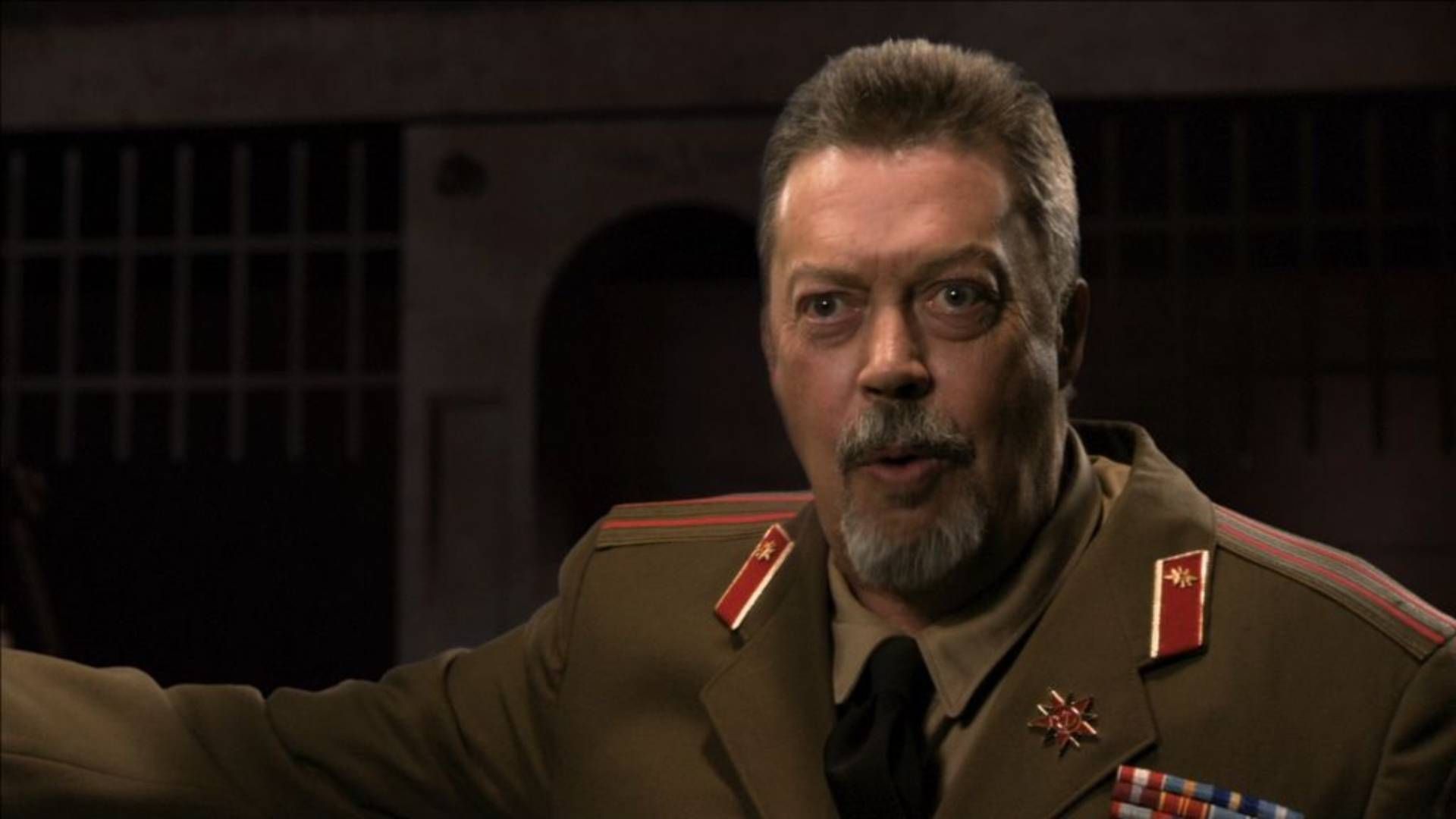
The headline phrase “video game icon” may surprise anyone who thinks of Curry only through cinema, but it makes sense in the history of live-action game performance. Command & Conquer: Red Alert 3 arrived from a tradition in which the series treated full-motion video not as an embarrassment but as part of its spectacle. Curry’s Premier Cherdenko fit that tradition perfectly: exaggerated, political, knowingly ridiculous and delivered with enough conviction to make camp feel like command.
His gaming reputation has endured because Red Alert 3 used what Curry did best. It did not ask him to become smaller or more naturalistic; it gave him an alternate-history Soviet leader and allowed him to play the material at the frequency where strategy-game melodrama, Cold War parody and stage villainy meet. That made the performance unusually internet-proof. Clips from the game circulated not because players were mocking Curry, but because they recognized his command of tone: he knew exactly how absurd the line was, and exactly how hard to sell it.
In that sense, Curry’s video-game legacy is not separate from Rocky Horror, Clue or It. It is another expression of the same artistic proposition. He treated “genre” as an invitation rather than a limitation. Horror, farce, children’s animation, Broadway parody, fantasy prosthetics and FMV strategy games all benefited from the same principle: if the world is heightened, the actor must make the height legible.
Later years, health and a voice that remained active
Curry’s public life changed after the severe stroke he suffered in 2012. AP reported that the stroke put him in a wheelchair . TV Insider wrote that he shifted mostly toward voice work after the stroke, noting that he needed a wheelchair afterward . FOX 11 reported that his health had limited his later work and that around the release of his 2025 memoir Vagabond, Curry had said he was still unable to walk .
Yet the later years did not erase the career; they reframed it. Curry had always been an actor of voice as much as body. The Daily Beast noted his Daytime Emmy win for Captain Hook in Peter Pan & the Pirates, while also pointing to his continued focus on voice roles and projects after the stroke . That made his post-stroke work feel like a continuation rather than a retreat. The face that had made so many villains sly or grotesque was less visible, but the instrument that carried amusement, contempt, seduction and danger remained central to how audiences remembered him.
The publication of Vagabond in 2025 also meant that Curry’s death came after a period of renewed attention to his own account of his life. The Daily Beast reported that the memoir covered his childhood in a military family, the death of his father when he was young, his rise to fame, health struggles and commitment to performance . For an actor so often hidden by makeup, costume or voice, that late self-portrait mattered.
A legacy measured in repeat viewings
Curry’s death at 80 invites the usual obituary inventory: birth in Cheshire, stage breakthrough, cult film immortality, Broadway nominations, Emmy recognition, horror fame, family-film ubiquity and late-career resilience. But inventories do not quite capture why he mattered. Curry specialized in performances people returned to. Rocky Horror was built for returning. Clue improves as viewers anticipate each line. It persists because his Pennywise lodged in childhood memory. Red Alert 3 remains replayable because Curry understood that games, like midnight movies, can make community out of shared exaggeration.
The most fitting tribute may be that no single audience can claim him completely. Theater fans saw the craft. Horror fans saw the nightmare grin. Comedy fans saw the timing. Children heard the voice. Gamers saw a classically trained performer attack a live-action strategy-game role with total relish. That is not a scattered legacy; it is a coherent one. Tim Curry made artificial worlds feel alive by refusing to apologize for their artifice. He knew that camp could be rigorous, that villainy could be musical, and that the shortest route to immortality was sometimes through a role no cautious actor would dare to play straight.
Sources from the last 72 hours
- [1]Tim Curry, actor known for "The Rocky Horror Picture Show" and "It," dies at age 80Aug 26, 2026, 4:08 PM UTC
- [2]Tim Curry, star of The Rocky Horror Picture Show and Stephen King’s It, dies aged 80Aug 26, 2026, 3:47 PM UTC
- [3]Tim Curry Dies: ‘The Rocky Horror Picture Show’ Star Was 80Aug 26, 2026, 3:28 PM UTC
- [4]Tim Curry, ‘Rocky Horror Picture Show’ star, dies: TMZAug 26, 2026, 3:26 PM UTC
- [5]‘The Rocky Horror Show’ Star Dies at 80Aug 26, 2026, 4:20 PM UTC
- [6]Tim Curry, Iconic Star of The Rocky Horror Picture Show, Dead at 80Aug 26, 2026, 12:00 AM UTC
- [7]Tim Curry, iconic character actor and ‘Rocky Horror Picture Show’ star, dies at 80Aug 26, 2026, 4:13 PM UTC
AI-generated article based on recent web research, then preserved as a dated editorial snapshot.