
Full article — scored 9/10
Iran rial sinks to record low as U.S. puts crypto lifeline in sanctions crosshairs
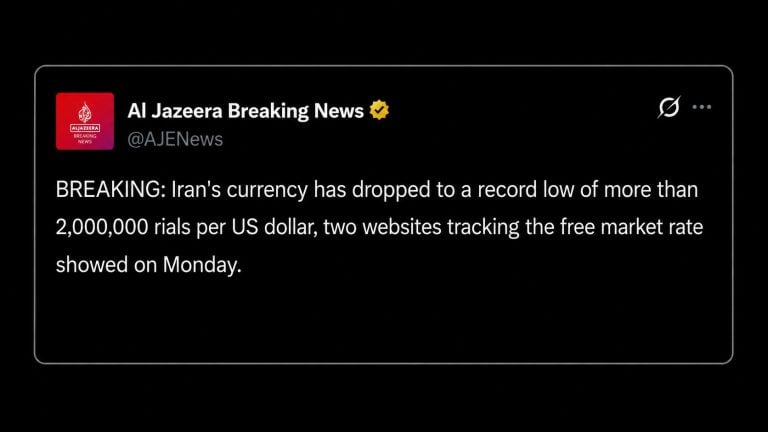
Iran’s rial has fallen to a fresh low near 2.02 million to the dollar while Washington’s new “Operation Economic Outcast” widens secondary-sanctions risk to Iran’s digital-asset sector, raising pressure on a cryptocurrency ecosystem that analysts say has helped Tehran and IRGC-linked networks convert energy and sanctions gaps into hard currency.
A currency break at the worst possible moment
Iran’s currency crisis has collided with a new U.S. sanctions front. On August 24, the rial fell to about 2.02 million to the U.S. dollar on open markets, while Iran’s official central-bank rate stood around 1.5 million, underscoring the widening gap between administered pricing and what households and traders actually face . The fall came hours before U.S. Treasury Secretary Scott Bessent announced a sanctions campaign designed to force governments, banks, shippers, exchanges and intermediaries to choose between doing business with Iran and preserving access to the U.S. financial system .
The immediate market signal was psychological as much as mechanical. RFE/RL reported that the dollar reached 2,016,400 rials on the open market on August 24, and cited economist Ahmad Alavi’s view that exchange-rate volatility is now being reinforced by inflation expectations and fear of tighter sanctions, not only by Iran’s long-running structural weaknesses . That matters because a collapsing exchange rate feeds directly into import prices, household expectations and the speed at which savings flee into dollars, gold or crypto.
The new U.S. package, branded “Operation Economic Outcast,” is not only another oil-and-shipping sanctions round. Treasury said it had begun an “unprecedented” economic campaign to sever the financial lifelines sustaining the Iranian regime and the Islamic Revolutionary Guard Corps, while pressing foreign governments to shut down Iran-related activity identified by Washington . In legal terms, OFAC’s new determination brings Iran’s aviation, digital-asset, gold, shipping and technology sectors under Executive Order 13902, meaning a person determined to operate in those sectors can be sanctioned .
Why digital assets are now central
The most novel element is the explicit inclusion of the digital-asset sector. Treasury’s public release says digital assets are among five “critical sectors” that Iran uses to support its economy and evade pressure . Bessent’s prepared remarks framed the move as a broadening of secondary-sanctions risk for anyone continuing business with Iran, while saying U.S. teams would engage foreign counterparts and give countries defined timelines to shut down targeted activity .
That wording matters for Bitcoin mining. The OFAC determination does not need to list every mining farm, wallet or exchange to raise risk across the sector. By naming “digital assets” as a sanctionable sector of the Iranian economy, Washington has created a compliance problem for overseas firms that provide equipment, hosting, exchange access, liquidity, stablecoin rails, custody, energy services or laundering channels connected to Iranian crypto activity . The Block reported that Treasury is “zeroing in” on digital assets it says are used to support Iran’s economy, and noted that Monday’s measures also included digital-asset addresses tied to designated actors .
The crypto outlet Bitcoin.com reported on August 26 that the rial’s record low coincided with sanctions that put digital assets in scope for the first time, threatening what it described as a Bitcoin-mining workaround linked to the IRGC . The same report said IRGC-linked or state-affiliated farms are estimated to control 65% of Iran’s mining capacity, and that Iran-based miners have accounted for between 3% and 7% of global Bitcoin hashrate since 2019 . Those figures should be read as estimates rather than official disclosures, but they explain why a sanctions order written in the language of “digital assets” can still land as a direct threat to mining.
Mining as energy arbitrage
Iran’s mining model is attractive because it converts subsidized or stranded energy into a censorship-resistant, dollar-denominated asset. Bitcoin mining requires electricity, specialized machines and a path to monetize newly generated coins. Iran’s advantage has long been cheap power; its disadvantage is isolation from the formal banking system. Mining sits exactly between the two. It can turn domestic energy into digital assets that can be transferred, swapped, pledged or sold through networks beyond normal bank channels.
That is why Washington’s new approach focuses less on banning Iranian miners inside Iran and more on the external rails that make the activity useful. ASIC mining machines need supply chains. Large mining farms need maintenance, firmware, pools and sometimes foreign intermediaries. Mined coins need exchanges, brokers, stablecoin markets, OTC desks or mixers to become usable purchasing power. If each foreign participant now faces possible U.S. penalties, the economics of Iran-linked mining become less predictable even before any single farm is physically shut down.
The pressure also intersects with earlier crypto-enforcement actions. The Block noted that U.S. authorities had already targeted Iran’s largest crypto exchange, Nobitex, earlier in the year and that Bessent said the United States had seized nearly $1 billion in crypto from Iran as of May . IranWire separately reported that Washington says the Islamic Republic uses cryptocurrencies to evade sanctions and move funds linked to the IRGC, and that foreign individuals and entities active in the newly designated sectors can face secondary sanctions . The August 24 decision therefore looks like an escalation from exchange-by-exchange enforcement to sector-wide deterrence.
The rial, prices and public pain
For Iranian households, the crypto dimension is abstract compared with the price of food, fuel and medicine. AP reported that rice prices are up about 60% since the war began and beef prices are more than 150% higher, while the International Monetary Fund forecasts Iran’s economy will contract by more than 5% . A weaker rial makes imported inputs costlier, pushes merchants to reprice inventories and forces families to hold fewer rials whenever they can.
The pressure is also visible at gas stations. AP reported on August 25 that lines had grown outside Tehran fuel stations, with some drivers waiting two hours or more, as the U.S. tightened its blockade and Iranian officials discussed possible reductions in heavy fuel subsidies . Shops and pharmacies were still stocked, AP found, but customers and shopkeepers described a widening affordability crisis rather than a simple absence of goods . That distinction is important: Iran is not necessarily facing a classic empty-shelves collapse, but a currency-and-income squeeze that can erode daily life quickly.
The rial’s record low therefore becomes a political number. It signals to Iranians that salaries, savings and pensions are losing purchasing power faster than authorities can stabilize expectations. It also tells foreign counterparties that delayed payments, barter deals, discounted oil and informal exchange channels may become more fragile. Once digital assets are added to the sanctions perimeter, even crypto-linked workarounds can start to trade at a larger risk discount.
Washington’s gamble: pressure without immediate rupture
The U.S. strategy is deliberately coercive, but it is not yet a full instant cutoff of every foreign actor. Axios reported that Bessent did not give public deadlines for compliance and said the administration wanted countries to have an opportunity to shift away from Iran before Treasury’s “hammer” fell . Axios also described the campaign as a slow-burn sanctions drive that could eventually lock Iran’s foreign enablers out of the U.S. financial system .
That gradualism reflects the China problem. AP reported that China, Turkey and the United Arab Emirates are among Iran’s largest trade partners, while Axios emphasized that China remains the major test because of its role in Iranian oil purchases . If Washington aggressively sanctions Chinese banks, refiners or shippers, it risks a broader financial confrontation. If it does not, Tehran may continue to find enough liquidity to survive. Digital assets add another layer: they are easier to trace on-chain than cash, but harder to neutralize completely when activity fragments across wallets, jurisdictions and informal brokers.
The administration is trying to solve that by raising the cost of ambiguity. Treasury’s message is that banks, exchanges, shippers, technology suppliers and commodity traders can no longer claim they did not know they were operating in sensitive channels . In practice, many risk departments will respond by blocking more Iran-adjacent activity than the law strictly requires. That over-compliance can be powerful, especially in crypto markets where stablecoin issuers, centralized exchanges and analytics firms often move faster than courts.
What happens to Iran’s Bitcoin sector now?
The near-term impact is likely to be uneven. Licensed or state-linked mining farms inside Iran can keep producing Bitcoin as long as they have electricity and hardware. But monetizing those coins may become harder, slower and more expensive. Pools may reject identifiable Iranian hashpower. Exchanges may freeze accounts with Iranian exposure. OTC desks may demand deeper discounts. Equipment sellers may reroute or halt shipments. Stablecoin counterparties may blacklist wallet clusters flagged by blockchain-forensics firms.
The larger strategic issue is whether mining remains a meaningful macro lifeline. Even a billion-dollar-scale crypto channel is small beside Iran’s oil economy, subsidy burden and import needs. But in a heavily sanctioned system, marginal hard-currency channels matter. They finance procurement, reward loyal networks and help politically connected actors preserve wealth. That is why the IRGC angle is central: the target is not only “Bitcoin mining” as an industry, but the possibility that security-linked networks can use mining, exchanges and cross-border wallets as a parallel treasury.
The rial’s crash and the digital-asset sanctions are therefore two sides of the same crisis. The currency fall shows the erosion of confidence inside Iran. The U.S. sanctions show Washington trying to close the external escape routes that can slow that erosion. Whether the strategy forces policy change in Tehran is uncertain; AP reported that there was no sign yet that the latest economic pain had brought Iran’s leaders to their knees . But the direction is clear: Iran’s financial battlefield now runs from the bazaar exchange rate to Bitcoin mining pools, from fuel queues in Tehran to compliance screens in Singapore, Dubai, Hong Kong and beyond.
For markets, the lesson is blunt. Iran’s rial is not only reacting to sanctions already imposed; it is pricing the fear that the remaining gray channels are becoming more dangerous. For the crypto sector, the message is equally sharp: neutrality claims will face a harder test when mining, wallets and exchanges intersect with sanctioned states. And for Iran, the record-low rial has turned Bitcoin from a workaround into a target.
Sources from the last 72 hours
- [1]Treasury Launches Unprecedented Campaign Against Iranian Regime on Economic D-DayAug 24, 2026, 12:00 AM UTC
- [2]Treasury Secretary Scott Bessent announces "D-day" sanctions against IranAug 24, 2026, 6:08 PM UTC
- [3]Iran's Rial Crashes to a Record Low as New Sanctions Target Its Bitcoin Mining LifelineAug 26, 2026, 8:30 AM UTC
- [4]US escalates Iran pressure with sanctions on crypto, aviation, shipping and gold as part of 'economic D-Day'Aug 24, 2026, 7:23 PM UTC
- [5]Iran's Currency Plunges As Washington Readies 'Economic D-Day'Aug 24, 2026, 10:33 AM UTC
- [6]US Expands Sanctions on Shamkhani Network and Iranian Digital AssetsAug 25, 2026, 12:00 AM UTC
- [7]Determination Pursuant to Section 1(a)(i) of Executive Order 13902Aug 24, 2026, 12:00 AM UTC
- [8]Bessent says new US sanctions aim to block all potential sources of revenue for IranAug 24, 2026, 8:27 AM UTC
- [9]Iran’s gas lines are growing, but there’s no sign so far that its leaders will bow to US sanctionsAug 25, 2026, 4:29 PM UTC
AI-generated article based on recent web research, then preserved as a dated editorial snapshot.