
Full article — scored 9/10
Dubai VDX: the certified vertiport that turns eVTOL air taxis from concept into infrastructure
Dubai’s VDX vertiport beside Dubai International Airport has become the first purpose-built commercial eVTOL vertiport to receive regulatory certification, giving the emirate a tangible launch hub for its planned air taxi network while leaving the biggest question still open: when passengers will actually board.
A milestone, but not yet a passenger service
Dubai’s VDX has crossed a line that the advanced air mobility industry has been chasing for years: it is no longer just a rendering, a policy ambition or a demonstration site, but a purpose-built commercial vertiport that has received regulatory certification for eVTOL operations from the United Arab Emirates’ General Civil Aviation Authority . Developed by Skyports Infrastructure, the facility is described by its backers as the world’s first purpose-built commercial vertiport approved for electric vertical take-off and landing aircraft .
That wording matters. The industry has already seen heliports adapted for trials, temporary pads used for demonstrations and prototype passenger concepts presented at major events. VDX is different because it was designed as a commercial node for battery-electric aircraft from the beginning, with passenger processing, charging, take-off and landing areas, and integration into a wider city network . It is intended to function as the primary hub in Dubai’s first air taxi network, not as a one-off technology showcase .
The current state is therefore both historic and incomplete. VDX is certified and technically positioned to receive eVTOL operations, but Dubai’s air taxi service is not yet carrying paying passengers, and no commercial route is flying as of the latest route-status update on 22 August 2026 . In practical terms, the infrastructure milestone has arrived before the full service launch.
What VDX actually includes
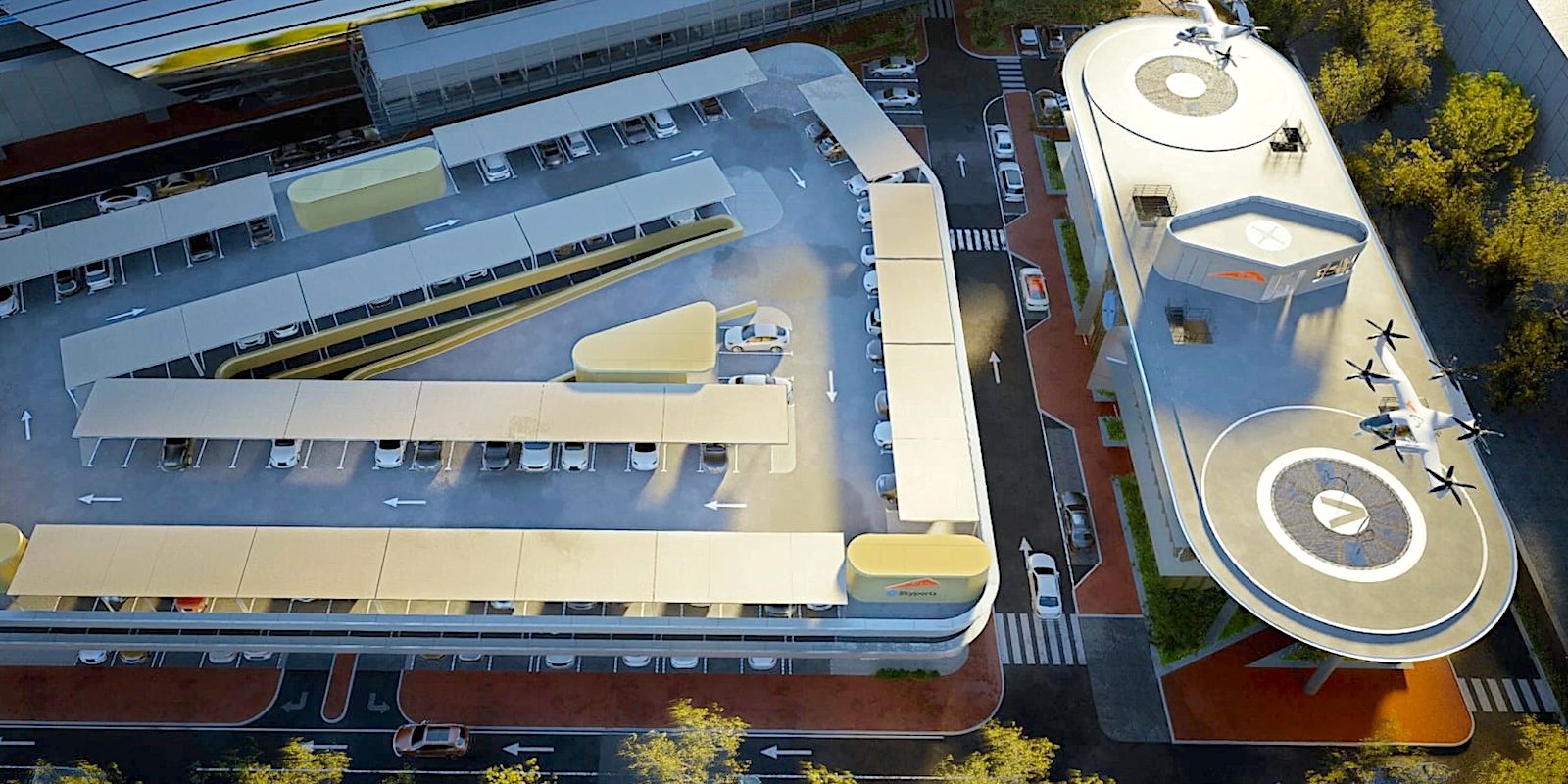
VDX is located beside Dubai International Airport, placing it next to one of the world’s most important passenger gateways and giving the future air taxi system an obvious anchor point for airport-to-city trips . The facility is a four-storey structure of roughly 3,100 square metres and includes two dedicated take-off and landing pads, rapid charging infrastructure for electric aircraft, and passenger areas designed for high-throughput operations .
Its stated annual capacity is up to 170,000 passengers once commercial operations begin . Venture Atlas also describes the site as designed for up to 42,000 aircraft movements a year, underlining that the facility is planned around recurring operations rather than ceremonial flights . For a new transport mode, those numbers are modest compared with rail, metro or conventional airport flows, but significant for a first certified eVTOL hub.
The design logic is closer to an airport terminal compressed into an urban footprint than to a helicopter landing pad. The key operational challenge is not simply landing an aircraft; it is managing passenger flow, charging turnaround, emergency procedures, safety oversight and integration with surrounding ground transport. The Electrek report notes that VDX includes high-powered DC fast charging intended to support quick turnaround for electric aircraft . That charging layer is essential because eVTOL economics depend on keeping aircraft moving rather than parked.
Certification shifts the debate
Until now, much of the air taxi debate has focused on aircraft: range, noise, payload, pilot requirements, certification timelines and manufacturing scale. VDX shifts attention to the ground system. A city cannot operate a reliable eVTOL network with aircraft alone; it needs certified locations where passengers can arrive, clear operational procedures can be followed, aircraft can recharge, and regulators can assess safety in a repeatable way.
The GCAA certification reviewed the vertiport’s infrastructure, physical characteristics, operational procedures, safety management, emergency preparedness and compliance with applicable requirements . That breadth is important because it shows that the approval is not merely architectural. It is a regulatory assessment of how the site is expected to function as part of an aviation system.
For Dubai, the symbolism is powerful. The city has often positioned itself as a testbed for futuristic transport, but VDX is a more concrete step than a concept video or a memorandum of understanding. A certified vertiport creates a real constraint and a real asset: the aircraft, operators, airspace procedures, dispatch systems and booking interfaces now have an approved hub to plug into.
The network around VDX
VDX is only the first node. Dubai’s announced launch network includes four vertiport locations: VDX at Dubai International, Dubai Marina in the American University of Dubai parking area, Dubai Mall, and Palm Jumeirah at Atlantis The Royal . The latest route explainer identifies VDX as certified, Dubai Marina as under construction, and the Dubai Mall and Palm Jumeirah sites as announced but without confirmed construction starts in the referenced primary-source record .
That distinction is important for readers trying to separate a launch network from an operating network. Four sites have been named, but only one is currently built and certified in the public record summarized by eVTOL Emirates . The absence of a commercial route as of 22 August 2026 means Dubai is still in the pre-launch phase, even though a key piece of infrastructure is now approved .
The likely early use case is airport access. The planned network would connect Dubai International with major tourist, residential and commercial areas, including Palm Jumeirah, Dubai Marina and Downtown Dubai through the Dubai Mall node . The strongest operational argument for eVTOLs in such a city is time compression across congested corridors, particularly premium trips between the airport and high-value destinations.
Joby’s role and the remaining bottleneck
The aircraft side of the Dubai plan centres on Joby Aviation’s S4 air taxi, which is designed to carry one pilot and four passengers, with stated performance of up to 200 mph and up to 100 miles of range . Venture Atlas says Joby is in the final Stage 5 Type Inspection Authorization phase of its FAA certification process, with five conforming aircraft flying and 12 more in production . It also reports that Joby’s Dubai network has been directed toward public service before the end of 2026, subject to the company completing final GCAA operational certification .
That caveat should not be overlooked. A certified vertiport is necessary but not sufficient. The aircraft must be certified or otherwise cleared for the intended service, the operator must satisfy operational requirements, airspace management must be in place, and passenger-facing systems must work. Venture Atlas notes that no passenger operations have yet begun in either Joby’s UAE or U.S. early markets as of late August 2026 .
This is the central reality of VDX: Dubai has solved one of the hardest infrastructure questions ahead of the market, but the business does not become real until aircraft, crews, regulators and passengers converge in scheduled service.
Why Dubai moved first
Dubai’s advantage is not only capital or appetite for spectacle. It is the ability to align a regulator, a transport authority, an infrastructure developer and an aircraft operator around a specific corridor network. VDX is being developed by Skyports in collaboration with Dubai’s Roads and Transport Authority, and the broader system is framed as part of the emirate’s planned Air Taxi network .
That coordination is what many other cities lack. In dense urban markets, eVTOL operators must solve land access, zoning, noise, community acceptance, charging, airspace, fire safety, passenger screening and emergency response before they can sell a seat. Dubai’s model appears to compress that process by making the public transport authority and aviation regulator part of the system design from the start.
Still, first-mover advantage comes with first-mover exposure. If passenger launch slips, VDX could become a highly visible reminder that ground infrastructure can mature faster than certified aircraft supply. If the service starts smoothly, however, the site could become a reference case for regulators and city planners elsewhere.
What to watch next
The next milestones are clear. First, observers should watch whether Joby completes the remaining certification and operational approvals needed to carry passengers in Dubai . Second, the status of the three other vertiports will determine whether Dubai launches with a meaningful network or an airport-led starter service . Third, the industry will be looking for real operating data: turnaround times, reliability, load factors, pricing, noise performance and how passengers move between vertiports and ground transport.
For now, VDX is best understood as a certified gateway rather than a finished revolution. It proves that a purpose-built commercial eVTOL vertiport can pass regulatory scrutiny and be prepared for real operations . It does not yet prove that urban air taxis can scale, price competitively or become part of daily mobility. That proof will come only when passengers are boarding regularly, aircraft are turning quickly, and the wider Dubai network is functioning beyond the first hub.
The milestone is nevertheless significant. In advanced air mobility, the future has often been aircraft-first and infrastructure-later. Dubai has reversed that sequence. With VDX, the city has put a certified place on the map before the service has fully arrived — and that may be the most important signal of all.
Sources from the last 72 hours
- [1]Dubai VDX becomes world’s first purpose-built eVTOL vertiportAug 25, 2026, 5:55 PM UTC
- [2]Joby Aviation - Company Profile, Milestones & Funding - Venture AtlasAug 24, 2026, 12:00 PM UTC
- [3]Dubai air taxi routes & flight timesAug 22, 2026, 7:00 PM UTC
AI-generated article based on recent web research, then preserved as a dated editorial snapshot.