
Daily Podcast full article
Google powers AI with 396 MW: geothermal becomes part of the data-center stack
Google’s 396 MW power-purchase agreement with Fervo Energy is less a routine renewable-energy buy than a sign of how AI infrastructure is changing: compute now depends on chips, land, water, transmission and firm low-carbon power secured years in advance.
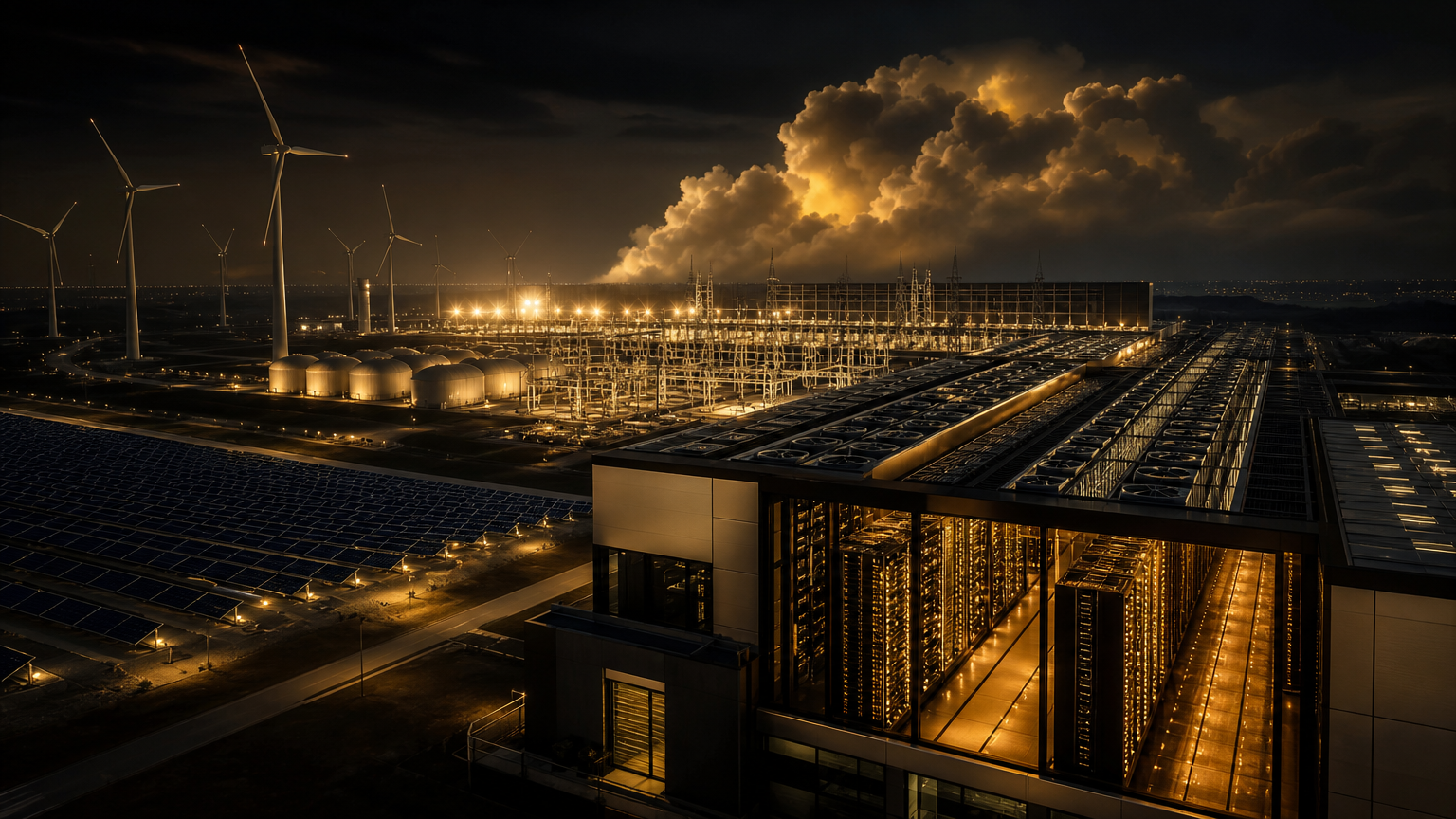
The deal behind the headline
Google has not found a magic way to make artificial intelligence run without an electricity bill. It has done something more practical: it has agreed to buy 396 MW of geothermal power from Fervo Energy’s Cape Station project in Utah, with deliveries expected from 2028 and an option to add roughly another 600 MW later . The agreement is designed to support a potential Google data center in Utah, although those data-center plans have not been finalized .
That caveat matters. The story is not that a new Google AI campus is already humming on geothermal power today. It is that Google is reserving a large block of future, around-the-clock, carbon-free electricity before the data center is fully locked in . In the AI era, that is increasingly what infrastructure planning looks like: a hyperscaler has to secure the power stack almost as deliberately as it secures GPUs.
Fervo’s Cape Station is being built around enhanced geothermal systems, a technology that uses deep drilling and engineered reservoirs to pull heat from rock that would not support traditional geothermal development on its own . The project has been described as targeting dispatchable power: electricity that can run continuously rather than rising and falling with sun or wind conditions . For data centers, that quality is central. AI workloads may be scheduled, shifted and optimized, but the physical facilities still need reliable electricity at massive scale.
Why 396 MW is a strategic number
A 396 MW contract is large enough to change the way the deal should be understood. This is not a symbolic offset or a boutique climate purchase. It is a power commitment sized for industrial computing.
According to recent coverage, Google’s agreement covers 396 MW from Cape Station and includes an option to expand by about 600 MW, potentially bringing the total toward nearly 1 GW by June 2030 . That optionality gives Google a path to scale if the data-center plan, the geothermal build-out and the commercial terms continue to line up. It also gives Fervo a marquee customer around which to organize financing, construction and investor expectations.
The current project schedule is still layered. One recent summary said Cape Station is expected to deliver an initial 100 MW of clean power to the grid by late 2026, with around-the-clock power delivery expected in 2028 and a second phase adding 400 MW in 2028 . Another recent analysis noted that public descriptions include 70 MW cited for 2026, a first phase described at about 100 MW and fuller 2028 targets, making milestone clarity an important issue for investors and power buyers .
That ambiguity does not erase the significance of the deal. It does, however, keep the story grounded. Google has bought a future stream of power; Fervo still has to deliver the wells, turbines, interconnection and operating performance that turn a PPA into electrons.
AI infrastructure is becoming energy infrastructure
For years, the dominant bottlenecks in AI were framed as chips, model talent and cloud capacity. Those are still decisive. But the Google-Fervo agreement shows that electricity procurement has moved from the sustainability department into core infrastructure strategy.
The reason is simple: a data center is not just a building full of servers. It is a continuous load on the grid. As models get larger and inference demand spreads across search, productivity software, advertising, video tools and enterprise cloud services, hyperscalers need power that is both large and predictable. Firm clean power is especially valuable because it helps companies expand while keeping climate commitments credible.
Geothermal’s selling point is that it can produce power continuously . Wind and solar are cheaper in many settings, but they are variable. Batteries can smooth part of that variability, but they add cost, complexity and duration limits. Enhanced geothermal, if it scales as promised, offers a different profile: clean power that behaves more like baseload generation.
That “if” is doing real work. Fervo’s system requires deep drilling, reservoir stimulation and long-term management of underground heat flow . The same recent analysis that highlighted the Google offtake also warned about technical and schedule risks tied to drilling depth, sustained well productivity, permitting, local approvals and interconnection . In other words, geothermal could become an AI-era power solution, but it still has to prove repeatable economics at scale.
The market read: validation, but not a free pass
Investors treated the Google agreement as important, but not as a complete de-risking of Fervo. StockTitan’s September data showed the PPA as a major news event for Fervo shares, with the stock closing at $19.75 after the announcement compared with $15.38 before it, before later trading around $15.73 as of September 10 [3]. The same data showed heavy announcement-day volume of more than 35 million shares and a relative volume near 9.8 times the prior median [3].
That pattern tells a useful story. The agreement validated Fervo’s commercial relevance, but the market still appears to be discounting execution risk. For a geothermal developer, signing a hyperscaler is a major milestone. Delivering hundreds of megawatts of dependable output on schedule is the larger test.
The stock reaction also helps explain why the deal is bigger than a procurement headline. Google is effectively providing demand certainty for a technology that needs large upfront investment. Fervo, in turn, is offering Google a possible answer to the question every AI operator faces: where will the next block of reliable low-carbon power come from?
By September 10, Fervo’s investor-relations calendar showed the company presenting at the Jefferies Renewables, Clean Energy & Construction Conference, a reminder that the PPA has quickly become part of the company’s capital-markets narrative as well as Google’s energy narrative [4].
Utah, Cape Station and the direct-to-load question
The Utah location matters because big AI loads are increasingly negotiated alongside state policy, grid constraints and community acceptance. Recent coverage described Cape Station as a project that could anchor Google’s potential Utah data center, but also emphasized that final plans remain unfinished . That means the power deal is a foundation, not a completed campus announcement.
For local communities, the benefits could include investment, jobs and a cleaner generation base. The concerns are also real: transmission availability, water use, land impact, electricity costs and whether large corporate customers receive special treatment while ordinary ratepayers absorb grid stress. The most durable version of the Google-Fervo model would need to show that new generation is being added rather than merely reshuffling scarcity.
That is why the “around-the-clock” framing matters. A clean-energy certificate is not the same as physical power at the hour and location a data center needs it. If Fervo can deliver geothermal output that is local, firm and additional, the agreement becomes a stronger template for AI growth. If it faces delays or cost overruns, the story becomes a cautionary tale about how hard it is to match digital ambition with physical infrastructure.
A template, not a conclusion
The 396 MW agreement is best understood as a template under construction. It shows how an AI hyperscaler can pair long-term compute expansion with a long-term generation commitment. It also shows how a clean-power developer can use hyperscaler demand to finance technologies that may otherwise struggle to move from demonstration to large-scale deployment.
But the deal is not yet proof that enhanced geothermal can solve the AI power problem. It is proof that Google is willing to contract for that possibility at a meaningful scale. The next proof points will be mundane and decisive: wells drilled, costs contained, permits secured, grid connections completed and megawatts delivered.
The robots, in short, have discovered their power bill. Google’s answer is to make power procurement part of model infrastructure. If Fervo delivers, 396 MW may look less like a one-off clean-energy headline and more like the beginning of a new rule for AI: no serious compute plan without a serious electricity plan.
Sources from the last 72 hours
- [1]Fervo Geothermal Could Deliver 400 MW From 15,000 FtSep 11, 2026, 12:00 AM UTC
- [2]New Studies & Data on Sustainable Energy & Climate Change – September 6, 2026Sep 11, 2026, 12:00 AM UTC
AI-generated article based on recent web research, then preserved as a dated editorial snapshot.
Comments
Be the first to comment.