
Daily Podcast full article
Nvidia backs Australia’s 2GW AI buildout
Nvidia’s Australia push is not just another data-center announcement: a proposed AI infrastructure buildout of up to 2 gigawatts by 2027 puts power, cooling, networking and sovereignty at the center of the country’s compute strategy.
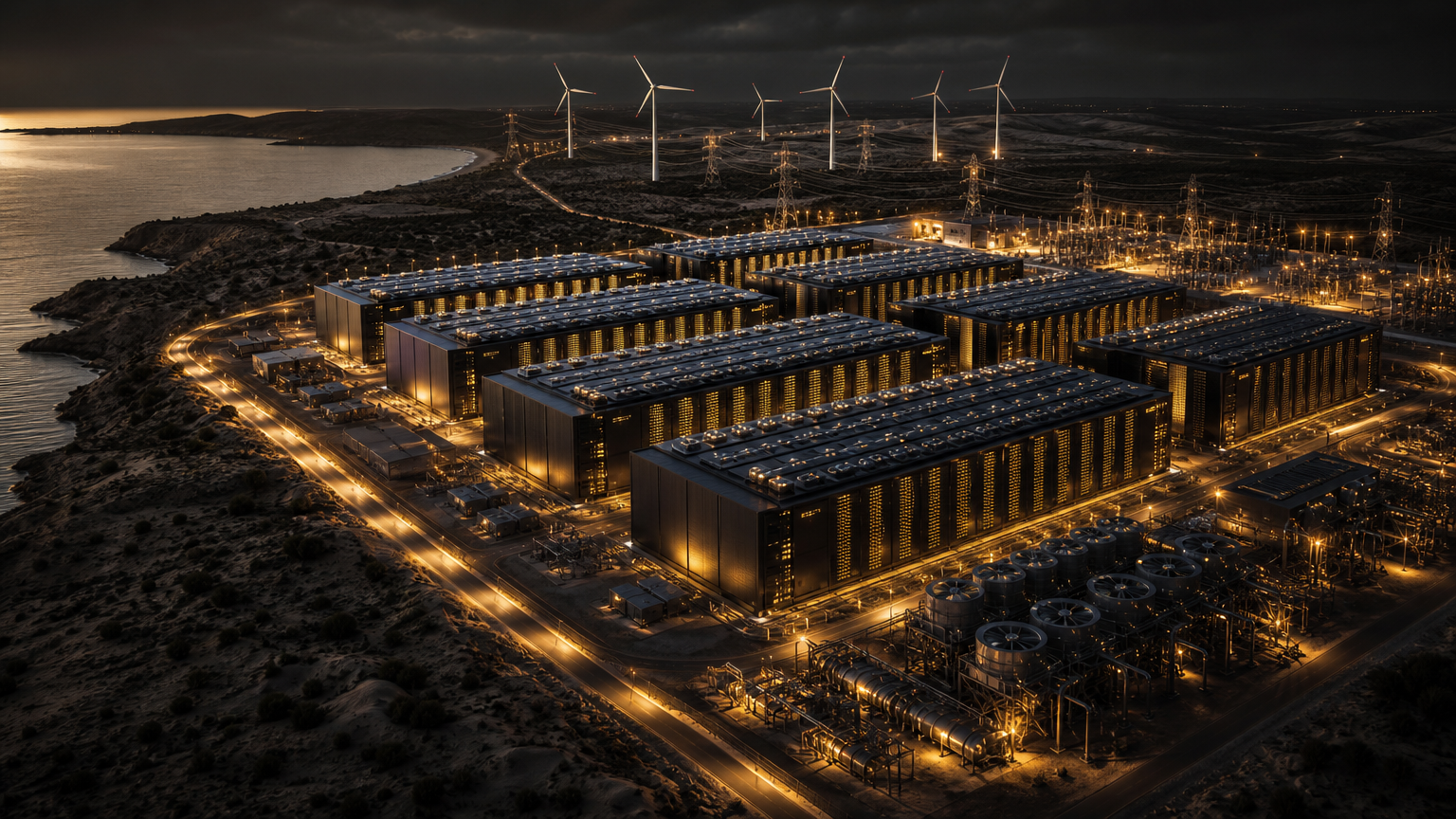
A gigawatt-scale bet on Australian AI
Nvidia has moved to anchor a major Australian AI infrastructure expansion, working with local cloud and data-center partners on facilities that could support up to 2 gigawatts of AI-related capacity by 2027 . The headline number is the story: 2GW is an industrial-scale power envelope, closer to a large energy or manufacturing project than to a traditional enterprise data-center rollout.
The company said the effort brings together Australian Nvidia Cloud Partners and infrastructure operators Firmus, Sharon AI, IREN, Megaport, ResetData, CDC, NEXTDC and AirTrunk . Those partners are expected to provide the land, power, powered shells, facilities and operations, while Nvidia supplies the DSX platform, accelerated computing, networking, software and ecosystem support . In plain terms, Nvidia is not merely selling chips into Australia; it is helping define the architecture through which those chips become national compute capacity.
Reuters reported that Nvidia’s plan would more than double Australia’s current data-center computing load, citing a Data Centres Australia report based on DC Byte research that put existing national capacity at about 1.6GW . That comparison explains why the announcement landed with unusual force. If the target is reached, the buildout would not be incremental infrastructure; it would be a new class of load on the Australian grid.
The partner map: land, power, GPUs and networks
The coalition reflects the practical reality of AI infrastructure: no single layer is enough. Nvidia named Firmus, Sharon AI, IREN, Megaport, ResetData, CDC, NEXTDC and AirTrunk as participants in the Australian buildout . Each occupies a different part of the stack, from data-center development and high-density cooling to connectivity, GPU deployment and sovereign cloud services.
Firmus is expanding its Project Southgate initiative, with Nvidia-powered AI factories intended to serve hyperscale and AI-native demand across Australia and the Asia-Pacific region . IREN is applying Nvidia’s DSX AI factory architecture to its broader development portfolio, including its proposed 800MW Bundey campus in South Australia . Sharon AI plans to deploy up to 68,000 Nvidia GPUs connected through Nvidia Quantum InfiniBand and Spectrum-X Ethernet networking . That last detail matters because at AI-factory scale, networking is no longer back-office plumbing; it is part of the compute fabric.
Megaport is contributing through Latitude.sh and its global software-defined network, positioning the infrastructure for lower-latency access and broader enterprise reach . ResetData is focused on organizations that require Australian data residency, including enterprises, government and research users . CDC, NEXTDC and AirTrunk bring the powered-shell and high-density data-center capabilities needed to house AI systems that are increasingly constrained by electricity, thermals and interconnect rather than by rack space alone .
ChannelNews reported that the participating companies had not detailed the total investment required or how much of the proposed 2GW would be operational by the end of 2027 . That caveat is important. The announcement defines a target architecture and partner ecosystem, but it does not yet provide a full project-by-project commissioning schedule.
DSX turns the data center into an “AI factory”
Nvidia frames the Australian plan around its DSX platform, which it describes as a full-stack AI factory platform spanning facilities infrastructure, computing, networking, software and reference designs . The language is deliberate. Nvidia wants customers, governments and infrastructure investors to think of AI data centers less as static real estate and more as production assets that convert energy into intelligence.
That framing is more than marketing. Large AI clusters have to be designed for multiple hardware generations, model-training bursts, inference workloads, fast east-west networking and ongoing software optimization. Nvidia said DSX is compatible with the CUDA ecosystem and can be enhanced through software during the life of the infrastructure . The business argument is that an AI factory should remain useful as GPUs, interconnects and workloads evolve, rather than becoming obsolete after a single hardware cycle.
This is why Nvidia’s role is strategic even if local operators own or run the facilities. The company is providing the design template for how the country’s next large AI facilities will be built and upgraded. In that model, power procurement, liquid cooling, GPU availability, network topology and software integration become one combined infrastructure problem.
Sovereign compute meets sovereign constraints
Australia has been trying to position itself as a trusted regional hub for digital infrastructure, but the Nvidia-backed buildout raises the classic contradiction of AI sovereignty: countries want local compute, but local compute demands local energy, land, water planning and grid capacity. Reuters noted that the announcement comes as Australia seeks to become a global data-center investment hub while facing calls for tougher regulation over environmental impact and heavy energy and water consumption .
Nvidia and its partners are leaning into the sovereignty argument. The company said expanded access to accelerated computing and Nemotron open models would allow Australian organizations to build local models, applications and agents . ChannelNews reported that the “AI factories” are intended to give Australian startups, universities, researchers, government agencies and enterprises greater access to high-performance computing without relying entirely on offshore infrastructure .
That distinction matters for sectors such as healthcare, public services, defense-adjacent research, financial services and enterprise software. Data residency, latency and control over sensitive workloads are becoming as important as raw model performance. Nvidia said Australian organizations including Heidi and Atlassian are using Nvidia Nemotron open models, datasets and tools for clinical AI and enterprise search use cases . The message is that the infrastructure is not just for foreign hyperscalers; it is meant to support domestic AI applications.
The thermodynamics of ambition
The most difficult part of a 2GW AI buildout is not the press release. It is the physics. AI training and inference systems concentrate enormous heat loads into dense racks. Nvidia’s Australian partners are therefore emphasizing liquid cooling and high-density designs. CDC says its facilities use direct liquid-to-chip cooling and zero-water advanced cooling technologies certified for Nvidia accelerated computing infrastructure . NEXTDC has highlighted liquid-cooled, high-density infrastructure, while AirTrunk is expanding AI-ready powered shells that include direct-to-chip liquid cooling .
Those details are central to whether the project can scale. A 2GW target means energy procurement, grid interconnection, backup power, cooling loops, water strategy and emissions claims will face scrutiny. CDC said it operates more than 550MW of capacity across Australia and New Zealand, with a further 800MW under construction, and that its facilities use 100% renewable electricity . Such claims will become part of the project’s license to operate, especially if community and regulatory attention intensifies around data-center energy use.
For Australia, the upside is significant: local AI compute, stronger digital infrastructure, skilled jobs and potential regional export capacity. The risk is that AI infrastructure becomes a new grid stressor before enough generation and transmission capacity is ready. Nvidia’s statement says the expansion can support additional power generation projects for regional and global AI-compute demand . That is both a promise and a warning: the AI economy is now directly tied to energy development.
What to watch next
The next phase will be measured less by announcements than by interconnection approvals, site development, GPU delivery, cooling deployment and customer commitments. Key questions remain: which sites will come online first, how much of the 2GW will be contracted versus aspirational, what power-purchase arrangements will underpin the load, and how regulators will evaluate environmental impact.
For Nvidia, the Australian buildout extends its infrastructure strategy beyond chip sales and into national-scale compute ecosystems. For Australia, it is a chance to convert energy resources, data-center expertise and geopolitical trust into AI capacity. But the size of the target changes the policy conversation. At 2GW, AI infrastructure is no longer just a technology story. It is an energy story, an industrial-planning story and a sovereignty story at once.
Sources from the last 72 hours
- [1]NVIDIA Expands AI Infrastructure Capacity in Partnership With Australia’s Data Center EcosystemSep 9, 2026, 12:00 AM UTC
- [2]Nvidia plans major expansion of data centre capacity in Australia to meet AI demandSep 10, 2026, 3:29 AM UTC
- [3]Nvidia Backs Massive 2GW Australian AI Data Centre BuildoutSep 9, 2026, 2:00 PM UTC
AI-generated article based on recent web research, then preserved as a dated editorial snapshot.
Comments
Be the first to comment.