
Daily Podcast full article
Boring Company lands $3B as Musk’s tunnel bet reaches $23B valuation
Elon Musk’s tunneling venture has raised $3 billion in a Series D round led by the United Arab Emirates and affiliated investment entities, pushing The Boring Company to a $23 billion valuation and giving it fresh capital for Loop projects in the U.S. and the Middle East.
A $3 billion endorsement for tunnels
The Boring Company has secured $3 billion in fresh financing, a round that values Elon Musk’s tunnel-construction startup at $23 billion and turns a once-eccentric congestion idea into one of the most richly valued private infrastructure technology bets in the world . The Series D round was led by the United Arab Emirates and affiliated investment entities, with other named participants including Human Capital, Vy Capital, Valor Equity Partners, Sequoia Capital, Andreessen Horowitz, Temasek, Shamal Holding and Baron Capital .
The headline number matters because tunneling is not a software market dressed up as infrastructure. It is expensive, slow to permit, exposed to local politics, and judged by a brutally physical standard: machines must cut ground, stations must be built, safety systems must pass inspection, and passengers or freight must eventually move through the resulting network. By raising $3 billion at this valuation, The Boring Company is asking investors to believe that its model can move beyond demonstration loops and isolated contracts toward a repeatable urban-construction platform.
The company said proceeds will support projects in the United States and overseas, including the Vegas Loop, the Music City Loop in Nashville and the Dubai Loop . That geographic spread is central to the investment case: the company is no longer being valued only as a Las Vegas mobility contractor, but as a tunneling system supplier that can sell to cities, airports, tourism hubs and governments with large infrastructure budgets.
The UAE becomes the strategic center
The most important detail in the round is not only its size but its lead investor geography. The financing was led by the UAE and affiliated investment entities, and the company’s UAE partnership could ultimately involve more than 150 kilometers of underground infrastructure . Reuters’ account said the proceeds would support an expanded partnership to develop more than 150 kilometers, or 93 miles, of underground infrastructure across the UAE, building on the already announced Dubai Loop project .
That makes the Gulf not just a source of capital but a possible proving ground. For The Boring Company, the UAE offers three strategic advantages: a government-led infrastructure environment, a strong appetite for prestige mobility projects, and the financial capacity to fund long-range urban systems. For the UAE, the attraction is different: a branded, high-visibility transport network linked to one of the world’s most recognizable technology entrepreneurs, plus the possibility of building below dense or fast-growing urban zones without relying exclusively on above-ground road expansion.
The company and Dubai’s Roads and Transport Authority signed a preliminary agreement in 2025 to build the Dubai Loop, described in recent coverage as an underground high-speed transport network . Bloomberg HT reported that the new capital injection would support the wider installation of underground transport infrastructure across the UAE and that the company described the agreement as additional to the previously tendered Dubai Loop project . That distinction matters. If the Dubai Loop is the first showcase, the broader UAE plan is the scale test.
From spectacle to construction economics
Musk companies often attract attention before their business models are fully proven, but tunneling leaves less room for abstraction than social media, software or electric-vehicle narratives. The Boring Company’s problem is not whether cities dislike congestion; they do. The harder question is whether the company can cut tunnels faster and cheaper than conventional alternatives while navigating the local permitting, safety and operating regimes that determine whether transport infrastructure is economically useful.
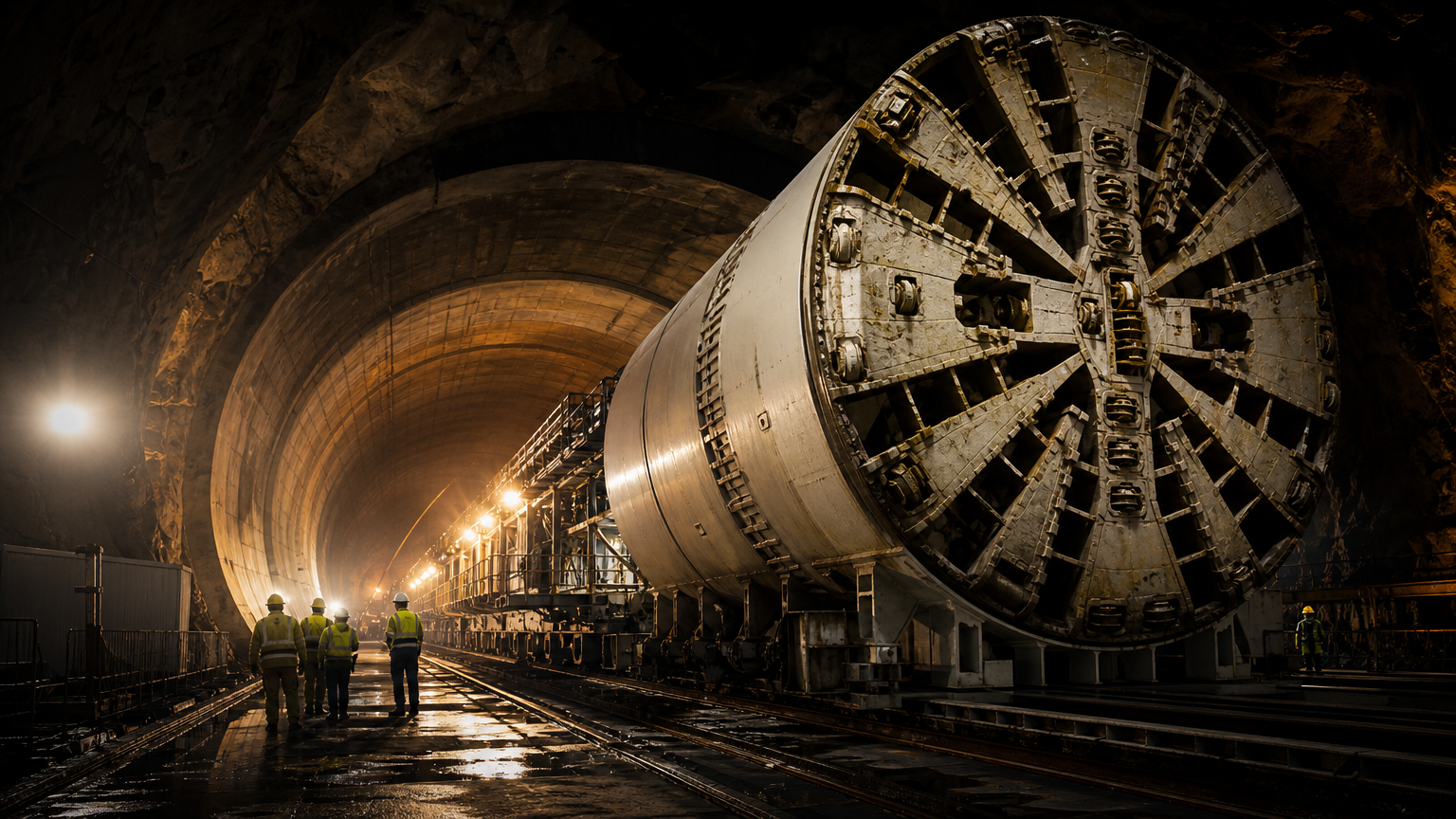
The company says it has grown from a single operating Loop system to a multi-city tunneling program over the past two years, spanning projects in soft soil and hard rock . It also said its Prufrock tunneling machines and autonomous construction technology are intended to increase boring speeds and reduce the need for traditional launch infrastructure . Those claims point to the core of the valuation: investors are not simply buying exposure to a construction contractor, but to the possibility that tunneling can be industrialized through machine design, repetition and automation.
That possibility is still a thesis, not a settled outcome. A $23 billion valuation implies that The Boring Company can convert engineering learning into predictable margins across very different cities. Las Vegas, Nashville and Dubai are not interchangeable markets. Their geology, procurement systems, labor markets, safety expectations and political incentives all differ. The prize is large because if the company can standardize enough of the process, it could make underground roads, transit connectors or airport links easier to propose and finance. The risk is equally clear: every project that remains bespoke weakens the case for software-like scaling.
Why investors are willing to fund the bet
The investor list gives the deal a hybrid character. Venture names such as Sequoia and Andreessen Horowitz sit alongside global capital pools and regionally connected investors such as Temasek and Shamal Holding . That mix reflects the unusual nature of The Boring Company: it is a hard-tech company with venture-style upside, but it requires infrastructure-style patience and government relationships.
The round is also a sharp mark-up from the company’s last major disclosed valuation. The Boring Company was valued at $5.7 billion after a $675 million funding round in 2022, according to recent reports summarizing the new financing . Moving from $5.7 billion to $23 billion in roughly four years is not just a financing achievement; it is a statement that investors believe the company’s opportunity set has expanded materially.
That belief appears tied to a broader market appetite for infrastructure that can be framed as strategic: AI data centers, power systems, ports, space logistics and now tunneling. The common thread is that investors are once again willing to fund physical systems if they appear to unlock constrained capacity. In The Boring Company’s case, the constraint is urban surface space and road congestion. The proposed unlock is a repeatable method for moving vehicles or pods underground with less disruption than traditional mega-projects.
The operating challenge after the money
Fresh capital solves only one part of the problem. The company also plans to use the funds to increase hiring across engineering, production and operations while expanding Loop projects in Las Vegas, Nashville and Dubai . Hiring is not a side issue. For tunneling, execution capacity is a competitive advantage: machine operators, geotechnical engineers, systems integrators, safety specialists and project managers determine whether a concept becomes a dependable transport asset.
The Vegas Loop remains important because it is the company’s most visible operating reference point, while Nashville gives the firm a chance to demonstrate that its model can travel to a different U.S. city . Dubai, however, may become the more consequential test because the announced scale of the UAE opportunity dwarfs a simple point-to-point connector. A 150-kilometer vision would require not only boring speed but also network planning, emergency access, passenger-flow design, station integration and long-term operations.
For investors, the new round sets a measurable exam. The company must show that its tunneling machines and construction approach can reduce costs or schedules enough to justify choosing Loop-style infrastructure over conventional roads, metro extensions, light rail or bus rapid transit. It must also show that city and national governments will move from memoranda and preliminary agreements to funded, built and operated networks.
A big valuation with a narrow margin for error
The Boring Company’s $3 billion raise is therefore both a validation and a burden. The validation is obvious: sovereign-linked and major private investors are willing to back a capital-intensive Musk venture at a valuation that would be extraordinary for a conventional construction business. The burden is that the valuation now demands proof at scale.
The story is not just that Musk’s tunneling company has more money. It is that investors have placed a very large wager on the idea that underground mobility can become a repeatable product rather than a sequence of custom civic engineering projects. If The Boring Company can make that leap, the UAE-backed round may be remembered as the moment tunnels became a venture-scale asset class. If it cannot, the $23 billion valuation will look less like confidence in infrastructure innovation and more like a costly bet that a mole machine could learn the economics of software.
Sources from the last 72 hours
- [1]Musk’s tunnel startup The Boring Company raises $3 billion at $23 billion valuationSep 10, 2026, 6:21 AM UTC
- [2]Musk’s Boring Company raises $3 bln at $23 bln valuationSep 10, 2026, 6:02 AM UTC
- [3]Musk'ın Boring şirketi 23 milyar dolarlık değerlemeye ulaştıSep 10, 2026, 7:17 AM UTC
- [4]Elon Musk’s Boring Company raises capital, valuing firm at $29bSep 10, 2026, 6:40 AM UTC
AI-generated article based on recent web research, then preserved as a dated editorial snapshot.
Comments
Be the first to comment.