
Daily Podcast full article
Google commits €13B to Finland in Europe’s biggest AI infrastructure bet
Google’s two-year Finland plan puts four locations at the center of Europe’s AI buildout, pairing data-center expansion with nuclear, wind, battery and community commitments as the cost of frontier computing keeps climbing.
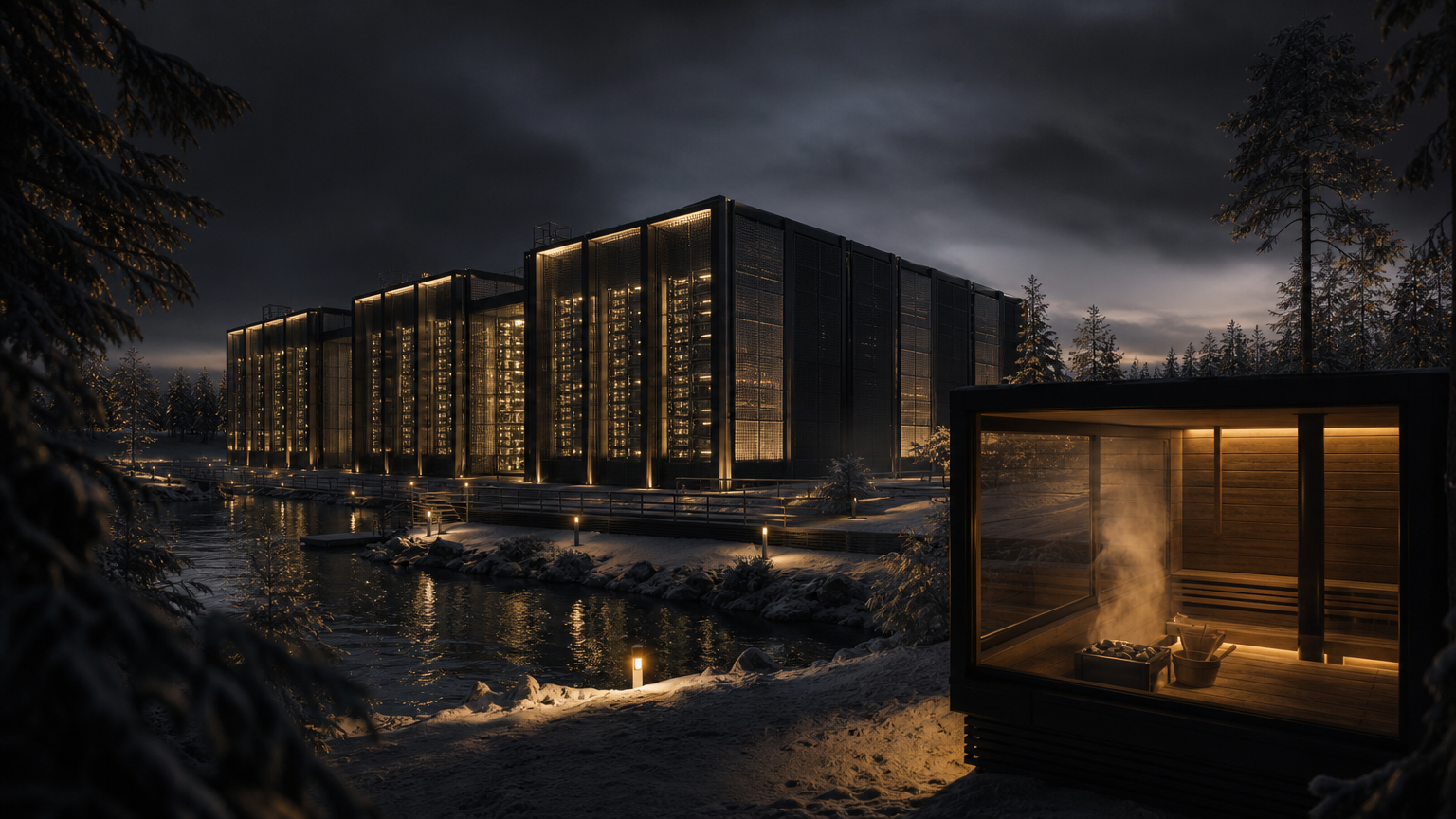
A Finnish expansion scaled for the AI era
Google has committed at least €13 billion to digital and AI infrastructure in Finland over 2027 and 2028, making the program the company’s largest single investment in Europe to date . The plan covers data centers and supporting infrastructure in Hamina, Kajaani, Muhos and Vaala, extending Google’s long-standing Finnish footprint from one established coastal campus into a broader Nordic compute network .
The investment is not simply another data-center announcement. Its size, timing and energy package make it a marker of where the AI race is heading: toward larger regional clusters, longer power contracts and deeper relationships with host governments. Google says the infrastructure will support services including Gemini, Search, Maps and YouTube, while adding capacity for Finnish and wider European digital readiness and AI development .
Finland is the protagonist here as much as Google. The country offers cool operating conditions, a comparatively low-carbon power mix, industrial sites, political stability and the kind of grid planning that hyperscale operators increasingly need. Google’s choice of Hamina, Kajaani, Muhos and Vaala also shows that the next phase of European cloud infrastructure is not confined to the continent’s biggest capitals; it is moving toward places where land, power and local partnerships can be assembled at industrial scale .
Four sites, one strategic geography
Hamina anchors the story. Google bought a former paper mill there in 2009 and converted it into a data center, creating the base for more than 15 years of operations in Finland . The site is already associated with seawater-based cooling and heat recovery, including offsite distribution designed to supply a large share of the local district heating network’s annual needs .
The new plan widens that model. Google says the 2027-2028 investment includes data-center and supporting infrastructure projects, plus partnerships, in Hamina, Kajaani, Muhos and Vaala . Independent industry coverage described the program as spanning four Finnish data-center sites and noted that the money covers both the existing Hamina base and the three additional locations .
The northern and central Finnish geography matters because electricity is now as strategic as chips. Google says it worked with Fingrid, Business Finland and local municipalities to identify locations where existing grid infrastructure and carbon-free energy are closer to the expected load . In its energy blog, the company said a commissioned study modeled a hypothetical 1GW of new demand in the Oulu-Kajaani region compared with southern Finland and found smart siting could generate an estimated €520 million in savings for Finnish energy consumers over 20 years .
That is Google’s argument for why the buildout can be more than a power-hungry import. The company wants to present Finland as a blueprint for responsible AI infrastructure: place the load near clean generation, add new energy resources, recycle heat where possible, and tie the development to local skills and nature programs .
The economic promise: jobs, GDP and suppliers
Google’s official estimates are large. During the initial construction phase in 2027 and 2028, the company says the investment is expected to add an annual average of €3.6 billion to Finland’s GDP and support more than 37,000 jobs nationwide . Around 16,000 of those jobs are expected to be in construction, generating €911 million in average annual labor income for the sector .
Once the facilities are fully operational, Google says they will support thousands of permanent jobs, from engineers and technicians to security, catering and facilities roles . A Finnish-language release distributed through Cision put the continuing employment effect at about 7,000 jobs a year and said the average wage for those roles is estimated to be 24% above Finland’s median wage .
The supplier channel is also part of the sales pitch. From 2023 to 2025, Google says its Hamina presence supported more than 600 Finnish suppliers across construction, operations and network infrastructure, including DNA, Elisa and Nokia . That history gives the new investment a ready-made industrial ecosystem, but it also raises the stakes for Finland: the country is not just hosting data halls; it is betting that AI infrastructure will spill into services, engineering, networks and local education.
The energy package: nuclear, wind and batteries
The most consequential part of the announcement may be the power strategy attached to it. Google is coupling its Finland investment with a 22-year power purchase agreement with Fortum to support the lifetime extension and power upgrade of the Loviisa nuclear power plant . Fortum said the agreement can cover up to 50% of Loviisa’s capacity, starting at smaller volumes in 2028 and reaching that level over 2030-2049 .
Loviisa is not a marginal asset. Fortum says the plant employs about 580 people, provides roughly 10% of Finland’s electricity, and could not continue beyond 2030 without the lifetime-extension investment program . Fortum also said it has an approximately €1 billion investment program aimed at extending Loviisa’s lifetime to 2050, with about €700 million of required capital expenditure still pending investment decisions .
For Google, the nuclear deal addresses the hardest problem in AI infrastructure: firm, low-carbon electricity available when the wind is not blowing and demand is high. The company also announced support for two onshore wind projects developed by Valorem and Suomen Hyötytuuli, bringing its contracted new-to-the-grid onshore wind energy in Finland to 629MW . A 94MW battery system near Google’s Kajaani site is expected to become operational in late 2027 to help balance the grid and reduce price volatility .
That combination — nuclear life extension, wind procurement and battery flexibility — reflects a new reality for hyperscalers. In earlier cloud cycles, a data-center operator could often buy renewable power and rely on the grid for the rest. In the AI cycle, operators increasingly need to help finance the firm capacity and grid stability that make their growth possible.
The unanswered question: how much power will AI need?
Google has disclosed the scale of the investment and the energy resources it is supporting, but not the expected power draw of the Finnish sites. The Next Web noted that the announcement is precise about 629MW of wind and a 94MW battery system, but silent on the data centers’ own megawatt demand . That missing number matters because it is the key to judging whether the new energy package fully offsets, partly offsets or merely accompanies the new load.
The broader policy issue is familiar across Europe. AI infrastructure is now part of economic strategy, but it also competes for power, water, land and grid connections. Google is trying to pre-empt that criticism by tying the Finnish expansion to affordability commitments, grid-friendly siting, demand-response exploration and local energy programs . Whether that framework satisfies communities and regulators will depend on execution after 2027, not just the announcement in 2026.
Europe’s AI capacity problem
For Europe, the Finland commitment lands at a sensitive moment. Governments want more domestic AI and cloud capacity, but the most capital-intensive parts of the stack remain dominated by U.S. technology companies. Google’s €13 billion plan therefore cuts both ways. It gives Europe more physical AI infrastructure on European soil, but it also reinforces the dependence of that infrastructure on American hyperscalers.
Finland appears willing to make that trade-off. Prime Minister Petteri Orpo called the decision evidence of the country’s investment strengths and said deeper collaboration with Google would support innovation, research and development . Business Finland’s leadership similarly framed the investment as a platform for digital-economy value creation and new expertise in Finland .
The strategic logic is clear. If Europe wants to train, serve and govern more AI systems locally, it needs power-dense data centers close to clean electricity and fiber networks. Finland offers many of those ingredients. Google offers the capital and demand. The question is how much of the value chain — from skills to suppliers to energy innovation — Finland can keep at home.
The bottom line
Google’s €13 billion commitment to Finland is a statement about AI’s physical reality. Models may be software, but the race around them is increasingly decided by land, steel, transformers, fiber, cooling systems, grid access and long-term power contracts.
The Finland plan gives Google more Nordic capacity for AI and core services, while giving Finland a chance to turn its power system and industrial geography into a European digital-infrastructure hub . It also shows the price of entry in the next cloud cycle. Even the cloud now needs a very large Finnish sauna.
Sources from the last 72 hours
- [1]Google Deepens Commitment to Finland with Two-Year €13 Billion investment in AI InfrastructureSep 9, 2026, 12:00 AM UTC
- [2]Google deepens its commitment to Finland with a €13 billion investment in AI infrastructureSep 9, 2026, 12:00 AM UTC
- [3]Our blueprint for responsible clean energy growth in FinlandSep 9, 2026, 12:00 AM UTC
- [4]Inside information: Fortum and Google partner to drive sustainable growth for Finland - sign nuclear Power Purchase AgreementSep 9, 2026, 7:00 AM UTC
- [5]Google pledges €13bn investment in digital infrastructure in FinlandSep 9, 2026, 12:00 AM UTC
- [6]Google will invest €13bn in four Finnish data centre sites over two yearsSep 9, 2026, 7:52 AM UTC
- [7]Google vahvistaa sitoutumistaan Suomeen kaksivuotisella 13 miljardin euron investoinnilla tekoälyinfrastruktuuriinSep 9, 2026, 12:00 AM UTC
AI-generated article based on recent web research, then preserved as a dated editorial snapshot.
Comments
Be the first to comment.