
Daily Podcast full article
Tesla Cybercabs enter US streets as autonomy leaves the steering wheel behind
Tesla’s steering-wheel-free Cybercabs have moved from prototype theater to Austin streets, turning a robotaxi launch into a live test of regulation, safety design and Tesla’s software-led valuation story.
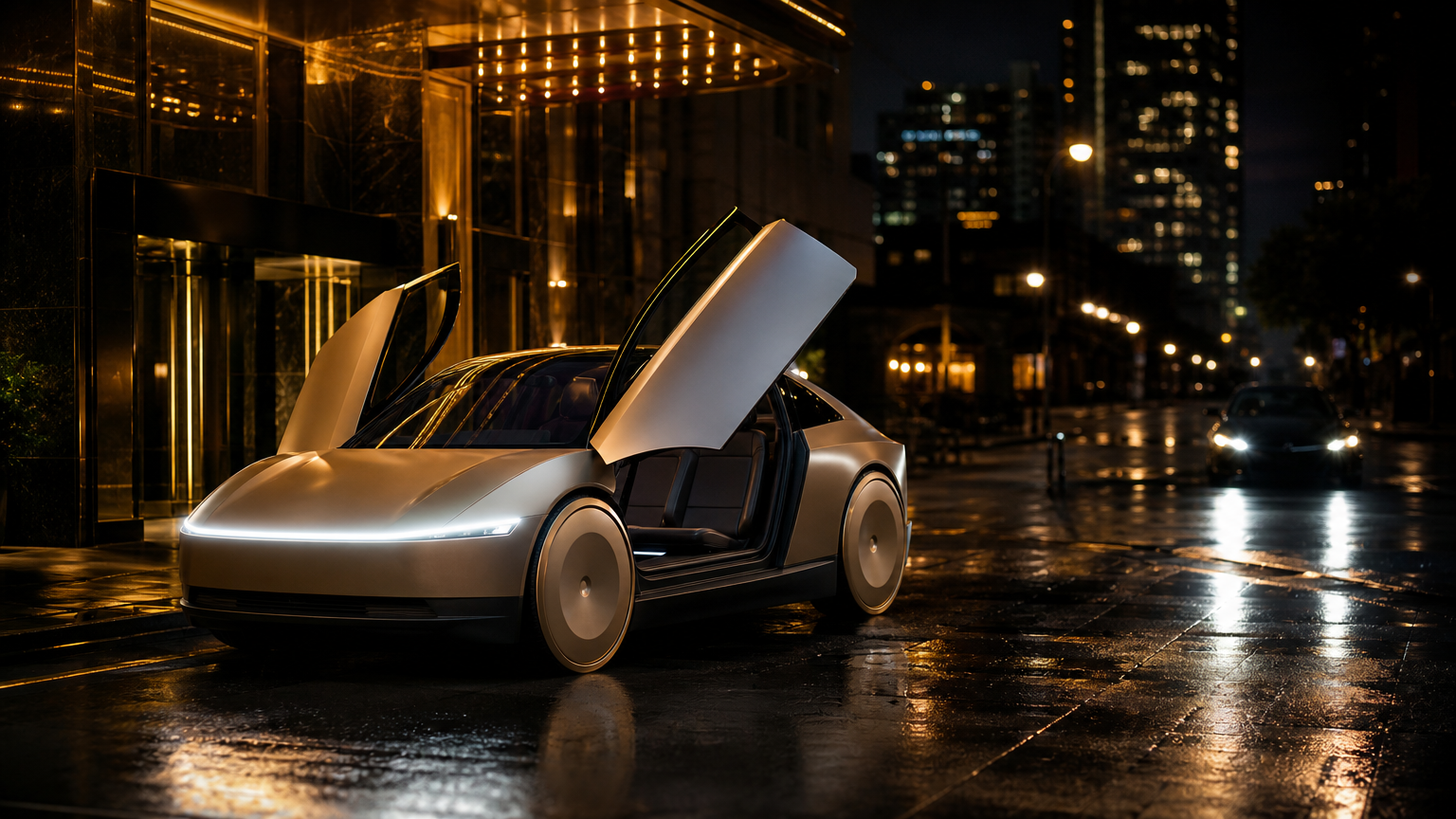
A stage prop becomes a street vehicle
Tesla’s Cybercab has crossed the line that matters most in autonomous driving: it is no longer only a futuristic object shown under event lights. Fresh reporting on September 7 said the two-seat vehicle, built without a steering wheel, brake pedal or accelerator pedal, had been dispatched onto streets in Austin, Texas, as part of Tesla’s robotaxi push . That puts the company’s most radical autonomy claim into contact with real traffic, real passengers and real regulators.
The detail that changes the story is not simply that the Cybercab drives itself. It is that there is no manual driving interface for a passenger, a safety monitor or an emergency responder to fall back on in the ordinary way. Reports described the Cybercab as a gold-hued, two-seat Tesla with no steering wheel, no pedals and, in regulatory accounts, no conventional mirrors . A launch of driverless rides is news; a launch of vehicles that cannot be conventionally driven is a policy argument on wheels.
Accounts published within the latest 72-hour window differ on the exact public-opening date, describing rides as beginning around September 3, September 4 or September 5 in Austin, but they converge on the core fact: Tesla has moved purpose-built Cybercabs into a limited U.S. street deployment rather than merely showing prototypes . The service is still small and geographically constrained, but the design choice is large. Tesla is asking the public and the government to accept a vehicle that skips the transitional “human can still take over” phase.
Why no pedals changes the safety question
Most robotaxi rollouts have tried to make autonomy look less strange. A converted car keeps the familiar cabin layout even when nobody touches the wheel. Tesla’s Cybercab does the opposite. It makes the absence of a driver visible the moment the door opens.
That matters because a steering wheel and pedals are more than symbols. They define assumptions embedded in crash standards, emergency procedures, passenger expectations and liability analysis. If a vehicle makes a bad planning decision, blocks an intersection, stops in an unsafe place or loses connectivity with remote support, there is no obvious in-cabin control for a human to use. September 7 reporting emphasized that passengers in the Cybercab do not have the ability to take over in an emergency .
This is the milestone and the risk in the same package. Tesla’s bet is that an autonomous vehicle designed only for autonomy can be cheaper, simpler and more efficient than a retrofitted consumer car. Its critics and regulators will ask whether deleting controls removes a useful redundancy before the technology has earned that trust on a broad scale.
The regulatory response came almost as quickly as the launch narrative. Fresh reports said the National Highway Traffic Safety Administration opened or pursued an audit into how Tesla certified the Cybercab for compliance with federal motor vehicle safety rules after the Austin deployment . The question is not merely whether Tesla’s software can handle a particular Austin route. It is whether a vehicle designed without driver controls fits rules written around the idea that vehicles normally have a human operator and a conventional driving position.
A small fleet with a large strategic role
The early Cybercab footprint appears modest. One September 7 account said Tesla opened public rides with 45 Cybercabs registered in Texas, within a broader state autonomous-vehicle fleet figure of roughly 420 Teslas . Another report also described the Cybercab presence as small beside Waymo’s larger fleet footprint, while noting that the Austin service was operating only in a limited pickup zone .
That scale matters. Tesla is not yet proving a national robotaxi business. It is proving whether the most difficult version of its concept can exist in public: a vehicle with no fallback driver interface, operating as part of a ride-hailing service. For investors, the distinction is crucial. Tesla’s market story has increasingly depended on the idea that autonomy can convert cars from one-time sales into high-utilization software platforms. A Cybercab fleet, if it can be manufactured cheaply and used intensively, points to recurring ride revenue and software-like margins rather than the lower-margin cycle of selling private vehicles.
The launch therefore plays two roles at once. Operationally, it is a limited Austin deployment. Financially, it is evidence for a much larger thesis: that Tesla can become not just an automaker but a network operator. That is why even a small number of vehicles can move the conversation. A 45-car pilot is not a transport system. But a 45-car pilot with no steering wheels is a direct challenge to how the United States will classify, certify and supervise purpose-built autonomous fleets .
Tesla’s minimalist autonomy versus the sensor-heavy model
The Cybercab also sharpens Tesla’s long-running technical split from rivals. Reporting this week described Tesla as relying on a camera-only Full Self-Driving architecture, while competitors such as Waymo and Zoox use combinations of cameras, radar and lidar . The design of the Cybercab makes that difference harder to ignore, because Tesla is not merely omitting lidar; it is omitting the driver hardware that might have reassured regulators during a transitional period.
For Tesla, minimal hardware is the point. Fewer expensive sensors and no driver cockpit could help reduce vehicle cost, simplify production and improve fleet economics. In a robotaxi market, cents per mile matter. A purpose-built two-seater can be optimized for the many urban trips that carry one or two people, instead of dragging around the cost and weight of a family SUV.
For rivals, the Cybercab is a provocation. Waymo’s strategy has been slower, heavily mapped, sensor-rich and conservative in visible hardware. Tesla is arguing that scale, neural-network training and fleet learning can substitute for more complex sensor stacks and for human fallback controls. The Austin deployment turns that argument from a slide-deck position into something regulators can inspect and passengers can experience.
The app becomes the cockpit
Without a wheel or pedals, the passenger interface shifts to software. A September 7 report said Tesla’s Robotaxi app now lets riders choose between a two-seat Cybercab and a four-seat Model Y before booking in Austin, suggesting Tesla is moving toward a mixed robotaxi fleet rather than a single-vehicle pilot . The same report described Cybercab-specific app functions such as identifying the vehicle by light color, opening doors by phone and managing cabin settings from the passenger interface .
That is more than a user-experience detail. In a Cybercab, the app and screen are effectively the cockpit. They mediate trust, route awareness, pickup confidence and emergency communication. The more Tesla removes mechanical controls, the more the software interface must carry the psychological burden of control.
For riders, the question becomes: do I need to control the vehicle, or only understand what it is doing? Tesla’s answer is the latter. The public’s answer will emerge ride by ride, especially among people who may be comfortable with driver-assistance features but uneasy in a car that offers no steering wheel at all.
The next test is not spectacle but routine
The Cybercab’s entry onto U.S. streets is a real autonomy milestone because it changes the default assumption. Until now, many deployments preserved the idea that a human driving interface remained part of the vehicle, even if unused. Tesla has now made the absence of that interface central to the product.
The coming test will be mundane by design: pickups, drop-offs, construction zones, confused pedestrians, bad weather, blocked lanes, first-responder interactions and customer support failures. Regulators will focus on certification and safety standards; investors will focus on utilization and margins; rivals will watch whether Tesla’s minimalist hardware model can scale without inviting restrictions.
The Cybercab has entered American streets not as a finished answer, but as a question moving through Austin traffic. If it works safely and repeatedly, Tesla will have forced a faster debate over purpose-built autonomy. If it stumbles, the missing steering wheel will become the symbol not of confidence, but of a fallback removed too soon.
Sources from the last 72 hours
- [1]Musk unleashes Tesla Cybercabs with no steering wheel or pedals onto US streetsSep 7, 2026, 8:03 AM UTC
- [2]Tesla's Cybercab Is Finally Picking Up Riders — Here's Why Regulators Moved Just as FastSep 7, 2026, 2:13 PM UTC
- [3]Cybercab Arrives in Japan as NHTSA Challenges Tesla's Legal Right to the RoadSep 7, 2026, 7:04 PM UTC
- [4]Tesla Launches Cybercab Robotaxi in Austin With 45 CarsSep 7, 2026, 12:00 AM UTC
- [5]Tesla Robotaxi App Lets Riders Choose Cybercab or Model YSep 7, 2026, 12:00 AM UTC
AI-generated article based on recent web research, then preserved as a dated editorial snapshot.
Comments
Be the first to comment.