
Daily Podcast full article
800 IQ Tesla Cybercab Analysis: Tesla’s Robotaxi Cost Machine
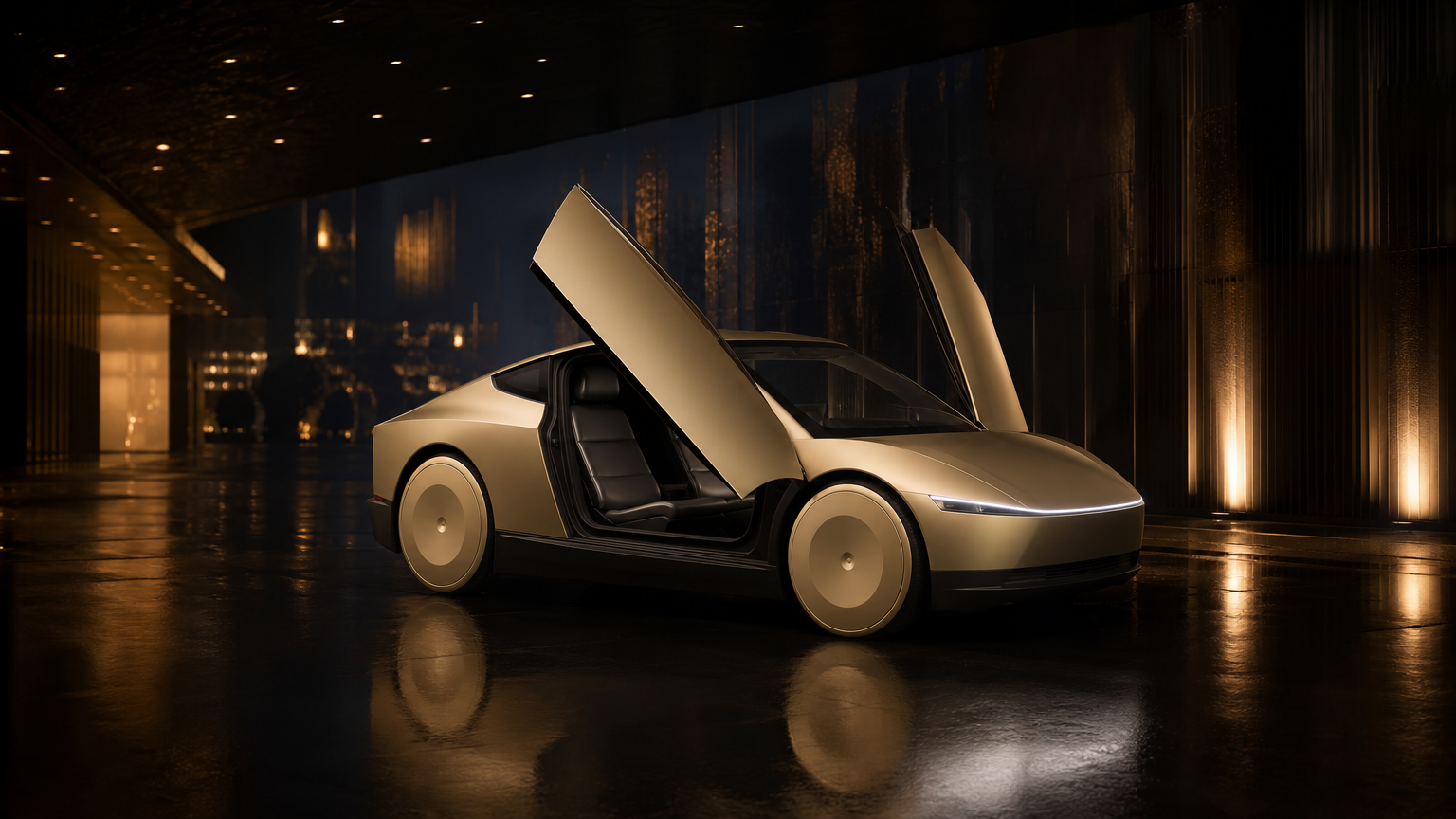
Tesla’s Cybercab is not just a small autonomous car; it is a stripped-down economic argument. By deleting the driver, the steering wheel, pedals, mirrors and much of the conventional EV charging and manufacturing stack, Tesla is trying to make robotaxi transport cheaper at the hardware level before software scale even enters the equation.
The headline idea: design as cost strategy
The “800 IQ” reading of Tesla’s Cybercab is that the vehicle should be judged less like a normal car and more like a cost-optimized mobility appliance. The current Cybercab thesis, as summarized in the September 7 analysis that framed this story, is simple: a purpose-built two-seat robotaxi with no steering wheel, no pedals and no side mirrors removes expensive, failure-prone and unnecessary parts from the beginning of the design process . That is why the Cybercab story is not only about autonomy. It is about whether Tesla can use autonomy to redesign the vehicle bill of materials.
The most important point is that this advantage would exist before Tesla proves any controversial software claim. A human-driven car needs a cockpit. A robotaxi designed never to be driven by a passenger does not. If the car has only two seats, it also needs less interior volume, less mass, fewer restraint systems and a smaller energy budget for the majority of short urban rides. The result is a vehicle that tries to cut cost per mile through geometry, component deletion and manufacturing flow, not only through artificial intelligence.
Why two seats matter
The Cybercab’s two-seat layout has been mocked as too small, but the economic logic is obvious: most ride-hailing trips do not need a five-seat vehicle. Tesla’s supporters argue that a two-person cabin is a deliberate optimization for the most common trip pattern, and recent coverage says the company designed the vehicle around the claim that more than 80% of rides involve two people or fewer . That turns “small” from a weakness into a specialization.
A smaller cabin means lower mass. Lower mass means less battery capacity is needed for the same urban duty cycle. Less battery means lower upfront cost, lower charging demand and less vehicle weight to move. The Cybercab’s cost argument therefore compounds: fewer seats reduce structure and interior parts, and the reduced structure then reduces the energy system needed to serve the same trip market.
This is also why the Cybercab is more threatening to Uber, Lyft, taxis and even some public-transit use cases than a normal Tesla Model Y robotaxi would be. A Model Y adapted for autonomy may remove the driver wage, but it still carries the cost and size of a family crossover. A Cybercab starts from the premise that the vehicle should be built only for paid urban passenger miles.
The Austin reality check
The launch is real, but it is still small. Fresh reporting on September 7 said Tesla opened public Cybercab rides in Austin on September 5, 2026, with the service beginning from 45 Cybercabs registered in Texas inside a wider autonomous fleet of roughly 420 vehicles . That is enough to prove the vehicle has crossed from prototype theater into limited public service, but not enough to prove the economics at scale.
The gap between 45 Cybercabs and Tesla’s stated ability to build up to 125,000 per year is the central tension . At pilot scale, fares can be subsidized, maintenance can be hand-held, operations can be monitored closely and enthusiastic early users can dominate the experience. At large scale, Tesla would need high utilization, predictable cleaning, fast charging or wireless charging logistics, low downtime, insurance confidence and regulatory acceptance.
Still, the Austin rollout matters because the Cybercab is no longer only an investor slide. It is a vehicle that can be hailed through Tesla’s Robotaxi system, and it is being tested against real pickup behavior, traffic, passenger expectations and urban operations.
Hardware deletion as a moat
The clearest engineering theme from the latest post-launch reporting is deletion. Not a Tesla App’s September 7 technical breakdown describes the Cybercab as a purpose-built autonomous platform whose newly revealed details include custom thermal hardware, compact mechanical packaging and design choices shaped by cost engineering . Drive Tesla’s fresh reporting also highlighted Cybercab’s aerodynamic focus, saying Tesla described the two-seater as having a drag coefficient below 0.20 .
Aerodynamics are not decoration here. In a privately owned car, a slightly better drag coefficient improves range. In a robotaxi, it can improve every revenue mile. If a vehicle operates many hours per day, small energy savings become fleet-level operating savings.
The same logic applies to manufacturing. Drive Tesla reported that Tesla presented the Cybercab’s “unboxed” manufacturing process as a way to build major subassemblies in parallel and cut manufacturing line size by 50% while raising output . If that process works, Tesla’s cost advantage would not only come from removing parts from the vehicle; it would also come from reducing the factory space and time needed to assemble each unit.
The thermal and braking story
Recent technical coverage adds more detail to why the Cybercab is a cost platform rather than just a design object. Not a Tesla App reported that the new technical picture includes Tesla’s Supermanifold V3 thermal system and other custom hardware choices intended to make the autonomous platform simpler and more efficient . The same wave of reporting describes brake-by-wire and steer-by-wire choices as part of a broader move away from conventional mechanical systems .
That matters because robotaxis are maintenance businesses. Every hose, fluid, linkage, motor, actuator and connector becomes a possible fleet cost. The fewer systems Tesla can safely remove or simplify, the more credible the long-term cost-per-mile thesis becomes.
Charging is part of the same pattern. Drive Tesla reported on September 7 that the Cybercab lacks an onboard AC charger, a deletion that would be unusual for a consumer EV but understandable for a fleet vehicle designed around controlled charging infrastructure and wireless inductive charging . Removing the onboard charger cuts hardware, weight and potential failure points, but it also signals that Cybercab is optimized first for robotaxi depots, not private driveway ownership.
Fares: early promise, not final proof
The most exciting consumer claim is price. The 8news subject analysis noted early Austin accounts describing Cybercab trips as roughly 50% cheaper than comparable Uber rides, while other fresh coverage around Tesla’s Robotaxi pricing points to a shift toward dynamic fares in Austin . Drive Tesla reported that Tesla has moved away from the earlier flat-rate Robotaxi pricing model and toward variable fares based on trip distance .
That is strategically important. Tesla cannot prove the Cybercab thesis only by building a cheap vehicle. It must translate vehicle savings into lower fares, high demand and acceptable margins. Dynamic pricing gives Tesla a lever to test that balance: lower prices when supply is available, higher prices when demand is tight, and potentially different pricing for Cybercab versus Model Y robotaxis.
But early fare screenshots and anecdotes are not the same as mature unit economics. The real question is whether Tesla can keep fares low after accounting for cleaning, charging, depreciation, remote assistance, insurance, customer support, vandalism, regulation and empty repositioning miles.
The regulatory constraint
The boldest Cybercab decision is also the regulatory risk: passengers have no manual controls. Santage’s September 7 report noted that federal regulators are reviewing the design because it ships without a steering wheel or pedals . That is the correct policy question. A vehicle with no fallback driver is not merely a car with a new interface; it is a different safety model.
If regulators accept Tesla’s self-certification logic and operational data, the Cybercab gets a clearer path to scale. If they challenge the certification or require changes, the cost thesis could weaken, especially if Tesla must add hardware it tried to delete. Regulation is therefore not a side issue. It is part of the bill of materials.
The “800 IQ” conclusion
The Cybercab’s smartest idea is not that it looks futuristic. It is that Tesla has aligned the product, factory and service model around one variable: cost per paid mile. Two seats, no driver controls, aerodynamic bodywork, unboxed assembly, simplified charging and fleet-first operations all point in the same direction.
The current verdict is therefore balanced. The Cybercab is a potentially formidable cost machine, but today it is still a limited Austin deployment with 45 registered vehicles, not a national transport network . If Tesla scales safely, the stripped-down design could pressure ride-hailing, taxis and underused transit routes. If regulation, reliability or real-world operating costs bite back, the “800 IQ” move may look less like genius and more like an elegant prototype searching for permission to become infrastructure.
Sources from the last 72 hours
- [1]800 IQ Tesla Cybercab AnalysisSep 7, 2026, 5:30 AM UTC
- [2]Tesla Cybercab Specs: Supermanifold V3, No Rare Earth Magnets & MoreSep 7, 2026, 12:00 AM UTC
- [3]Tesla Reveals New Cybercab Details As It Officially Joins Robotaxi Fleet at 5pm TonightSep 6, 2026, 12:00 AM UTC
- [4]Tesla Launches Cybercab Robotaxi in Austin With 45 CarsSep 7, 2026, 12:00 AM UTC
- [5]Tesla introduces dynamic fare pricing for Robotaxi rides in AustinSep 6, 2026, 12:00 AM UTC
- [6]Tesla Cybercab has no onboard AC charger, but that doesn’t rule out home chargingSep 7, 2026, 12:00 AM UTC
AI-generated article based on recent web research, then preserved as a dated editorial snapshot.
Comments
Be the first to comment.