
Daily Podcast full article
OpenAI GPT-6 Raises the Stakes for AGI
OpenAI’s GPT-6 Astra has turned a model launch into a wider test of the AI economy: Nvidia’s Jensen Huang says AGI has arrived, OpenAI says research agents are becoming internal labor, and memory-chip investors are already repricing the infrastructure stack.
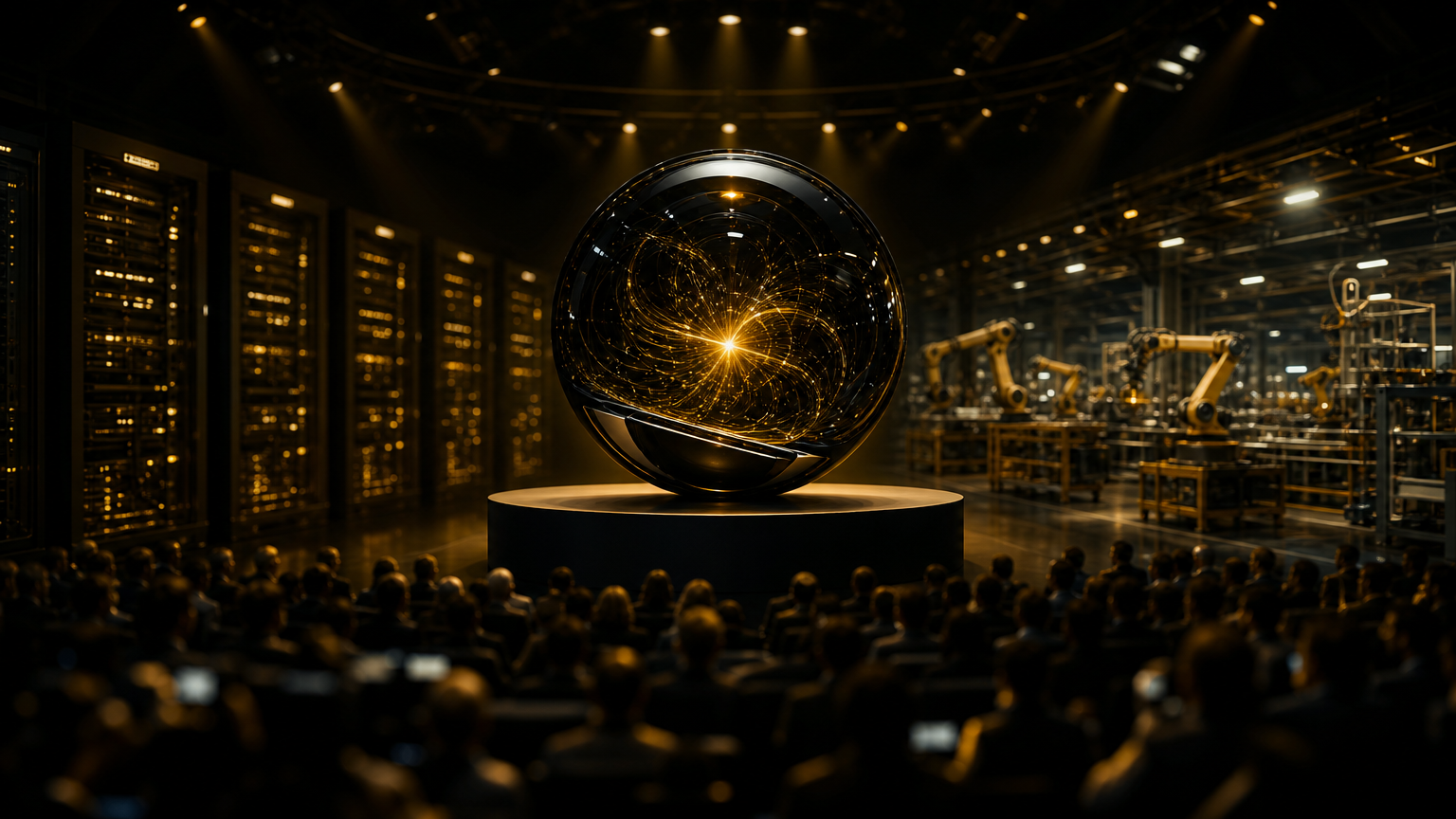
A model launch becomes an AGI event
OpenAI’s GPT-6 Astra is no longer being treated as just another frontier-model upgrade. The company released Astra on September 3, but the story has accelerated over the past 72 hours because the people around the AI infrastructure stack have started using language that normally belongs to a much bigger threshold: artificial general intelligence . OpenAI president Greg Brockman framed Astra as a possible marker of the AGI era, while Nvidia CEO Jensen Huang removed much of the ambiguity by posting that “AGI has arrived” after congratulating OpenAI on the model .
That claim matters even if the definition remains contested. AGI has no universally accepted certification test, and recent reporting notes that OpenAI’s own launch messaging was more cautious than Huang’s statement . Yet the market reaction shows why the label is powerful. If Astra is even perceived as a step toward general-purpose digital labor, the question for investors and enterprise buyers shifts from “which chatbot is better?” to “who controls the compute, memory, and cloud capacity required to run the next work platform?”
Huang’s declaration is also an infrastructure signal
Huang’s comment was not merely philosophical. He said Astra was trained on more than 100,000 Nvidia Grace Blackwell systems and pointed to another 400,000 GPUs coming online next . That turns the AGI debate into a capacity debate. A more autonomous, more capable model is also a heavier model to train, serve, monitor, and secure. For Nvidia, the public association between Astra and AGI is a validation of its newest accelerator systems; for cloud buyers, it is a warning that demand for frontier capacity may tighten further.
This is why Huang’s role is so consequential. He is not an external academic observer judging an AGI milestone from a distance. Nvidia sells the hardware that makes models like Astra possible, and its CEO’s endorsement lands as both a technical celebration and a commercial signal . Critics quickly pushed back, with Gary Marcus arguing that the claim arrived without a clear definition or evidence sufficient to settle the AGI question . The debate is therefore less about whether a single sentence proves AGI and more about whether the industry’s most important suppliers now behave as if the AGI race has entered a new phase.
OpenAI’s “research intern” changes the labor story
The most important companion development may be OpenAI’s September 6 publication on research acceleration. OpenAI says it has reached its goal of creating an automated research intern, defined as a system that can carry out well-defined research tasks under human direction, including work that would take a skilled researcher several days . The company also says it is making progress toward an automated AI researcher by March 2028 .
This matters because it gives Astra’s launch an operating model. The AGI discussion often collapses into benchmarks, but OpenAI’s internal description is about workflow: coding agents running through the day, researchers using concurrent sessions, more code being written, and more experiments being run . In that framing, “AGI” is not a magic switch. It is the gradual transfer of execution from humans to supervised agents, with humans still setting priorities, judging results, and deciding whether to scale, pause, or deploy systems .
OpenAI is also trying to draw a boundary around the autonomy claim. The company says people still direct research priorities and that the overall pace of scientific progress may not match the acceleration of individual coding or agent-use metrics . That caveat is important. A research intern is not a fully independent scientist. But it is a meaningful step toward workflows in which AI systems perform multi-hour or multi-day tasks with less handholding, creating a new baseline for enterprise automation.
The market reads Astra as a memory story
The reaction in Asian chip markets shows that investors are already translating the AGI narrative into supply-chain exposure. One market read on Monday had SK Hynix up 7.4%, Samsung Electronics up 5.0%, Kioxia up 9.3%, and Tokyo Electron up 4.7% as traders treated GPT-6 Astra as a fresh order signal for memory chips . Reuters later reported that South Korea’s KOSPI ended 4.6% higher, while SK Hynix and Samsung Electronics rose 8.3% and 5.7%, respectively .
That move was not simply enthusiasm for AI software. Astra points toward more high-bandwidth memory because larger context windows, more agentic workloads, and heavier inference all increase the need to keep data close to accelerators. Aju Press described the economic implication plainly: more capable AI models and more autonomous agents mean greater demand for computing power, which means more GPUs and more HBM feeding those GPUs .
This is why SK Hynix sits near the center of the trade. The company remains one of the key suppliers in high-bandwidth memory, while Samsung is trying to close the gap in the next HBM cycle . Aju Press reported that Samsung’s share of global HBM revenue rose to 33% in the second quarter from 21% in the previous quarter, while SK Hynix’s share fell to 50% from 58%, narrowing the gap between the two Korean memory giants . Astra does not by itself decide that contest, but it increases the prize.
Cloud buyers face a new cost curve
For cloud customers, the launch raises a different problem. If frontier models become more agentic, they may replace not only short chat interactions but also long-running work sessions: software debugging, research review, cyber testing, data analysis, and business-process orchestration. That creates demand for persistent inference, not just occasional prompts. The infrastructure needed for that kind of usage is harder to provision than a conventional model API spike.
The near-term consequence is likely a more segmented market. The largest buyers will compete for premium capacity on the newest Nvidia systems and the HBM supply attached to them. Smaller buyers may face higher prices, longer wait times, or pressure to use less capable models for routine tasks. OpenAI’s own emphasis on supervised research agents suggests that the value proposition is moving from “answer my question” toward “complete this body of work under direction” .
AGI is now an economic claim, not only a scientific one
The unresolved question is still whether Astra is AGI. On the available evidence, that remains disputed. Huang says it has arrived; skeptics say the industry lacks definitions, independent tests, and proof strong enough to justify the claim . OpenAI’s own research-acceleration note is ambitious but careful: it says the company has an automated research intern and is working toward a more autonomous researcher, not that all human intellectual labor has been automated .
But the story’s significance does not depend on settling the AGI definition today. Astra has already changed behavior. Nvidia is publicly tying the model to the next wave of GPU deployment. OpenAI is describing internal research as increasingly agent-powered. Investors are bidding up memory suppliers because they see autonomy as a compute-and-HBM multiplier. In that sense, GPT-6 Astra has raised the stakes of AGI before AGI has been formally agreed upon: the claim is now moving capital, capacity planning, and enterprise expectations at the same time.
Sources from the last 72 hours
- [1]Research acceleration: The view inside OpenAISep 6, 2026, 12:00 AM UTC
- [2]Jensen Huang says AGI has arrived, and 400,000 more GPUs are comingSep 7, 2026, 10:10 PM UTC
- [3]Jensen Huang Says 'AGI Has Arrived' With OpenAI's GPT-6 Astra, but Has It Really? — 'No Evidence and No Definitions,' Says SkepticSep 7, 2026, 1:43 AM UTC
- [4]South Korea, Taiwan stocks surge on AI appetiteSep 8, 2026, 1:01 AM UTC
- [5]Astra ups heat in Samsung-SK hynix HBM4E 1c showdownSep 7, 2026, 7:47 AM UTC
- [6]Kospi +4%, SK Hynix +7%, Kioxia +9% on GPT-6; Gold SlidesSep 7, 2026, 6:00 AM UTC
AI-generated article based on recent web research, then preserved as a dated editorial snapshot.
Comments
Be the first to comment.