
Daily Podcast full article
Google gets Iowa nuclear restart as AI power demand meets baseload reality
A $1.9 billion federal loan has moved NextEra’s Duane Arnold nuclear restart from ambition toward execution, with Google positioned as the key power buyer for Iowa cloud and AI infrastructure. The deal does not switch the reactor back on tomorrow: federal nuclear approvals still stand between the idled plant and commercial operations. But it marks a sharp policy signal that Washington now sees data-center electricity, grid reliability and nuclear restarts as one industrial strategy.
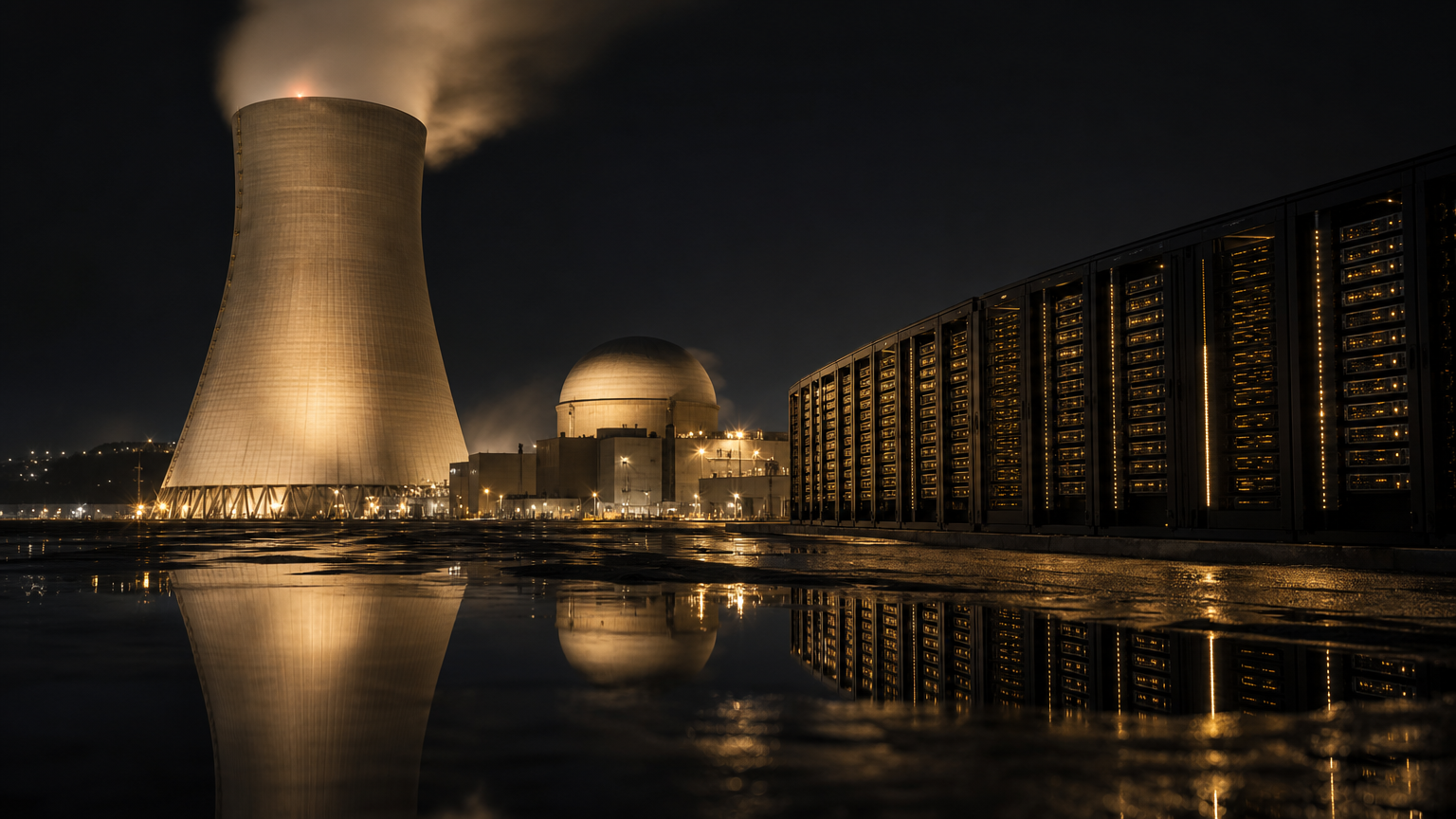
A federal loan turns an idled reactor into an AI-era asset
Google’s Iowa nuclear bet just gained the financing muscle it needed. On September 8, 2026, the U.S. Department of Energy said its Office of Energy Dominance Financing had reached financial close on a loan of up to $1.9 billion to NextEra Energy for the restart of the Duane Arnold Energy Center in Linn County, Iowa . NextEra described the same step as a combined conditional commitment and financial close supporting the return of Iowa’s only nuclear plant to service .
The numbers explain why this is not a symbolic transaction. Duane Arnold is a 615-megawatt nuclear facility, and the Energy Department says its restart would put 615 megawatts of baseload generation back on the grid, enough by DOE’s estimate to power nearly 500,000 homes . The department also says the project could create nearly 1,500 construction jobs and support more than 450 jobs during operations . NextEra’s release adds a broader economic claim: a study cited by the company estimates more than $9 billion in Iowa economic benefits over 25 years and about $75 million in tax revenue over the life of the project .
The financing is important, but it is not the same thing as a restart license. DOE said Duane Arnold ceased operations in 2020 and that the return of the plant remains pending required U.S. Nuclear Regulatory Commission licensing approvals . KCRG, the local Iowa station covering the Palo plant, made the same point more plainly: the loan has been closed, but the plant cannot immediately return to service without the necessary NRC approvals .
Google is the anchor customer, not just a green-credit buyer
The strategic center of the deal is Google. Utility Dive reported that Google will be the primary customer of the revived Duane Arnold plant and will use the output to help power its growing cloud and AI infrastructure in Iowa . World Nuclear News reported that NextEra’s plan, announced last October and now backed by the DOE loan, is underpinned by a 25-year power purchase agreement with Google .
That matters because this is different from a conventional corporate clean-energy purchase. Many technology companies have historically bought renewable-energy credits or entered virtual power contracts that support clean generation somewhere on the grid. Here, the logic is more direct: a retired nuclear plant is being refurbished because a hyperscale technology buyer needs firm electricity close enough to support large Iowa data-center growth. The electrons still flow through the regional grid, but the commercial driver is clear: cloud and AI demand has made reliable power a strategic asset.
The structure also highlights a new phase of AI infrastructure planning. GPUs, fiber routes, land and cooling remain essential, but they are no longer enough. Large AI clusters need electricity at high density and high availability. A restarted nuclear unit offers steady output in a way that intermittent resources alone cannot guarantee for the full load profile of a major data-center campus. That is why Duane Arnold is best understood not only as an energy project, but also as digital infrastructure.
A “dead” plant with a restart path
Duane Arnold’s revival is striking because the plant was not merely paused. It had been shut down. World Nuclear News describes it as a single-unit boiling water reactor plant in Linn County that closed in 2020 . The NRC status page, as summarized in current reporting and company statements, leaves no ambiguity that NextEra must move through licensing, operational readiness and inspection steps before the facility can return to commercial power operations .
The plant’s closure followed a severe 2020 storm, although Utility Dive notes that retirement had already been planned because of cost pressures . World Nuclear News adds that, at the time Duane Arnold was taken out of service, it had been licensed to operate until 2034 . In other words, the new plan is not to build a first-of-a-kind reactor from scratch, but to recover an existing nuclear asset whose original operating life had not run its full regulatory course.
NextEra says it is targeting a restart no later than the first quarter of 2029, pending regulatory approvals . World Nuclear News also reports an early-2029 target tied to the Google power-purchase agreement . The difference between the September 2026 loan closing and a 2029 operating date is the hard part of the story: engineering evaluations, inspections, procurement, staffing, fuel planning, NRC licensing work and grid preparations still have to line up.
Washington’s message: AI and energy security are now linked
The Energy Department framed the loan as part of a wider nuclear push. DOE said the Duane Arnold closing means its financing office has now financed three nuclear plant restarts and completed four concurrent conditional commitments and financial closings under the Trump administration . Utility Dive reported the same context, noting that DOE has financed three plant restarts while making other commitments to bring nuclear power online .
That is the policy signal behind the financing. Federal support is no longer being described only as climate policy, nor only as utility reliability policy. It is increasingly tied to industrial competitiveness, reindustrialization and the ability of the United States to power AI infrastructure. DOE’s own announcement explicitly links the restart to reliable baseload power, energy security and the power system needed for economic growth .
For Google, the incentive is straightforward: the company needs long-term access to large amounts of dependable electricity. For NextEra, the loan reduces the financing burden of reviving a capital-intensive asset. For the federal government, the plant becomes a test case for whether older nuclear infrastructure can be brought back faster than new reactors can be built.
The ratepayer question is not settled
The deal’s political sensitivity lies in who pays, who benefits and who carries risk. NextEra CEO John Ketchum said the restart is about delivering new power to meet new demand while helping keep power affordable for existing customers, and he argued that Iowa families and businesses should not be asked to bear the costs of growth . That is the core defense of the Google-backed model: the data-center boom creates the demand, and a dedicated power buyer helps make new supply financeable.
Still, questions remain. Utility Dive reported that DOE did not immediately respond to questions about how the loan complies with a ratepayer-protection pledge meant to ensure residential customers do not foot the bill for large-scale data-center infrastructure . TechCrunch, in a Yahoo Finance republication, also noted skepticism around claims that the restart would drive down electricity costs, reporting that DOE’s James Danly did not explain how that would occur .
The local allocation of power will matter. TechCrunch reported that 50 megawatts would be set aside for a local power cooperative, citing comments by NextEra’s CEO from an earnings call last year . That figure is small compared with the 615-megawatt plant rating, but it shows the balancing act: Duane Arnold is being revived for a large corporate buyer while officials also argue that the regional grid and Iowa economy will benefit.
What to watch next
The next milestone is regulatory, not financial. The September 8 loan close gives NextEra a stronger path to fund refurbishment, but the plant still needs NRC approvals before it can resume operations . Investors, local communities and data-center planners will now watch whether NextEra can keep the 2029 target intact while satisfying nuclear safety requirements and controlling restart costs .
The bigger lesson is already visible. A reactor once treated as uneconomic has become attractive because AI changed the value of firm power. The Duane Arnold restart is therefore more than a Google procurement story. It is a marker of a new infrastructure bargain: if the AI economy needs always-available electricity, governments and hyperscalers are willing to bring dormant baseload assets back into the center of national energy planning.
Sources from the last 72 hours
- [1]Energy Department Closes $1.9 Billion Loan to Restart Duane Arnold Nuclear PlantSep 8, 2026, 12:00 AM UTC
- [2]U.S. Department of Energy Closes Up to $1.9 Billion Loan to Restart NextEra Energy's Duane Arnold Energy CenterSep 8, 2026, 12:00 AM UTC
- [3]NextEra secures $1.9B DOE loan for Duane Arnold nuclear restartSep 8, 2026, 12:00 AM UTC
- [4]US Department of Energy closes loan for Duane Arnold restartSep 8, 2026, 12:00 AM UTC
- [5]Duane Arnold Energy Center to restart under $1.9B federal loanSep 8, 2026, 11:59 AM UTC
- [6]Google’s revived nuclear power plant gets $1.9B loan from US governmentSep 8, 2026, 3:25 PM UTC
AI-generated article based on recent web research, then preserved as a dated editorial snapshot.
Comments
Be the first to comment.