
Daily Podcast full article
NEW GIGA Press Makes Cybercab Production 7X Faster! Welding Deleted!
Tesla’s Cybercab story is no longer only about a driverless two-seater. The latest manufacturing focus is the “unboxed” factory architecture behind it: large cast sections, parallel module assembly, fewer late-stage operations and a target cycle-time drop from roughly 34 seconds on Model Y to under 10 seconds, with an eventual five-second ambition.
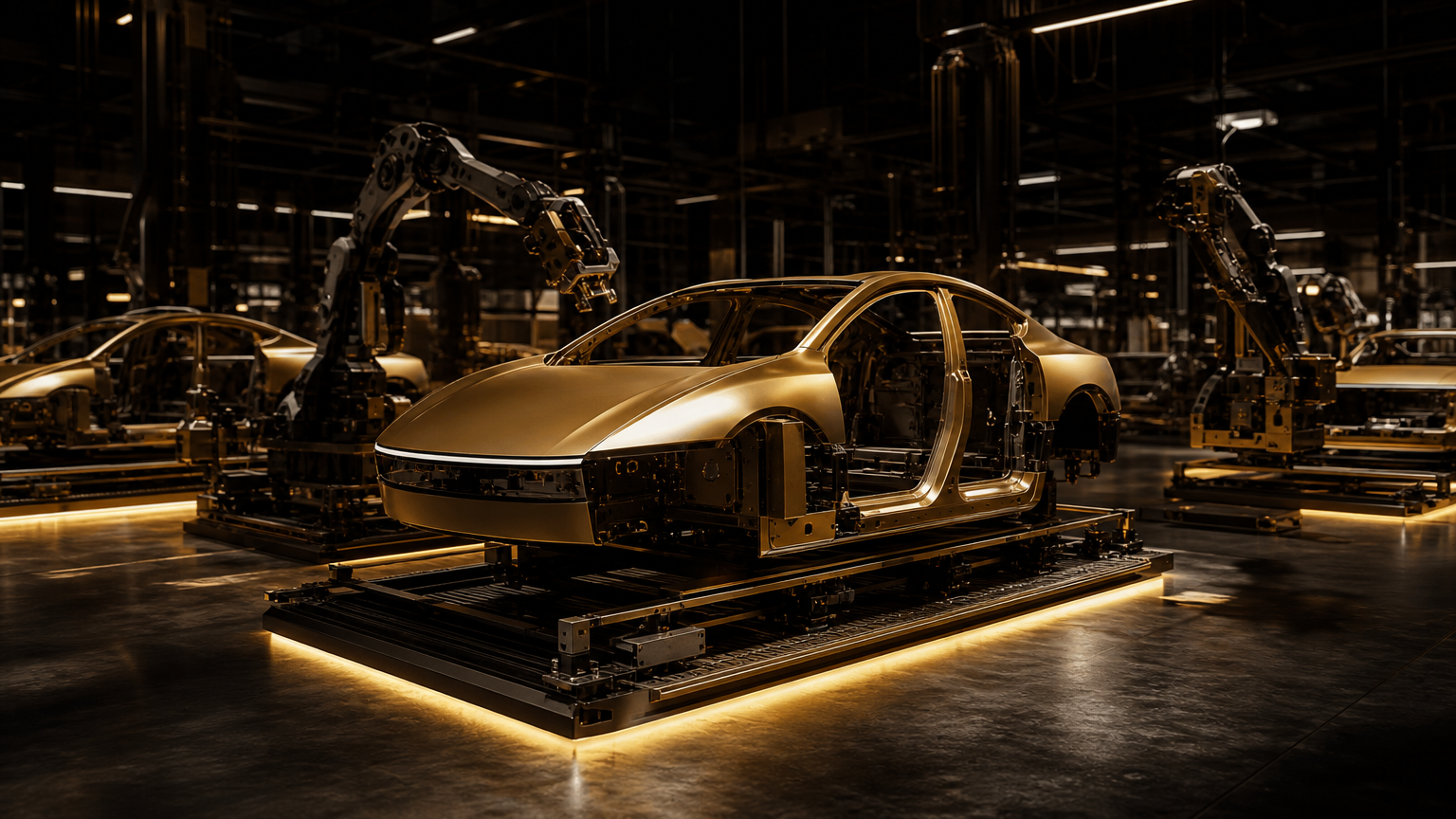
The headline is really about the factory
The working headline matches the story: NEW GIGA Press Makes Cybercab Production 7X Faster! Welding Deleted! The core claim is not simply that Tesla has installed a bigger casting machine. It is that the Cybercab is becoming the clearest test of Tesla’s attempt to delete whole categories of conventional vehicle assembly: sequential body travel, repeated weld stations, late cabin installation, paint-shop dependency and the downtime created when one bottleneck controls the whole line .
The fresh 8news briefing published on September 8 frames the manufacturing target plainly: Tesla is positioning Cybercab as a test case for a modular “unboxed” factory system intended to cut a key production cycle from about 34 seconds for Model Y to below 10 seconds, with a long-term target around five seconds . The same briefing calculates why the “7X” shorthand matters: five seconds versus 34 seconds implies about 6.8 times faster at that measured production flow, while 10 seconds would still represent a major step-change rather than a normal line-speed improvement .
That distinction is important. A five-second number does not mean a complete factory instantly ships 720 finished cars every hour. It describes a target cycle at a specific flow or station, while real plant output still depends on casting yield, battery supply, quality checks, logistics, software validation and ramp discipline . In other words, the Cybercab manufacturing story is about architecture before arithmetic.
From assembly line to parallel modules
The conventional car factory is linear. A body-in-white moves through stations, parts arrive in sequence, and work is often constrained by what has already been attached. Tesla’s “unboxed” approach changes the order of operations by building large vehicle sections separately and joining them late in the process .
Recent launch coverage points in the same direction. Drive Tesla reported that Tesla showed Cybercab’s unboxed manufacturing process at the Austin launch, describing a system that assembles separate vehicle modules rather than moving a completed body through a traditional production line . Not a Tesla App’s September 7 technical write-up similarly describes the Cybercab as part of an ultra-lean unboxed manufacturing strategy, pairing the vehicle’s purpose-built autonomy with a highly simplified production package .
The significance is practical. If a front casting, cabin tray, body panel set and interior module can be built and inspected in parallel, the factory stops waiting for a single shell to arrive before the next large task can begin. More work happens outside the cramped body structure. Fewer robots have to reach into confined spaces. More subassemblies can be validated before final marriage. That is where the “welding deleted” phrase gets its force: not every joint disappears, but the number of separate stamped pieces, joining operations and dedicated weld cells can fall dramatically when larger castings and modular assembly replace a traditional body shop .
The Giga Press is only one part of the system
The subject title puts the Giga Press at the center, and for good reason: Tesla’s manufacturing identity has become tied to very large castings. But the current Cybercab evidence suggests the press is not a standalone miracle. It is one node in a larger industrial stack that also includes molding, automated material flow, module-level validation, software-controlled production monitoring and late-stage joining .
That is why the Cybercab matters more than a normal model launch. The vehicle is simplified by design: two seats, no steering wheel, no pedals and a robotaxi mission that rewards low operating cost over consumer feature complexity . Bloomberg reporting republished by Claims Journal on September 8 notes that the two-seat Cybercab lacks traditional driver controls and that Tesla has begun rolling it into public robotaxi service in Austin, while regulators examine how the vehicle was self-certified under federal safety rules . Those vehicle choices are not separate from manufacturing. Fewer controls, fewer customer variants and a purpose-built fleet role all make the production target more plausible.
The hardware simplification goes deeper. Not a Tesla App reported that the Cybercab’s Supermanifold V3 consolidates controllers and reduces valves and plumbing, while the drive unit can be assembled in under ten seconds and is smaller and lighter than competing EV drive units, according to the engineering details it reviewed . That is exactly the kind of component-level compression an unboxed factory needs. A fast final line cannot compensate for slow, complex subcomponents; the modules themselves must be engineered for speed.
Why “welding deleted” changes the cost equation
Welding is not just a process. It is factory space, tooling, robots, fixtures, inspection routines, rework loops and tolerance management. Reducing weld count can therefore reduce more than cycle time. It can shrink the line, lower capital intensity and simplify quality control.
The September 8 8news briefing says Tesla’s Cybercab manufacturing language points toward modular parallel unboxed flows, cycle-time optimization, overall equipment effectiveness, material flow and line configuration for both people and automation . That reads less like a faster version of the old assembly line and more like a new layout built around bottleneck removal. If the body structure arrives as fewer large parts, the plant can avoid many of the incremental operations that make traditional body shops long and expensive.
This is also where reaction-injection-molded exterior panels and reduced paint dependence become relevant. Drive Tesla’s launch report said Tesla discussed injection-molded exterior panels and recycled materials, a shift that can reduce reliance on a conventional paint shop . Paint shops are among the most expensive and space-intensive parts of vehicle manufacturing. If Cybercab’s outer skin reduces painting complexity, the “deleted” processes extend beyond welding into the broader factory footprint.
Current reality: launch hype meets ramp math
The current state is both impressive and unresolved. MotorTrend’s September 8 first-ride report, carried by Yahoo Autos, says Austin is presently the only city where Cybercab rides are available to the general public, and that its test team used the Tesla Robotaxi app to hail five rides inside the operating domain . Tesla Oracle reported on September 7 that early demand has pushed Cybercab wait times to around one hour in some app comparisons and, in some cases, made Cybercab fares higher than both Uber and Tesla’s Model Y Robotaxi .
That matters for manufacturing because demand is the pressure that tests the factory thesis. A robotaxi can be elegant, efficient and low-cost on paper, but the business only works if Tesla can deploy enough units to keep wait times down and utilization high. If the unboxed system really can move a key production flow from 34 seconds toward five seconds, it gives Tesla a path to flood dense service areas with purpose-built vehicles instead of adapting consumer Model Ys one fleet batch at a time .
But the ramp cannot be assumed. Bloomberg’s September 8 report notes that Wall Street found the Austin rollout light on details and that the National Highway Traffic Safety Administration opened an audit query into the process and technical data behind Tesla’s self-certification of the Cybercab . Regulatory scrutiny does not directly disprove the manufacturing plan, but it can affect how fast finished vehicles can enter commercial service.
The real breakthrough is line architecture
The Cybercab production story should therefore be read carefully. The “new Giga Press” is not just a bigger machine stamping out a faster car. It is shorthand for Tesla’s larger attempt to make the factory behave like a coordinated product: cast large structures, build modules in parallel, validate them early, join them late and remove operations that do not support robotaxi-scale economics.
If Tesla reaches the sub-10-second target, it would already be a major manufacturing achievement. If it reaches the five-second ambition, the “7X faster” headline becomes a fair description of a specific cycle-time gain rather than a loose exaggeration . The open question is whether Tesla can convert that local speed into system-wide throughput under the real constraints of quality, regulation, fleet service and battery supply.
For now, Cybercab is the vehicle where Tesla’s manufacturing philosophy is most visible. The robotaxi gets the attention because it has no steering wheel. The factory may matter more because it tries to remove something even older: the assumption that every car must be built one boxed shell at a time.
Sources from the last 72 hours
- [1]NEW GIGA Press Makes Cybercab Production 7X Faster! Welding Deleted! · Tesla · 8news.aiSep 8, 2026, 11:30 AM UTC
- [2]Tesla Cybercab Specs: Supermanifold V3, No Rare Earth Magnets & More - Not a Tesla AppSep 7, 2026, 12:00 AM UTC
- [3]Tesla Reveals New Cybercab Details As It Officially Joins Robotaxi Fleet at 5pm Tonight - Drive TeslaSep 6, 2026, 12:00 AM UTC
- [4]Tesla’s Rollout of Cybercab Is Marred by Regulatory ProbeSep 8, 2026, 12:00 AM UTC
- [5]Tesla Cybercab First Ride: What It’s Really Like to Use Tesla’s New Autonomous TaxiSep 8, 2026, 3:18 PM UTC
- [6]High demand for Tesla Cybercab makes it more expensive than Uber and the Model Y Robotaxi - Tesla OracleSep 7, 2026, 12:00 AM UTC
AI-generated article based on recent web research, then preserved as a dated editorial snapshot.
Comments
Be the first to comment.