
Daily Podcast full article
Tesla Bot Gen 3 Massive Upgrade Revealed at Cybercab Event!
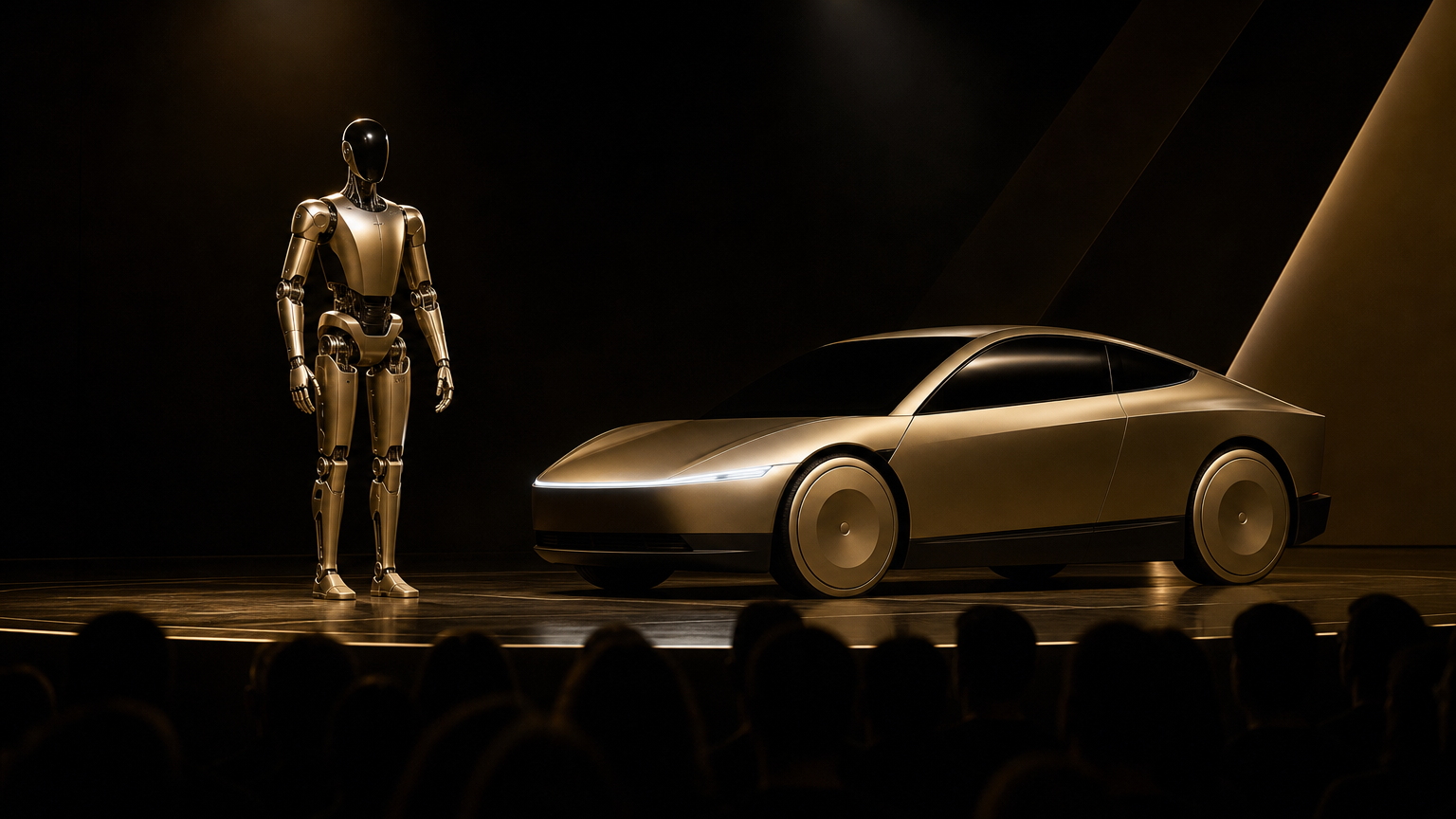
A gold-toned Optimus quietly appearing around Tesla’s Cybercab launch in Austin may have said more than the formal presentation did: Tesla is increasingly framing robotaxis and humanoid robots as one physical-AI system, even as the company has not yet confirmed a full public Gen 3 specification sheet.
The headline matches the signal
Tesla’s Cybercab event in Austin was officially about a two-seat autonomous vehicle, not a humanoid robot. But the most revealing detail for Optimus watchers was the quiet appearance of Tesla’s humanoid robot at the launch, documented by attendee-sourced material and later summarized by BASENOR as a Cybercab-event Optimus appearance rather than a standalone product unveiling . That distinction matters. The event did not deliver a formal Gen 3 keynote, a full engineering teardown, or a new production-price announcement for Tesla Bot. Instead, it placed Optimus inside the same visual and strategic frame as Cybercab, turning a background display into a message about Tesla’s next platform.
The working story, therefore, is not that Tesla suddenly published every Gen 3 specification. It is that the company allowed Optimus to be seen beside the Cybercab program at the moment Cybercab moved from presentation to operational ride-hailing context in Austin [5]. In product terms, that is subtle. In corporate-strategy terms, it is loud.
A robot beside a robotaxi is not decoration
BASENOR’s fresh Cybercab-event report says Optimus was “on the scene” at Tesla’s September 3 launch and notes that the appearance did not dominate official headlines . That is precisely why the placement drew attention. Tesla did not need Optimus there to explain the Cybercab’s doors, passenger screen, route flow, or ride-hailing process. Its presence instead suggested a single thesis: the same company trying to remove the driver from urban mobility is also trying to build a general-purpose machine for human workspaces.
This is where the “Gen 3 massive upgrade” framing becomes less about a single visible component and more about convergence. A humanoid robot needs perception, planning, manipulation, balance, power management, thermal discipline, training data, manufacturing scale and safe real-world behavior. A robotaxi needs perception, planning, energy efficiency, fault tolerance, high-volume manufacturing and public trust. Those lists are not identical, but they overlap enough that Tesla appears to be treating Cybercab and Optimus as related embodiments of one AI-and-manufacturing stack [4].
What Tesla actually showed at Cybercab
The Cybercab event itself remained focused on the autonomous vehicle. Not a Tesla App reported that Tesla did not provide a public livestream, that Elon Musk was not present, and that the roughly 15-minute presentation was handled by engineering leadership including Tesla’s VP of AI, Ashok Elluswamy . The same report said the showcase centered on Cybercab hardware displays, including an integrated Starlink V5 terminal, a Supermanifold v3 thermal system, the drive unit, unboxed assembly elements and a more capable FSD computer whose exact specifications were still unconfirmed .
That matters for Optimus because the event’s explicit hardware story was about packaging autonomy into a product designed for repeatable service. The company was not merely showing a concept car. Tesla’s official Cybercab Rider Guide, published September 4, describes Robotaxi as a ride-hailing service using Tesla Full Self-Driving technology and says riders request driverless rides through the Robotaxi app, enter a destination in the displayed service area and use app cues to identify the arriving vehicle . In other words, the Cybercab context was operational, not purely theatrical.
Against that backdrop, Optimus served as the second body in Tesla’s physical-AI argument. Cybercab is AI moving people through roads. Optimus is AI intended to move through human environments. If Cybercab is the transportation proof point, Optimus is the labor proof point.
The AI hardware clue: AI5 shifts toward Optimus
The strongest current evidence for Tesla’s deeper linkage between autonomy and robotics came not from the robot’s pose at the event, but from Tesla’s AI hardware roadmap. Drive Tesla reported on September 4 that Elon Musk described an upgraded AI4.1 or AI4+ computer for vehicle autonomy while reaffirming that AI5 would not go into cars immediately [4]. According to that report, Musk said he expected AI5 to be used for Optimus and data-center applications, while Tesla works toward unsupervised self-driving using AI4-derived hardware [4].
That is a crucial clue. If AI5 is being aimed first at Optimus and data-center uses, Tesla’s humanoid robot program is not a side experiment waiting behind the car business. It is one of the first claimed destinations for the company’s next major AI silicon generation [4]. For a potential Gen 3 upgrade, this points to the most important “massive” improvement being invisible: more compute headroom, more efficient inference, tighter integration between the robot body and Tesla’s training infrastructure, and a design path aimed at production rather than stage demos.
It also reframes Cybercab. If Cybercab can scale on AI4+ while Optimus becomes an AI5 priority, then the Cybercab event may have been less about one product replacing another and more about Tesla dividing the roadmap: vehicles get the autonomy computer they need now; humanoids get the next compute leap.
Why the gold-toned display resonated
The event’s aesthetic also mattered. Current reporting described the Cybercab as a gold-painted or gold-toned two-seater with gull-wing-style doors and no conventional human controls [5]. Tesla’s own Rider Guide presents Cybercab as a driverless ride-hailing vehicle and explains passenger-facing details such as app-based pickup, license-plate matching and exterior lighting cues . In that visual language, the gold-toned Optimus appearance read like a companion object rather than a random prop.
For Tesla, design often functions as strategy. The gold Cybercab says autonomy is no longer hidden inside a Model Y; it has its own body. A displayed Optimus beside that launch says humanoid robotics is also expected to have its own body, its own production system and eventually its own operating model. The upgrade is not merely a sleeker shell. It is the implication that Tesla wants cars and robots to be manufactured, trained and improved as parallel fleets.
The caution: no confirmed Gen 3 spec sheet yet
A senior reading of the event has to separate signal from proof. MarketWise, in a September 4 analysis of Tesla, Cybercab, Grok and Optimus, cautioned that Tesla has not officially revealed the Gen 3 robot and that external Optimus sales are not expected immediately [6]. That caveat is important because the Cybercab event created strong imagery but not a complete Optimus launch document.
So the correct conclusion is not “Gen 3 is now fully disclosed.” The correct conclusion is that Tesla used the Cybercab moment to reinforce Optimus as part of the same physical-AI future. The robot’s appearance supports the strategy; it does not, by itself, confirm actuator specs, hand degrees of freedom, battery capacity, production cost, safety certifications or delivery dates.
Why investors and engineers are watching the same thing
For investors, the key question is whether Tesla can turn two capital-intensive bets into one scalable platform. Axios reported that Cybercab’s Austin availability began with an invite-only event and a limited initial fleet, while noting the vehicle’s lack of steering wheel, pedals and mirrors [5]. Axios’s local Austin report the same day said federal safety scrutiny arrived quickly, with the National Highway Traffic Safety Administration evaluating the effort and Austin having logged incidents or complaints involving Tesla autonomous vehicles since prior testing began [7]. That regulatory context matters for Optimus as well, because physical AI becomes valuable only when it can operate safely outside demos.
For engineers, the key question is whether Tesla’s shared-stack theory works. Can vision-heavy autonomy, fleet learning, custom silicon and factory automation transfer from roads to warehouses, homes and factories? Optimus at the Cybercab event did not answer that question. It sharpened it.
The real upgrade is strategic
The most credible reading of “Tesla Bot Gen 3 Massive Upgrade Revealed at Cybercab Event” is that the upgrade revealed so far is strategic architecture, not a published spec table. Tesla put a humanoid robot into the orbit of its purpose-built robotaxi launch . It showed Cybercab as an app-based driverless ride product . It let engineering leadership explain Cybercab hardware and autonomy packaging . And, in parallel, Musk’s reported AI roadmap placed AI5 first around Optimus and data-center uses rather than immediate vehicle deployment [4].
That combination points to a broader strategy: Tesla is building toward mass-scale physical AI, with Cybercab as the road embodiment and Optimus as the human-space embodiment. The gold-toned Optimus did not need a long speech. Its placement beside Cybercab made the argument visually: Tesla wants the same AI foundations to perceive, decide and act in two of the largest physical markets on earth, transportation and labor.
Sources from the last 72 hours
- [1]Optimus Shows Up at Tesla's Cybercab Launch EventSep 6, 2026, 12:00 AM UTC
- [2]Tesla's Cybercab now available for ride-hailingSep 4, 2026, 9:00 AM UTC
- [3]Feds probe Tesla's Cybercabs; Texas takes back seatSep 4, 2026, 10:16 PM UTC
AI-generated article based on recent web research, then preserved as a dated editorial snapshot.
Comments
Be the first to comment.