
Daily Podcast full article
SpaceX adds 27 Starlinks as Falcon 9 keeps the constellation machine moving
SpaceX’s latest California Starlink launch was not just another broadband deployment: the Falcon 9 flight, booster landing and on-schedule satellite release show how reusable launch cadence is becoming the infrastructure behind a much larger orbital strategy.
The launch: 27 more satellites from California
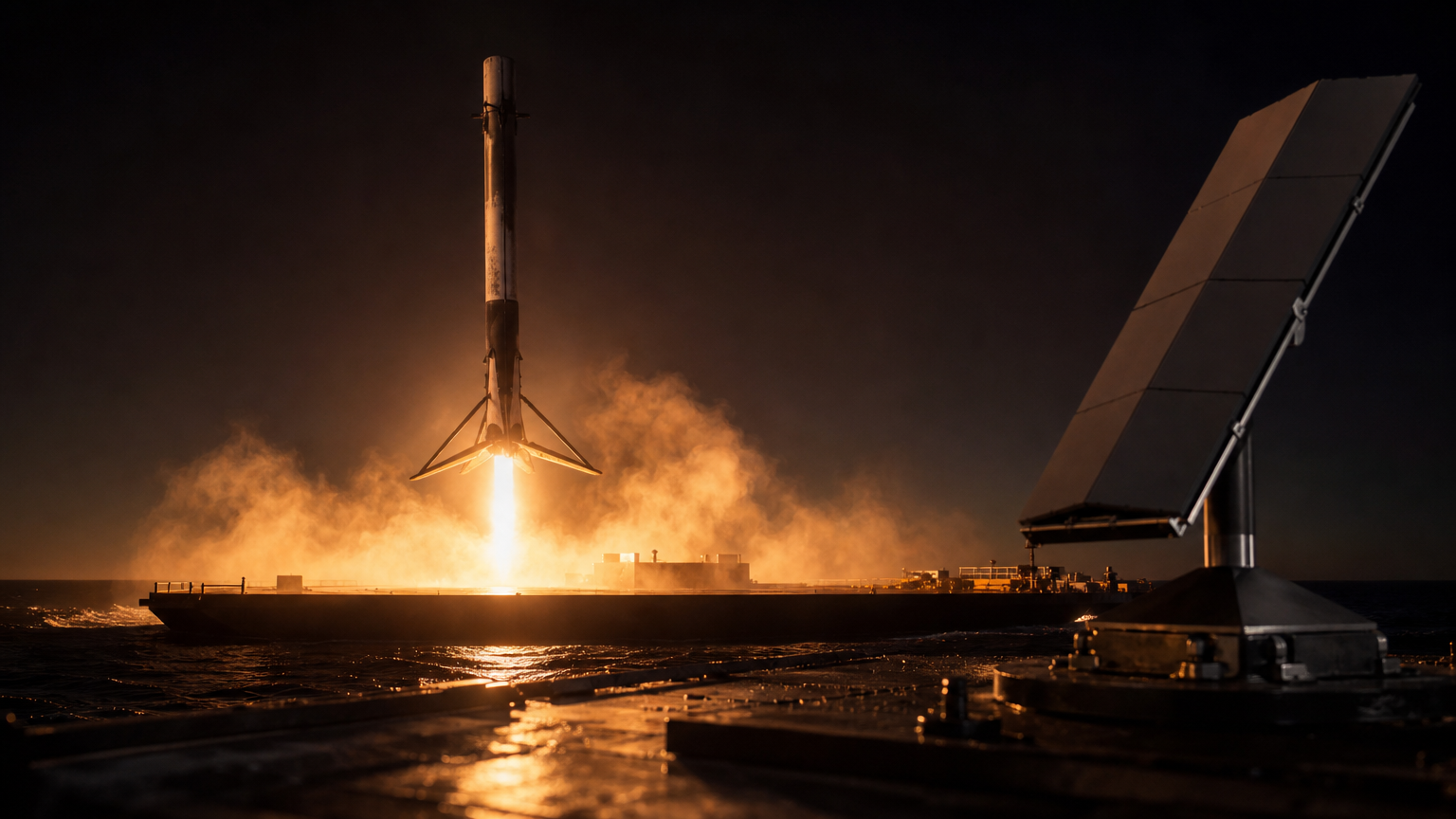
SpaceX added another 27 Starlink satellites to orbit on September 6, sending them up on a Falcon 9 from Space Launch Complex 4E at Vandenberg Space Force Base in California . The rocket lifted off at 10:26 a.m. EDT, or 1426 GMT, and carried the satellites toward low Earth orbit as part of the Starlink Group 15-24 mission . Independent launch tracking also recorded liftoff at 14:26:54 UTC from Vandenberg and classified the flight as successful .
The mission followed the now familiar Starlink pattern: a Falcon 9 first stage did the heavy work through ascent, separated, then returned to land at sea while the upper stage continued toward deployment . About eight and a half minutes after liftoff, the booster landed on the droneship Of Course I Still Love You in the Pacific Ocean . The upper stage then released the 27 satellites on schedule about 62 minutes after launch .
That sequence is routine only because SpaceX has made it routine. The booster used for the flight was B1088, flying for the 19th time . Everything Space’s flight record likewise identifies B1088 as the first stage and says it landed on Of Course I Still Love You, 574 kilometers downrange . The key point is not the number 27 by itself; it is that the same reusable transportation system keeps putting batches of network hardware into orbit with little operational drama.
Why a single Starlink batch still matters
One Starlink launch does not transform global connectivity overnight. But Starlink is not built through isolated spectacular missions. It is built by accumulation: dozens of satellites at a time, launched often enough that each deployment becomes a small but measurable addition to coverage, capacity and network resilience.
Space.com reported that this was the 103rd Falcon 9 launch of 2026, and that 80 of those Falcon 9 flights had been dedicated to building out the Starlink megaconstellation . The same report said Starlink currently consists of more than 11,000 active spacecraft, citing satellite tracker Jonathan McDowell . Against that backdrop, 27 spacecraft are a modest increment. Yet the logic of the system is incremental by design.
For users, more satellites can mean denser coverage, more aggregate throughput and greater ability to serve demand in crowded cells. For SpaceX, each mission also validates the factory-to-pad-to-orbit pipeline: satellite manufacturing, range scheduling, booster refurbishment, maritime recovery, upper-stage deployment and post-launch network integration. If any link in that chain slows, Starlink’s expansion slows with it.
TrackStarlink described Group 15-24 as adding 27 satellites to SpaceX’s broadband constellation from Space Launch Complex 4E at Vandenberg . That phrasing captures the operational essence of the mission. SpaceX is not launching one flagship satellite with a long independent story; it is feeding a distributed communications platform whose value depends on scale.
Reuse is the hidden center of the story
The booster landing is more than a visually satisfying ending to the webcast. It is the economic mechanism behind the cadence. A Falcon 9 first stage that can fly 19 times, land, be inspected and return to the manifest changes the meaning of launch frequency. It turns rockets from bespoke hardware into repeatable logistics assets.
B1088’s 19th flight is also a reminder that SpaceX’s Starlink program and its reuse program are now deeply coupled . Starlink gives Falcon 9 a steady internal customer. Falcon 9 gives Starlink a predictable ride to orbit. The droneship landing closes the loop by preserving the most expensive part of the rocket for another mission.
That loop is why the phrase “another Starlink launch” can be misleading. The repetition is the accomplishment. A network this large is not maintained by occasional breakthroughs; it is maintained by industrial tempo. The September 6 launch shows SpaceX continuing to operate Falcon 9 as a conveyor belt for orbital infrastructure rather than as a vehicle reserved for rare national or scientific payloads.
The flight also took place in a changing Starlink launch environment. Space.com reported that Starlink missions now fly exclusively out of Vandenberg, while launches from Florida have been put on hold until SpaceX gets Starship operating on the Space Coast . That makes the California pad even more central to the current Starlink deployment rhythm.
The bigger ambition: from internet constellation to orbital compute
The 27-satellite deployment also lands inside a larger strategic conversation around what Starlink could become. A September 6 report from The News International said SpaceX has outlined plans for up to one million low Earth orbit satellites functioning as orbital data centers, an effort framed as a way to work around terrestrial power and land constraints . That concept pushes the Starlink logic far beyond broadband: satellites would not merely route data, but host compute.
The bridge between today’s Starlink and a future orbital data-center network is not imaginary. Both depend on mass satellite production, low-cost launch, optical links, power management and autonomous fleet operations. Starlink is the proof-of-rhythm system. If SpaceX can repeatedly launch, land, deploy and manage thousands of satellites, it gains experience relevant to any larger distributed orbital infrastructure.
Still, the scale of “up to one million” satellites is in another category entirely . The September 6 Starlink launch added 27 spacecraft; at that rate, reaching one million would require a volume of launches, production and orbital traffic management far beyond today’s already aggressive tempo. The comparison is useful precisely because it shows the gap between present capability and future ambition.
That gap is likely why Starship remains so important to SpaceX’s plans. Space.com reported that SpaceX expects to rely on Starship to launch next-generation Starlink V3 satellites, which are larger and more capable than the current V2 spacecraft . Falcon 9 can keep adding capacity now. Starship is intended to change the batch size and economics for what comes next.
The risks of normalizing scale
The operational success of Group 15-24 should not obscure the policy and environmental questions raised by massive satellite fleets. Every successful launch adds useful capacity, but also adds objects that must be tracked, maneuvered, deorbited and coordinated with other operators. Starlink’s present size already makes it the largest satellite network ever assembled . A future architecture involving hundreds of thousands or even one million satellites would multiply the importance of orbital traffic rules, debris mitigation and astronomy impacts.
That does not make the September 6 mission controversial on its own. It does make it part of a much larger debate about how much infrastructure low Earth orbit can responsibly absorb. SpaceX’s argument is operational: reusable rockets and mass-produced satellites can make space infrastructure more capable, cheaper and more responsive. Critics and regulators will focus on the cumulative effects: congestion, collision risk, brightness, spectrum use and the long-term governance of shared orbital shells.
The mission therefore matters in two ways. In the narrow sense, SpaceX successfully launched 27 Starlink satellites and recovered the booster at sea . In the broader sense, it demonstrated the launch cadence required for any company trying to treat low Earth orbit as infrastructure rather than destination.
What comes next
The immediate outcome is straightforward: 27 more Starlink satellites are in orbit, and Falcon 9 booster B1088 is back from its 19th mission . The strategic outcome is more interesting. SpaceX continues to show that it can add capacity through repetition, not just invention.
That is the real story behind “SpaceX adds 27 Starlinks.” The launch was a small increment in a giant constellation, but it was also another data point in SpaceX’s central thesis: if satellites can be manufactured in volume, launched frequently and supported by reusable rockets, orbit becomes a platform. Today that platform is broadband. Tomorrow, if Musk’s far larger data-center ambitions survive the technical, regulatory and economic tests, it could also become a place where computation itself moves off Earth .
Sources from the last 72 hours
- [1]SpaceX Falcon 9 rocket launches 27 Starlink satellites, lands on ship at sea (video)Sep 6, 2026, 12:00 AM UTC
- [2]Falcon 9 launches Starlink Group 15-24 from Vandenberg SFBSep 6, 2026, 12:00 AM UTC
- [3]Starlink Group 15-24 — Launch DetailsSep 6, 2026, 12:00 AM UTC
- [4]Elon Musk, SpaceX eyes 1 million satellites for orbital data centersSep 6, 2026, 12:00 AM UTC
AI-generated article based on recent web research, then preserved as a dated editorial snapshot.
Comments
Be the first to comment.