
Daily Podcast full article
Google backs impossible fusion
Google’s name on a €411 million Proxima Fusion financing round has turned a difficult stellarator project into a larger signal about AI infrastructure: hyperscalers are treating long-duration, carbon-free power as a strategic asset, even when the reactor design is still far from commercial proof.
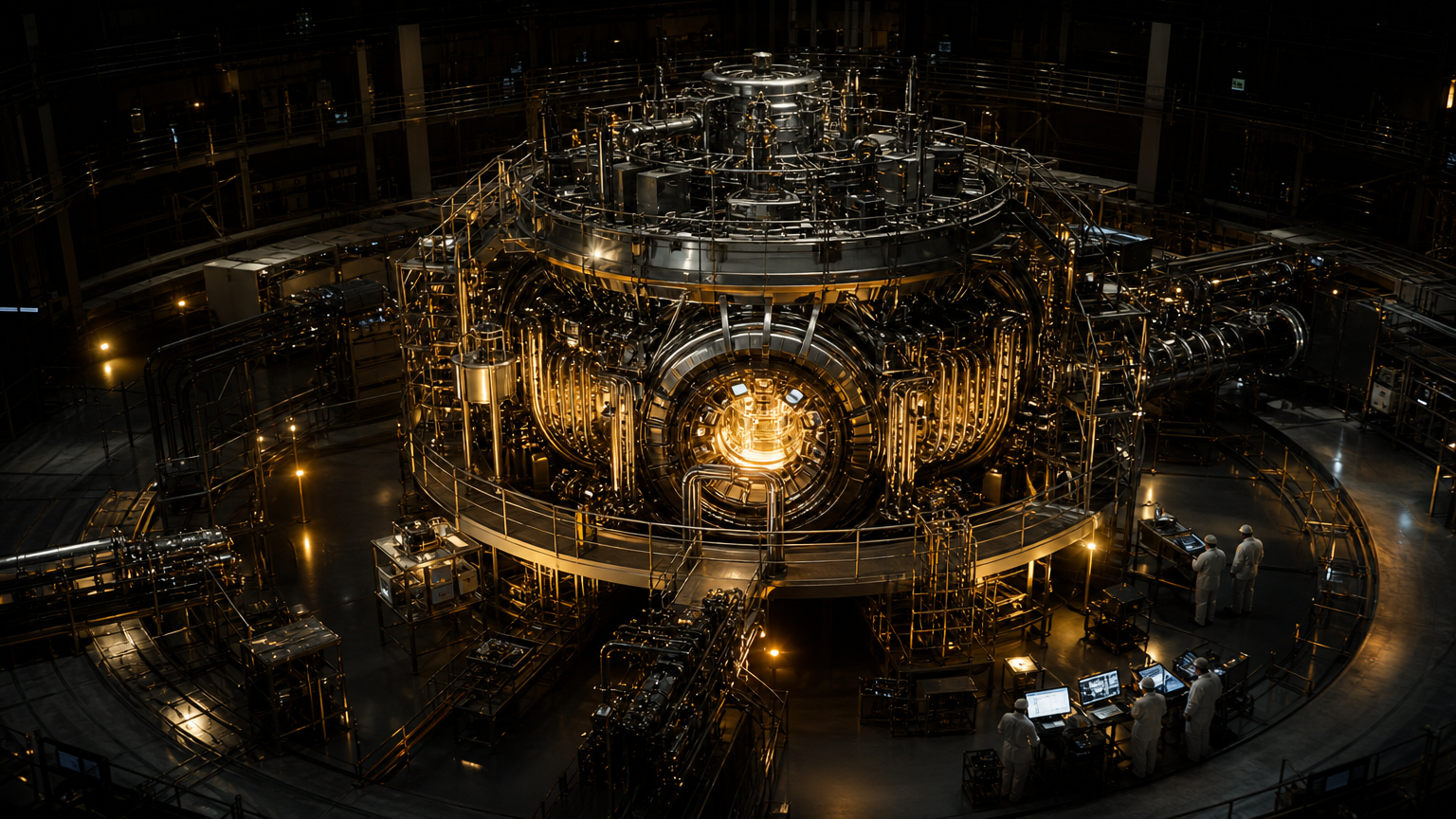
The story: a moonshot energy cheque tied to AI’s power problem
Google’s latest fusion headline is not about a reactor suddenly producing commercial electricity. It is about a €411 million financing round for Munich-based Proxima Fusion, a company pursuing a stellarator design that recent coverage described as an “impossible” reactor because of its twisted, highly complex geometry . The round includes Google and German utility RWE as strategic investors, and current reporting says it values Proxima at about €2.4 billion, or roughly $2.7 billion .
That distinction matters. Fusion has not crossed from laboratory promise into dependable grid supply, and Proxima’s project remains a high-risk engineering programme rather than a power plant. But Google’s participation shows why fusion is no longer just a science story. For companies building AI data centres, energy is becoming part of the core stack: chips, networks, land, cooling, and now long-term access to firm low-carbon electricity.
The “impossible” label comes from the stellarator itself. Unlike the better-known tokamak, a stellarator twists its magnetic field into an intricate three-dimensional path, aiming to hold ultra-hot plasma steady without relying on the same pulsed plasma current used in tokamaks . The design was long treated as too hard to build at useful scale, not because the physics was fantasy, but because the calculation, manufacturing and magnet challenges were brutal .
What Google is really buying
Google is not buying electricity from Proxima tomorrow. It is buying optionality. The company’s participation in the round sits beside a broader pattern in which technology firms are looking beyond standard renewable power purchase agreements toward firm clean power that could operate around the clock . Reporting on the Proxima round says Google’s interest reflects expectations that fusion could one day provide abundant, carbon-free baseload energy, while also stressing that commercialisation is difficult and not guaranteed .
That is the sober reading. The strategic case is straightforward: AI workloads require dense, reliable power. Wind and solar can be cheap and clean, but they are variable. Batteries help, but only up to a point. Nuclear fission, geothermal, long-duration storage and fusion all answer the same infrastructure question in different ways: how can a data-centre operator secure clean electricity when compute demand keeps rising?
Fusion is the riskiest option in that set, but also the most asymmetric. If it works commercially, it could provide high-output, low-carbon power with a fuel cycle very different from fossil fuels or fission. Current coverage explains fusion as the process of combining light atoms, typically hydrogen isotopes, to release energy, while noting that no commercial fusion power plant is operating today .
Why Proxima’s stellarator is the centre of the bet
Proxima’s plan is built around a stellarator rather than a tokamak. Current reports describe the company as a spin-out from Germany’s Max Planck Institute for Plasma Physics and say it is building on decades of European stellarator research . The company’s roadmap points first to a full-scale stellarator model coil, then to “Alpha,” a demonstration machine intended to show net energy in the early 2030s, before a commercial plant concept called “Stellaris” later in the decade .
The technical promise is continuity. Tokamaks dominate fusion research, but their reliance on induced plasma current creates operational complexity and can make steady, always-on power harder to achieve. Stellarators are designed to produce the confining magnetic geometry through external coils, which could make them better suited to continuous operation if the engineering works .
The problem is that the coils are not simple rings. They are elaborate, contoured components that must be manufactured with extreme precision while carrying intense magnetic loads. Recent coverage says Proxima intends to use the new funds to expand high-temperature superconducting cable and magnet production and to develop the engineering and manufacturing systems required for stellarators . That means the investment is as much about industrialisation as plasma physics.
Why the amount matters
The €411 million figure is important because it pushes fusion from grant-funded speculation toward infrastructure-scale venture finance. Current reporting calls Proxima the best-funded fusion company in Europe and says the round was led by XTX Ventures and East X Ventures, with Google and RWE joining strategically . In other words, the capital stack now includes financial investors, a hyperscaler and a utility.
That mix is significant. Google brings a future power-user’s perspective. RWE brings grid, generation and site experience. Venture investors bring the appetite for a large, risky payoff. Proxima’s challenge is to convert that alignment into hardware: magnets, coils, shielding, heat extraction, tritium systems, remote maintenance and eventually licensing.
The size of the commitment also reflects the rising cost of the AI era. Google’s AI systems need increasingly large compute clusters, and every new cluster forces a physical question: where will the electricity come from? The answer cannot rely only on symbolic offsets or incremental contracts. For hyperscalers, power procurement is becoming a competitive constraint. A company that cannot secure enough clean firm power may struggle to place future data-centre capacity where customers need it.
The current state: excitement, but no shortcut
The current state of the story is therefore both bold and cautious. Google-backed money has lifted Proxima’s profile, given Europe a more visible private fusion champion, and attached the “impossible reactor” phrase to a real industrial programme . But nothing in the recent coverage means Proxima has solved commercial fusion. Its next steps are demonstrations, not deployment.
The roadmap is aggressive. Reports say Proxima is targeting an early-2030s demonstration plant and a commercial facility later in the same decade . MotorBiscuit’s latest article says Alpha is intended to be the last test machine before Stellaris, and that Proxima and RWE plan to use the former Gundremmingen nuclear site in Bavaria for the first pilot power plant .
Those dates should be read as targets, not guarantees. Fusion history is full of timelines that stretched. Even if plasma performance is achieved, a power plant must still turn heat into electricity, withstand neutron bombardment, handle fuel breeding and maintenance, and compete economically with other clean energy sources. Google’s involvement does not remove those hurdles. It simply suggests the potential prize is large enough for Big Tech to underwrite part of the risk.
Why this is an infrastructure story, not philanthropy
The most important takeaway is that Google’s fusion backing belongs in the same category as data-centre campuses, subsea cables, custom AI chips and long-term power contracts. It is infrastructure strategy. Clean energy used to be framed mainly as a corporate sustainability pledge. In the AI build-out, it is becoming a capacity requirement.
That is why the “impossible” reactor line resonates. Hyperscalers are not funding exotic energy systems because they enjoy science fiction. They are trying to solve a practical bottleneck: AI growth may demand more electricity, for longer periods, in more concentrated locations, than traditional grid procurement can comfortably deliver. Fusion may fail to arrive on Proxima’s schedule. But Google’s presence in the round shows that the search for post-crunch power has already begun.
If Proxima succeeds, Google’s bet will look early. If it misses, the investment will still mark a shift in how technology companies think about energy: not as an external utility bill, but as a strategic input to compute itself .
Sources from the last 72 hours
- [1]Google Just Dropped €411 Million on a Fusion Reactor Deemed “Impossible” to BuildSep 6, 2026, 6:00 PM UTC
- [2]Google Just Dropped €411 Million on a Fusion Reactor Deemed “Impossible” to BuildSep 6, 2026, 1:00 PM UTC
- [3]Our Neighborhood Earth - Nuclear PowerSep 6, 2026, 12:00 AM UTC
AI-generated article based on recent web research, then preserved as a dated editorial snapshot.
Comments
Be the first to comment.