
Daily Podcast full article
The Truth About Tesla’s Cybercab Launch
Tesla’s Cybercab launch in Austin is real, but it is not the instant nationwide robotaxi revolution some supporters imagined. The current story is narrower and more consequential: Tesla has put a purpose-built, two-seat, steering-wheel-free robotaxi into limited service while betting that low operating cost, a new manufacturing system and regulatory tolerance can let it scale faster than rivals.
What actually launched in Austin
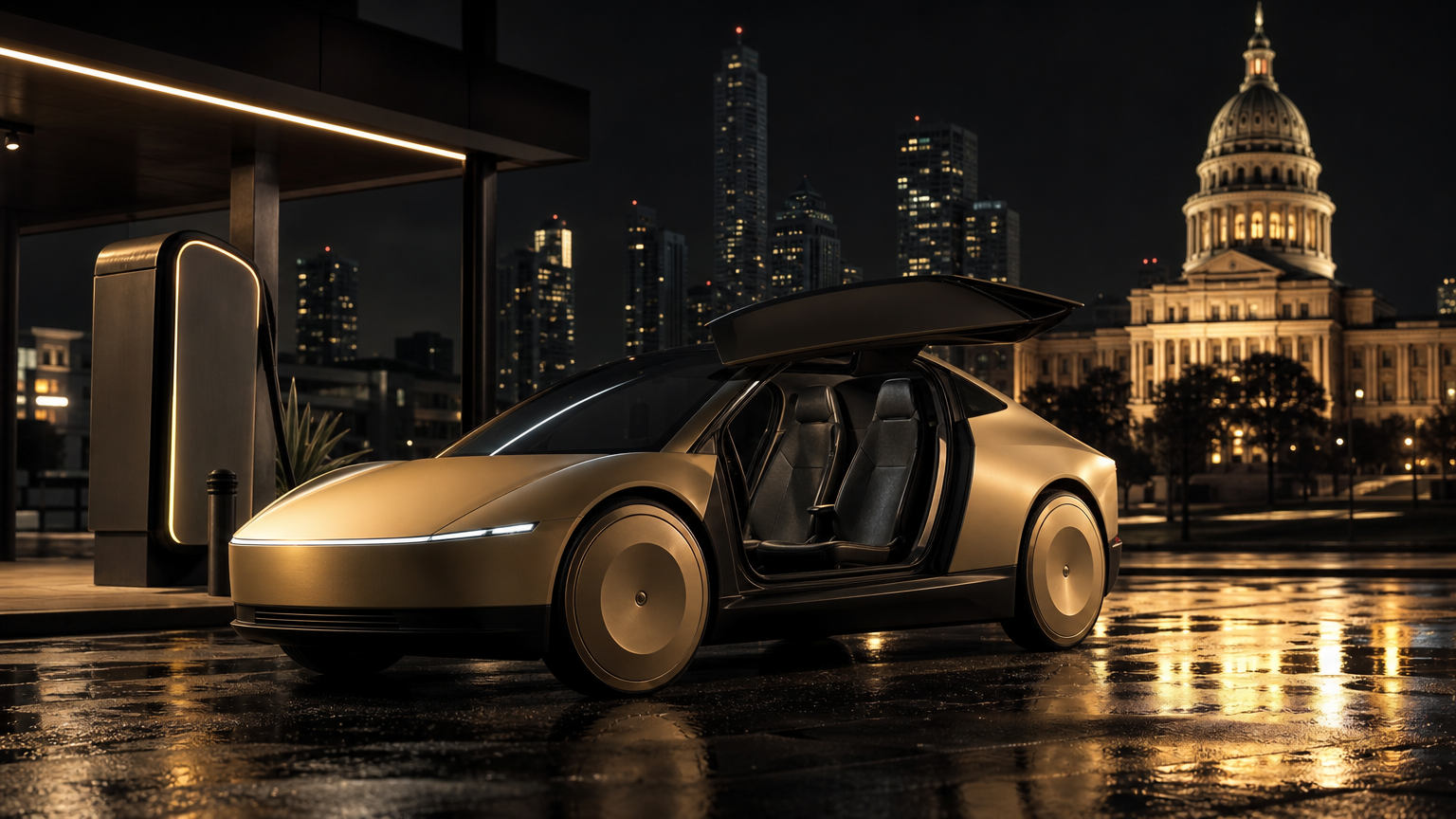
Tesla’s Cybercab launch is best understood as the start of a controlled commercial deployment, not a mass-market car release. The vehicle has begun operations in Austin, Texas, as a two-seat robotaxi with no steering wheel, no pedals and no conventional rearview mirrors . Associated Press reporting from Austin described dozens of gold-colored Cybercabs appearing on city streets on Thursday, September 3, and noted that the vehicle gives passengers no manual way to take over in an emergency .
That distinction matters. Tesla is not simply adding another Model Y to its robotaxi fleet. Cybercab is the first Tesla vehicle built around the premise that the human driver is never part of the design. CnEVPost reported that the cabin contains two passenger seats and a central display, and that the vehicle is controlled entirely by Tesla’s autonomous driving software . In other words, this is a product decision as much as a technical one: Tesla has removed the fallback assumption that a person inside the car can drive.
The launch is also geographically narrow. Tesla’s own materials and post-launch reporting point to Austin as the first Cybercab market, with early availability limited rather than universal . Drive Tesla reported that Cybercab joined Tesla’s Robotaxi fleet after the Austin event and that public rides were set to open in Austin on Friday at 5 p.m. Central Time, while noting that Tesla had not specified exactly how many Cybercabs would be available . CnEVPost, citing Texas Department of Motor Vehicles data, reported that Tesla had registered 45 Cybercabs for the local robotaxi fleet as of August 31 .
The vehicle is a cost machine
The core of the Cybercab thesis is not luxury, performance or even novelty. It is cost per mile. Tesla’s pitch is that a robotaxi designed from scratch can be cheaper to build, cheaper to run and easier to keep in revenue service than a consumer EV adapted for ride-hailing.
The two-seat layout is central to that argument. Drive Tesla reported that Tesla deliberately designed the Cybercab for two passengers, saying more than 80% of rides involve two people or fewer . That allows the car to be smaller, lighter and more aerodynamic than a conventional four- or five-seat vehicle serving the same short urban trips. CnEVPost reported a curb weight of 1,412 kilograms, a 47.6-kWh battery pack and a 163-kW motor, while also reporting expected energy consumption of about 10.2 kWh per 100 kilometers .
The efficiency story extends to the body. Drive Tesla reported that Tesla disclosed a drag coefficient below 0.20 for the two-seater, putting aerodynamics at the center of the Cybercab’s operating-cost case . CleanTechnica likewise summarized the post-launch disclosures by noting that the Cybercab has no steering wheel, pedals or side mirrors, seats two passengers and uses a low-drag design intended to reduce energy use .
Tesla’s target is aggressive. CnEVPost reported that Tesla expects Cybercab’s cost per mile to fall to $0.20 once operations reach scale, while stressing that this remains a long-term target rather than the actual cost of today’s small fleet . That caveat is the truth behind the launch: Tesla has begun the service, but the economics being advertised depend on scale, utilization, reliability, cleaning, charging and regulatory continuity.
“Unboxed” is the manufacturing bet
Cybercab is also a test of Tesla’s long-discussed “unboxed” manufacturing system. Instead of moving a mostly complete vehicle body down a traditional linear assembly line, the process builds major modules in parallel and joins them late in assembly. CnEVPost reported that Cybercab uses this unboxed process, with different subassemblies produced in parallel before final assembly .
Drive Tesla reported that the Austin event highlighted Cybercab’s modular manufacturing approach and that Tesla said the process reduces line size by 50% while allowing substantially higher output . Not a Tesla App reported similar details from the exhibit floor, including parallel sub-modules, front gigacastings, seating trays and outer panels assembled separately before final joining .
The manufacturing implications are large if the process works at scale. A smaller line can mean lower factory footprint, faster duplication in other locations and fewer bottlenecks. The exterior panels also serve the cost thesis: Drive Tesla reported that Tesla is using injection-molded exterior panels and recycled materials, eliminating the need for a conventional paint shop . Not a Tesla App added that the panel process injects color into the parts and is intended to cut cycle time and emissions .
This is why the Cybercab launch is not only about autonomy. Tesla is trying to combine three cost reductions at once: fewer parts for a vehicle with no driver controls, lower energy use from a purpose-built shape and a cheaper assembly method. If any one of those fails, the cost-per-mile promise becomes harder to defend.
Regulation moved immediately
The first major constraint appeared almost as fast as the launch itself. On September 4, the National Highway Traffic Safety Administration announced an Audit Query into Tesla’s certification that the Cybercab complies with all applicable Federal Motor Vehicle Safety Standards . NHTSA said the inquiry follows Tesla’s commercial deployment of driverless Cybercab vehicles in Austin and will evaluate the data and processes Tesla used to self-certify a vehicle lacking traditional human controls .
That does not mean regulators have concluded the Cybercab is illegal. It means the burden is now on Tesla to show how a vehicle without a steering wheel, brake pedal or conventional mirrors fits within existing federal safety standards. NHTSA also said it is working on rulemakings related to items including brake pedals, windshield wipers, lighting and rearview mirrors, but emphasized that existing standards remain in force until updates are completed .
Fortune, citing the federal action, reported that regulators are examining Tesla’s self-certification one day after the company began offering rides in the vehicles . The report also noted that Tesla did not respond to a request for comment and that federal investigators are looking at whether the Cybercab meets rules that traditionally assume human controls .
This is the key regulatory truth: Tesla can move fast in Texas, but federal compliance is not optional. If NHTSA accepts Tesla’s certification logic, Cybercab gains a clearer path. If the agency challenges that logic, rollout pace could slow even if the software performs well.
The competitive race is still open
Tesla’s advantage is its ability to manufacture vehicles at scale and gather driving data from a broad fleet. Its disadvantage is that it is entering a robotaxi market where competitors have accumulated years of driverless service experience. AP reported that Tesla trails Waymo in the number of cabs deployed and trips completed, while noting that Waymo and Amazon’s Zoox supplement cameras with radar and lidar . Tesla’s Cybercab strategy remains camera-first, which makes the vehicle simpler and potentially cheaper, but also keeps attention on whether vision-only autonomy can handle edge cases reliably.
There is also the consumer-trust problem. AP cited a February Pew Research Center survey showing that seven in 10 U.S. adults were not comfortable riding in a driverless car . That skepticism matters more for Cybercab than for a supervised driver-assistance feature, because the passenger has no steering wheel and no pedals to reassure them.
Tesla is already signaling that service hours may expand. Teslarati reported that Tesla AI lead Ashok Elluswamy said 24-hour Robotaxi service could arrive in roughly the “next month or so,” while the current paid Robotaxi network runs from 6 a.m. to 10 p.m. across Austin, Dallas, Houston, Miami, Orlando and Tampa . The same report cautioned that he did not say whether the change would apply first to Cybercabs, Model Y robotaxis or both .
The bottom line
The truth about Tesla’s Cybercab launch is that it is both smaller and bigger than the hype. Smaller, because the first deployment is limited, the fleet appears modest and the headline cost target is still aspirational. Bigger, because Tesla has crossed a design boundary: it has put a purpose-built vehicle with no human driving controls into paid robotaxi service and tied its business case to a new manufacturing architecture.
The next test is not whether Cybercab can generate viral videos in Austin. It is whether Tesla can prove three things at once: that the autonomy is safe enough for regulators, that riders will accept a vehicle with no controls and that unboxed manufacturing plus efficient operation can deliver the low cost per mile Tesla is promising. Until those three pieces are proven together, Cybercab is not yet the end of ride-hailing. It is the beginning of Tesla’s most difficult transportation experiment.
Sources from the last 72 hours
- [1]NHTSA Opens Investigation into Tesla Cybercab Self-Certification Following Austin DeploymentSep 4, 2026, 12:00 AM UTC
- [2]Cybercab Rider GuideSep 4, 2026, 12:00 AM UTC
- [3]Tesla Cybercab begins operations in US, China debut set for mid-SeptemberSep 4, 2026, 1:56 AM UTC
- [4]Tesla Reveals New Cybercab Details As It Officially Joins Robotaxi Fleet at 5pm TonightSep 4, 2026, 12:00 AM UTC
- [5]Musk launches steering-wheel-free taxi service in bet riders lose ‘no control’ fears and hop insideSep 4, 2026, 12:00 AM UTC
- [6]Tesla Cybercab Event Highlights: Everything Tesla Showed OffSep 4, 2026, 12:00 AM UTC
- [7]Federal regulators are investigating Musk’s new steering-wheel-free Cybercabs a day after launch, unconvinced by Tesla’s self-certification processSep 5, 2026, 2:01 PM UTC
- [8]10 Facts About The Tesla CybercabSep 5, 2026, 12:00 AM UTC
- [9]Tesla Robotaxi will be a 24/7 service: here’s whenSep 5, 2026, 12:00 AM UTC
AI-generated article based on recent web research, then preserved as a dated editorial snapshot.
Comments
Be the first to comment.