
Daily Podcast full article
Watch Tesla’s Cybercab Launch Event From Today (full replay)
Tesla’s Cybercab debut was less a conventional product keynote than a controlled handoff from concept car to public robotaxi service: no official livestream, a short attendee-recorded replay, a gold two-seat cabin with no steering wheel or pedals, and an immediate federal compliance review that now frames the launch as both a technology milestone and a regulatory test.
A quiet launch for a loud bet
Tesla’s Cybercab launch event in Austin has now become a replay-first story. The company did not provide a public livestream of the presentation, leaving followers to rely on attendee video after the fact; Not a Tesla App reports that a roughly 15-minute front-row recording of the keynote was posted online after the event . That makes the “full replay” unusually important: it is not merely a second viewing of a polished broadcast, but the main public record of a launch Tesla chose to keep semi-closed.
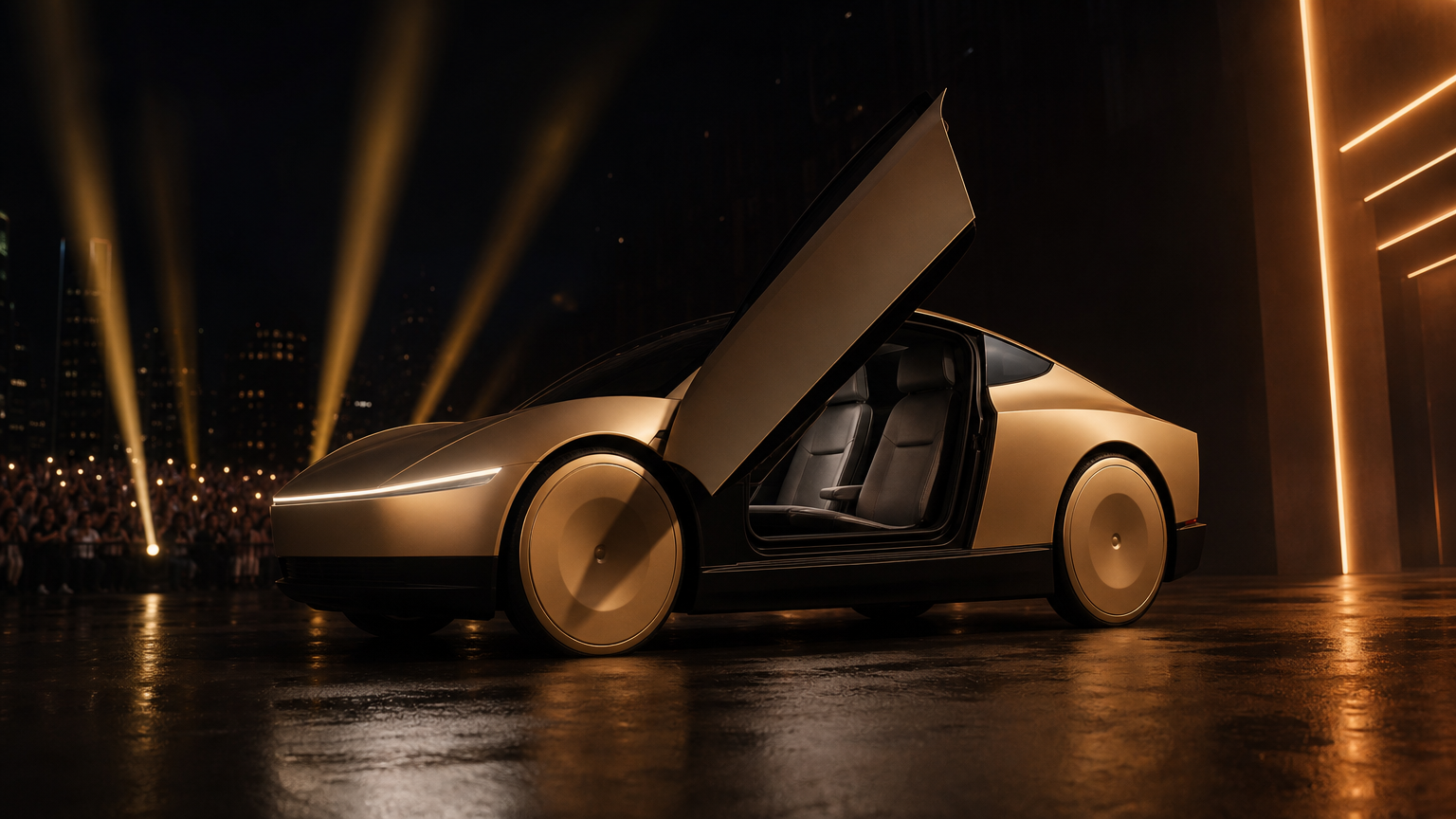
The event centered on the Cybercab, a gold, two-seat autonomous vehicle designed for Tesla’s Robotaxi network and built without the ordinary human-driving interface. Coverage from Austin describes a vehicle with butterfly or gull-wing-style doors, no steering wheel, no pedals and no mirrors, presented to invited guests in downtown Austin before public ride availability began . The format was restrained by Tesla standards. Instead of a broad livestreamed spectacle, invited riders, influencers and loyal customers got the first direct look, while the wider audience received clips and replay footage afterward .
That choice shaped the news cycle. The story is not just that Tesla showed a new autonomous taxi. It is that the company put the Cybercab into service while limiting the launch stagecraft that usually accompanies a defining Tesla product. For viewers watching the replay now, the key context is this: the video captures a commercial deployment moment, not simply a design reveal.
What the replay shows
The available replay shows Tesla presenting the Cybercab as a purpose-built robotaxi rather than a modified consumer car. According to Not a Tesla App’s account of the event, the presentation focused on hardware and engineering displays, including the vehicle’s drive unit, a more capable Full Self-Driving computer, steer-by-wire and brake-by-wire systems, a 22-inch cabin display, accessibility-related features and high-efficiency manufacturing elements . Tesla also used the event to tell attendees that the Cybercab would join the Austin Robotaxi fleet the following day .
That last point is the difference between the 2024 concept story and the 2026 launch story. Tesla first positioned Cybercab as a dedicated self-driving vehicle built around passengers, mass deployment and low-cost operations. The Austin event moved that pitch into a real service environment: a ride-hailing product that passengers can request through Tesla’s Robotaxi app, rather than a prototype sitting under stage lights.
Tesla’s own rider material reinforces the passenger-first framing. The Cybercab Rider Guide, published for North America on September 3, 2026, lists sections on riding with Cybercab, opening and closing doors, trunk use, seats and seat belts, cabin comfort, emergency procedures, specifications, support and disclaimers . The existence of that guide matters because it treats the vehicle as something riders are expected to encounter in service, not just admire at a launch.
No wheel, no pedals, no normal rollout
The Cybercab’s signature feature is also its biggest policy problem: it has no conventional controls. Axios reported that Austin customers can now book rides in the driverless Cybercab, describing it as a vehicle with no steering wheel or pedals and noting that Tesla customers can hail it through the Robotaxi app . Reuters, in a report republished by Investing.com, said Tesla began commercial deployment of a small number of two-seat Cybercabs in Austin on Thursday and planned a gradual expansion to additional vehicles and locations .
The initial scale appears deliberately limited. Axios reported that only 45 Cybercabs were registered in Texas at the time of its story, within a statewide Tesla robotaxi fleet of 420 vehicles, most of them conventional Model Ys fitted with Tesla’s Full Self-Driving software . Reuters reported the same 420 autonomous vehicles registered in Texas and 45 Cybercabs as of Friday morning . That means the launch is commercially real, but not yet a mass-market flood of autonomous two-seaters.
Tesla’s strategic logic is clear. Cybercab is not meant to be a niche shuttle; it is Tesla’s attempt to make robotaxi economics work through a dedicated low-cost vehicle, a camera-led autonomy stack and manufacturing scale. But the replay arrives at a moment when scale is more aspiration than reality. The Austin launch proves Tesla is willing to put the vehicle in front of paying riders. It does not yet prove that Tesla can expand the service quickly, safely and cheaply across many cities.
The regulatory clock started immediately
Within hours of the Austin rollout, the National Highway Traffic Safety Administration opened an Audit Query into Tesla’s self-certification that the Cybercab meets applicable Federal Motor Vehicle Safety Standards . NHTSA said the enforcement action followed Tesla’s commercial deployment of driverless Cybercab vehicles in Austin and would allow the agency to assess the basis for Tesla’s certification .
The issue is not whether autonomous vehicles can exist in the United States. The issue is how a vehicle with no steering wheel, brake pedal, accelerator pedal or mirrors fits rules written for vehicles that humans can drive. Reuters reported that NHTSA is examining the process and technical data Tesla relied on to demonstrate compliance for up to 1,000 Cybercabs . The same report noted that NHTSA has previously offered an exemption path for vehicles that do not comply with certain safety standards, but that such exemptions are capped at 2,500 vehicles per manufacturer per year .
NHTSA’s statement is carefully balanced. The agency said it supports safe automated-vehicle development, but emphasized that existing standards remain in force until rulemakings are completed . That line is central to understanding why the replay matters beyond Tesla fans. The Cybercab launch is now a live test of the gap between autonomous-vehicle ambition and the slow-moving machinery of federal vehicle rules.
Austin is the proving ground
Austin’s role is also important. Axios Austin reported that Texas authorizes driverless-vehicle companies without approving each vehicle model, and that Austin’s local role is largely coordination and emergency preparedness rather than model-by-model approval . The same report said Tesla Robotaxi LLC has held a state authorization since May 24, and that Tesla added 45 Cybercabs to the state list of vehicles operating under that authorization .
Local preparation did happen. Axios Austin reported that Tesla provided first-responder guides and held trainings with Austin first responders ahead of the launch, including guidance for crashes and other emergencies . At the same time, city data supplied to Axios showed 10 incidents or complaints involving Tesla autonomous vehicles since Cybercab testing began, including seven categorized as safety concerns . Those figures do not by themselves establish that the Cybercab is unsafe, but they explain why a public-service launch in city traffic attracts scrutiny faster than a closed demonstration.
Why Tesla’s camera-only argument is on trial
The Cybercab embodies Tesla’s long-running belief that autonomy can be solved primarily through cameras and artificial intelligence, without relying on lidar-heavy vehicle architectures. AP’s launch coverage framed the competitive contrast clearly: Tesla must show that its camera-only system can safely navigate streets and avoid pedestrians, while competitors such as Waymo and Zoox supplement cameras with radar and lidar .
That distinction is more than engineering preference. If Tesla is right, Cybercab could be cheaper to build and easier to scale. If it is wrong, the absence of redundant sensing and manual controls will intensify questions about edge cases, low-visibility driving and emergency response. The replay therefore functions as a sales pitch and a burden of proof. It shows the product Tesla wants the public to trust, while regulators and riders now watch the real-world data.
The bottom line for viewers
If you are watching the Cybercab launch replay today, watch it as a compressed version of Tesla’s next big wager. The presentation shows the hardware, passenger experience and engineering confidence behind a two-seat robotaxi designed for high-volume autonomous transport. But the surrounding facts are just as important as the video itself: there was no public livestream, the first public record came through attendee footage, the initial Austin fleet is small, and NHTSA has already opened a formal review of Tesla’s compliance position .
That combination makes the Cybercab launch more consequential than a normal product event. Tesla has moved from promises to paid rides. Now the story shifts from the stage to the streets, from replay clips to rider experiences, and from product design to federal safety law. The full replay is worth watching because it captures the moment Tesla declared the Cybercab ready. The next question is whether regulators, cities and passengers will agree.
Sources from the last 72 hours
- [1]Watch Replay of Tesla's Cybercab EventSep 4, 2026, 12:00 AM UTC
- [2]Cybercab Rider GuideSep 3, 2026, 12:00 AM UTC
- [3]NHTSA Opens Investigation into Tesla Cybercab Self-Certification Following Austin DeploymentSep 4, 2026, 12:00 AM UTC
- [4]US opens probe into Tesla self-certification of Cybercab robotaxisSep 4, 2026, 5:49 AM UTC
- [5]Tesla's Cybercab now available for ride-hailingSep 4, 2026, 9:00 AM UTC
- [6]Feds probe Tesla's Cybercabs; Texas takes back seatSep 4, 2026, 10:16 PM UTC
- [7]Tesla launches steering-wheel-free Cybercabs on Austin, Texas, streetsSep 3, 2026, 8:59 PM UTC
AI-generated article based on recent web research, then preserved as a dated editorial snapshot.
Comments
Be the first to comment.