
Daily Podcast full article
NYC bans AI through eighth grade as schools draw a new line on classroom tech
New York City is putting a one-year stop on student-facing generative AI from 2-K through eighth grade, while keeping limited, supervised AI use for high school students. The policy is less a rejection of artificial intelligence than an age-based bet: protect younger children from tools city officials say may weaken human instruction, while teaching older students how to question and use AI with guardrails.
A one-year moratorium for the youngest students
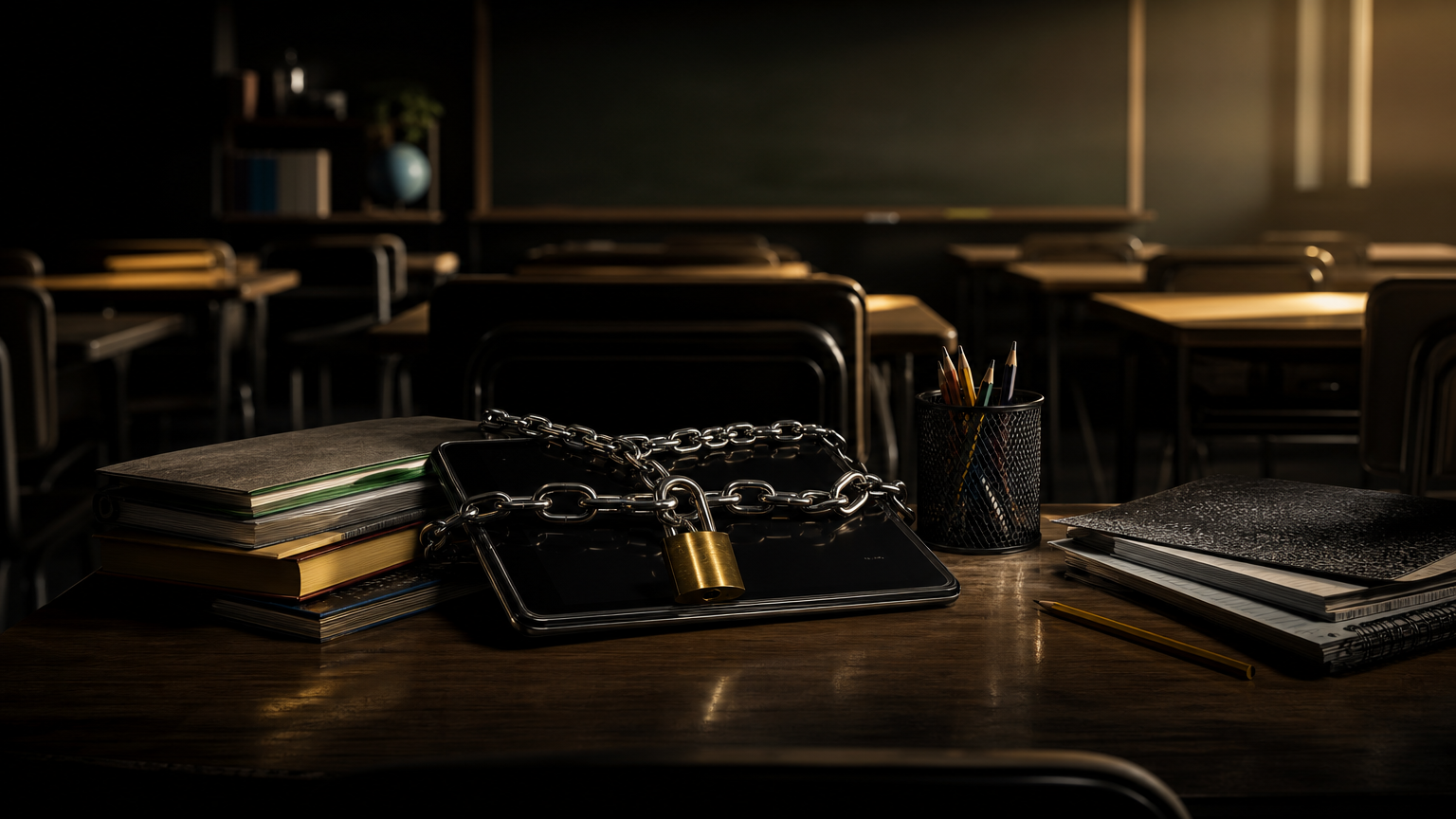
New York City, the largest public school system in the United States, will bar student-facing generative artificial intelligence for students from 2-K through eighth grade during the 2026-27 school year . Mayor Zohran Mamdani and Schools Chancellor Kamar Samuels announced the policy on September 2, describing it as the country’s broadest student-facing AI moratorium in schools . The move affects nearly 600,000 students, roughly two-thirds of the city system’s total enrollment .
The rule applies to software that places generative AI directly in front of students in early childhood, elementary and middle school settings . In practice, that means chatbots, AI tutors and other prompt-driven tools are not supposed to be used by children through eighth grade in city classrooms . The city is also banning companion chatbots across all grades, a broader restriction that reaches beyond the K-8 cutoff and reflects rising concern about emotionally responsive AI products marketed to young people .
City Hall framed the measure as temporary but consequential. Officials called it a one-year moratorium, not a permanent ban, and said the school year will be used to study the effect of AI restrictions and limited high school pilots . A Technology in Schools Coalition made up of students, educators, parent leaders, elected officials, advocates, union partners and experts will review the policy and make recommendations for future years .
Why grade 8 became the dividing line
The clearest signal in the policy is developmental: New York is saying that students should first build reading, writing, reasoning and classroom habits without generative AI acting as an ever-present shortcut. Mamdani said children need teachers, human connection, peers and the experience of struggling through difficult problems before relying on automated systems . Samuels described the policy as an attempt to protect curiosity, creativity and human relationships while the city gathers evidence on whether and how classroom AI helps learning .
The grade 8 line is politically and educationally significant because it avoids the two extremes that have defined school AI debates since chatbots entered mainstream use. New York is not banning AI from the entire school system. It is also not treating AI as an inevitable tool for every age group. Instead, it is creating a hard boundary for younger students and a limited pathway for high school students who are closer to college, training programs and workplaces where AI tools are increasingly common.
That compromise may matter beyond New York. AP reported that schools around the country are trying to teach students how to incorporate AI while also stopping overreliance and cheating . The same report noted that at least 37 states have official AI guidance available for schools, but there is no single agreed definition of AI literacy or consensus on how it should be taught . New York’s policy therefore gives other districts a concrete model: prohibit student-facing AI through middle school, then introduce supervised exposure in high school.
What remains allowed in high school
The policy leaves high schools with a controlled AI lane rather than a free-for-all. All public high school students will receive twice-yearly AI literacy and critical thinking modules . The two 45-minute lessons are supposed to cover what AI is and is not, along with bias, risks, ethical questions, data privacy, career effects and future skills .
In addition, the city will allow five limited AI pilot programs for no more than 50,000 high school students in general education classes, or about 5% of the public school system . The approved pilots are Quill, Edia, Brisk Teaching, Playlab and Intel AI-Ready Schools . City officials said the pilots will be capped at no more than five classes per high school, supervised by trained educators and limited to vetted tools selected for safety, data privacy, teacher guidance and keeping students as the primary thinkers in the classroom .
The program design is intentionally narrow. Quill is framed around close reading, text analysis and evidence-based claims, with student use capped at 15 minutes per week . Edia is for math coaching and reasoning, with use capped at 20 minutes per week . Brisk Teaching is tied to teacher-created activities, Playlab to assignment-specific apps and bias analysis, and Intel AI-Ready Schools to semester-long community problem-solving projects . The message is that AI may be used in high school, but only with teacher direction, limited exposure and a stated instructional purpose.
Screen time restrictions move with the AI policy
The AI moratorium is paired with new screen-time guidance for younger students. Children in 2-K through second grade will have restricted one-to-one screen time, while the city recommends daily caps of 30 minutes for grades 3 through 5 and 45 minutes for grades 6 through 8 . News 12 reported the same age-based screen-time limits as part of the new package .
This matters because the city is not treating AI as an isolated software issue. It is connecting AI to a larger question about how much routine individual device use belongs in early education. Officials said the approach is meant to prioritize student safety, human instruction and critical thinking . The city’s own announcement also says technology tools used in NYC public schools will undergo an exhaustive review and may be barred if they are not considered mission-critical to learning .
Teachers can still use AI, but not for everything
The policy does not prohibit educators from using AI behind the scenes. Teachers may continue to use AI for instructional planning and operational tasks if the tools comply with NYC Public Schools safety standards . Chalkbeat reported that teachers may use AI for work such as planning lessons, translating materials or drafting communications, but not for grading student work, monitoring behavior, writing special education plans or assisting with student mental health challenges .
That distinction is central to the city’s approach. Younger students are shielded from direct generative AI interaction, while adults can still use approved systems as support tools. Exceptions are also built in for assistive technology used by students with disabilities, multilingual learners and students in certain career readiness programs, including computer science . In other words, the policy limits unnecessary AI exposure but tries not to cut off legally or educationally necessary access.
The unresolved questions
Even with the announcement, schools face practical uncertainty. Chalkbeat reported that city officials said they are disabling AI features on 38 software programs already used in schools, but had not shared the full list of products . Chalkbeat also reported that officials had acknowledged limited hard data on how much AI is currently used across the system’s roughly 1,600 schools .
Enforcement is another open issue. The city has said new technology purchases will face tighter review and that products may be eliminated if AI features cannot be turned off . But classroom-level compliance may still depend heavily on principals and teachers, especially when AI functions are embedded inside familiar education software rather than sold as obvious chatbots.
Reaction is already mixed. United Federation of Teachers president Michael Mulgrew praised the screen-time limits but said the AI policy leaves unanswered questions about how aggressively the Education Department will demand safeguards from vendors . Josh Golin of the children’s advocacy group Fairplay said one year may be too little time to evaluate the policy and argued that AI platforms should have to prove they are safe, effective and not displacing face-to-face interaction .
A policy other districts will watch
New York’s decision is notable because it comes from the country’s largest school system and because it arrives just before students return to classrooms . The policy’s most important feature is not simply that it bans AI through eighth grade. It is that it creates a structured sequence: no student-facing generative AI for younger children; limited, supervised pilots for high schoolers; mandatory AI literacy for older students; and a year-long review before the next policy turn.
That sequence may become the template for districts that are neither ready to embrace AI tutors for children nor willing to leave students unprepared for an AI-shaped workplace. New York is betting that the first task of school is still human learning, and that AI literacy is more useful after students have had time to develop the skills AI can so easily imitate.
Sources from the last 72 hours
- [1]Mayor Mamdani and Chancellor Samuels Put Students First with Nation’s Broadest Generative AI Moratorium in SchoolsSep 2, 2026, 4:00 AM UTC
- [2]NYC’s new school AI ban explained: What’s changing? What’s still murky?Sep 2, 2026, 9:58 PM UTC
- [3]New York City schools ban student use of generative AI through 8th gradeSep 2, 2026, 1:22 PM UTC
- [4]NYC, the nation’s largest school system, bans AI for students through 8th gradeSep 2, 2026, 4:54 PM UTC
AI-generated article based on recent web research, then preserved as a dated editorial snapshot.
Comments
Be the first to comment.