
Daily Podcast full article
SpaceX targets Starship orbit
SpaceX’s latest Flight 14 paperwork signals a major change in the Starship test campaign: the company is preparing regulators for a mission profile that would take the vehicle from repeated suborbital demonstrations to its first true orbital attempt, with Starlink V3 deployment now central to the plan.
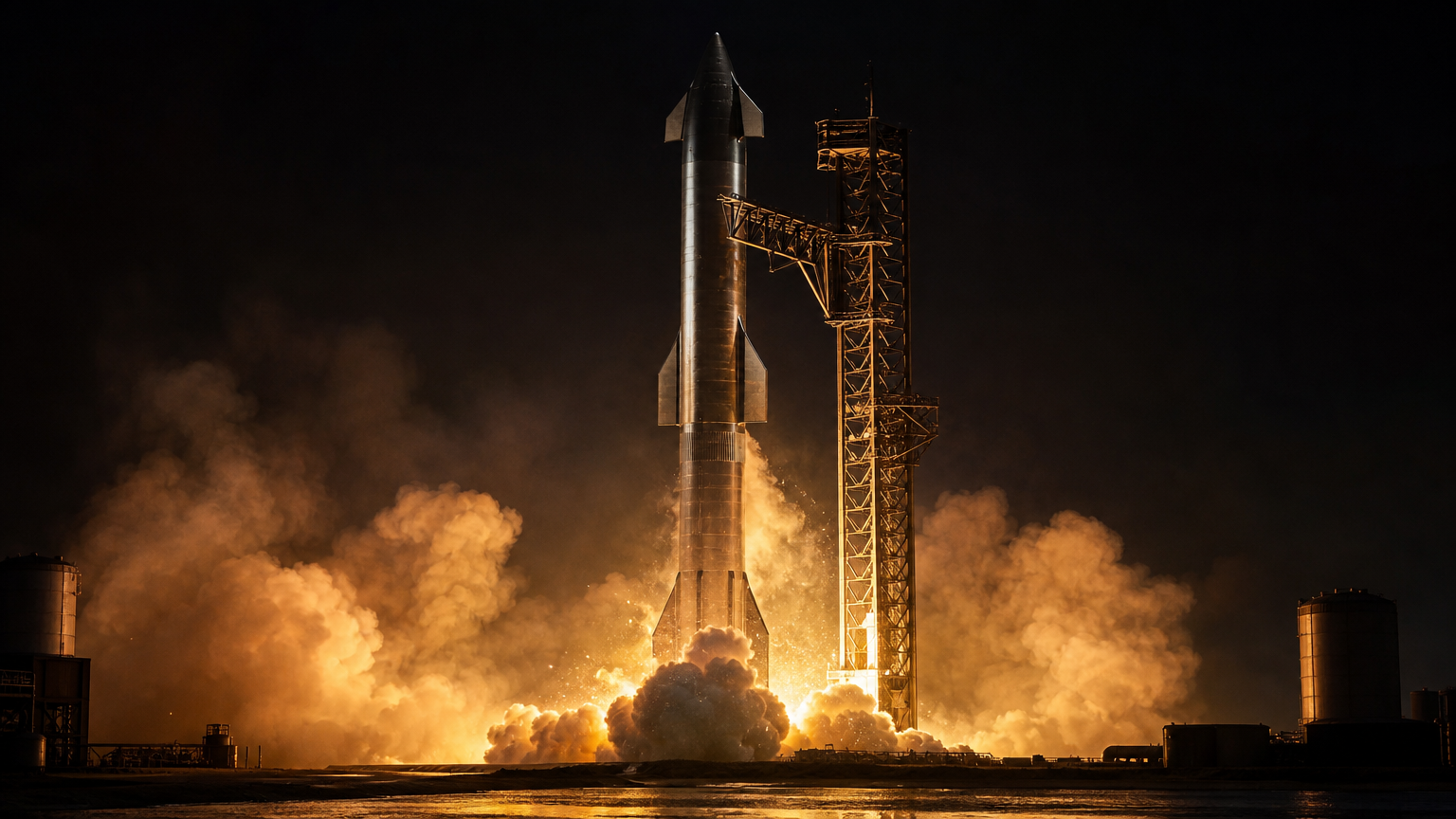
A filing that changes the shape of Flight 14
SpaceX’s Starship program appears to be moving toward its most consequential test yet after fresh FCC-related paperwork pointed to Flight 14 as the vehicle’s first true orbital launch attempt . The key shift is not merely another date on a launch calendar. It is the mission profile: after years of iterative tests designed to clear the tower, separate stages, survive reentry and refine recovery procedures, Flight 14 is now being described in regulatory language as an orbital mission rather than another suborbital arc .
That matters because Starship has been tested so far in a way that let SpaceX gather data without committing the upper stage to a sustained orbit. Previous flights sent the vehicle through space and back into the atmosphere on trajectories that ended with planned splashdowns, allowing engineers to focus on stage separation, in-space engine relight, thermal protection, guidance and recovery behavior . According to the latest reporting on the filing, Flight 14 is designed to cross the next boundary: orbital insertion .
The FCC angle is important because communications authority is one of the practical pieces needed before a flight. SpaceX has asked for permission to operate Starlink terminals during Starship’s fourteenth flight test, and the filing describes a mission profile built around an actual trip to orbit . Separately, a public FCC filing index for a related Flight 14 special temporary authority record includes the phrase “orbital second stage” and lists a requested operation start date of September 15, 2026, while also marking that particular record as denied or dismissed after a withdrawal . In other words, the paperwork is a signal of intent and coordination, not a launch license by itself.
September 15 is a planning marker, not a promise
The current public target circulating around Flight 14 is September 15, 2026. Benzinga reported that the FCC filing lists September 15 as the requested start date for Flight 14 communications and says the mission includes an “orbital second stage” . A SpaceX-focused public feed also noted that September 15 appears in the FCC request as the planned launch or deployment date for high-capacity orbital Starlink satellites on Starship Flight 14 .
But the distinction between “target” and “confirmed launch date” is essential. SpaceX had not formally announced a launch date in the reporting available within the current window, and the date could still move as vehicle readiness, range coordination and regulatory approvals converge . Starship schedules have always been fluid because each mission combines prototype hardware, ground-system work, FAA oversight, FCC spectrum coordination and post-test analysis.
That makes the September 15 marker useful but provisional. It tells range operators, spectrum users and regulators what SpaceX is preparing to support. It does not prove that the rocket is stacked, that the FAA has cleared the flight, or that SpaceX will keep the same timeline if inspections or tests reveal a problem.
Why orbit is different
Starship’s earlier milestones were dramatic, but they were still incremental. Clearing the launch tower proved the integrated vehicle could survive liftoff loads. Hot staging and stage separation proved the architecture could hand flight from Super Heavy to the ship. Controlled reentry and splashdown work showed whether the upper stage could manage the brutal heating and aerodynamic instability of return from space. Recovery experiments tested the path toward rapid reuse.
An orbital attempt adds a new layer. If Flight 14 reaches orbit, the vehicle would no longer be demonstrating only a high-energy suborbital path. It would be acting more like the operational launcher SpaceX ultimately needs for the Starlink network, NASA lunar missions and future logistics beyond Earth orbit.
The payload plan underscores that transition. Current reporting says Flight 14 is expected to carry roughly 20 Starlink V3 satellites, with the goal of placing them into an operational orbit if the mission succeeds . That would differ from Flight 13, which reportedly carried 20 functional Starlink V3 satellites but kept them on a suborbital trajectory, meaning they reentered with the vehicle rather than joining the constellation . Flight 14 is therefore not only a rocket test; it is a test of whether Starship can begin doing useful work while still in development.
Starlink V3 is the business reason orbit matters
The Starlink element is not incidental. SpaceX’s next-generation V3 satellites are tied directly to the economics of Starship. Benzinga reported that each V3 satellite is designed for about one terabit per second of downlink capacity, that Starship could eventually carry up to 60 of them, and that SpaceX estimates one Starship V3 launch could add about 20 times the network capacity of a Falcon 9 mission carrying current V2 satellites .
That is why a successful orbital Flight 14 would be more than a symbolic first. It would point toward a new deployment model for Starlink, where Starship’s mass and volume capacity replace Falcon 9 as the main vehicle for the largest satellites. If SpaceX can regularly place V3 spacecraft into useful orbits, the network gains a scaling path that Falcon 9 cannot match.
The comparison also explains the regulatory choreography. A mission involving orbital Starlink deployment requires not just rocket readiness but communications planning, spectrum authorization and coordination with other users. The filing tells the broader operating environment that Starship is being prepared for a different class of flight.
What Flight 14 is not
Flight 14 should not be read as the end of risk in the Starship campaign. Starship remains a development vehicle, and SpaceX’s test philosophy accepts visible failures if they accelerate design learning. Even a successful launch could still face failures at orbital insertion, payload deployment, in-space operations, reentry, landing burn or splashdown.
Nor does the FCC paperwork mean Flight 14 is cleared to fly. The FCC handles communications authorizations; launch safety authority rests elsewhere, including the FAA’s commercial space transportation process. The public FCC index also shows how quickly individual applications can change status, with one related Flight 14 record marked denied or dismissed after withdrawal despite containing useful mission-profile language .
There is also a recovery distinction. Earlier discussion around Flight 14 had included the possibility of catching the Starship upper stage with the launch tower, but current reporting says Elon Musk later indicated that a ship catch would more likely happen “in a few months,” suggesting that milestone has moved beyond Flight 14 . That would keep Flight 14 focused on orbit and deployment rather than combining too many firsts in one test.
The strategic reading
The most important conclusion is that SpaceX is preparing the system around Flight 14 as an orbital operation. The company has hardware moving through final test milestones, including a reported full 33-engine static fire of Booster 21 and a six-engine test campaign for Ship 41 before the latest filing story broke . It has a provisional mid-September planning marker . It has filings that speak the language of an orbital second stage and operational satellite deployment .
For Starship, this is the logical next step. A vehicle designed for high-mass Starlink deployment, lunar landing architecture and eventually Mars logistics cannot remain forever in the suborbital-test phase. Flight 14 is therefore best understood as a transition attempt: not yet routine, not guaranteed, but materially more ambitious than the flights that came before.
If it works, SpaceX will have moved Starship from spectacular experimental vehicle to the threshold of operational orbital service. If it fails, the company will still gain data from its first serious attempt to fly the full mission profile. Either way, the paperwork shows that the next Starship test is no longer framed merely as another launch. It is framed as the first real bid for orbit.
Sources from the last 72 hours
- [1]SpaceX tells the FCC that Starship Flight 14 is going to orbitSep 1, 2026, 3:25 PM UTC
- [2]SPCX Targets September 15 for Starship Flight 14, Sets Stage For Rocket’s First Orbital Mission And Major Starlink V3 DeploymentSep 1, 2026, 10:25 AM UTC
- [3]1688-EX-ST-2026 - Space Exploration Technologies Corp. (SpaceX) - FCC.reportSep 1, 2026, 5:13 AM UTC
- [4]SpaceX filed a request with the FCC today that states Tuesday… — SpaceX Feed — TG.MESep 1, 2026, 12:58 AM UTC
AI-generated article based on recent web research, then preserved as a dated editorial snapshot.
Comments
Be the first to comment.