
Daily Podcast full article
Google locks in Fervo geothermal for AI-era power
Google has signed a record next-generation geothermal power deal with Fervo Energy, converting part of a wider 3-gigawatt relationship into a 396-megawatt Utah power purchase agreement aimed at giving future data-center growth something intermittent renewables cannot easily provide: clean electricity around the clock.
The deal: 396 MW now, a path toward much more
Google’s latest energy move is not another conventional wind or solar procurement. It is a 396-megawatt power purchase agreement with Fervo Energy for output from Cape Station, Fervo’s enhanced geothermal systems project in Beaver County, Utah . Fervo described the contract as the world’s largest enhanced geothermal PPA to date, and said the power is expected to support the continued development of the Cape Station GeoCluster, with service targeted for 2028 .
The commercial structure is important. A regulatory filing says the agreement was signed on August 26, 2026, by Fervo subsidiary Cape Generating Station 6 LLC and Google Energy LLC, a Google affiliate . It covers a 396 MW enhanced geothermal project at Cape Station and is scheduled to be delivered in four 99 MW sub-tranches, with target commercial operation dates beginning in the third quarter of 2028 . The PPA has a 15-year delivery term, backed by parent company guarantees from Fervo Energy and Alphabet .
Google also secured an expansion path. Fervo says it will offer Google an option to increase offtake by about 600 MW, bringing total potential contracted capacity at Cape Station to nearly 1 GW by June 2030 . The SEC filing adds that the expanded capacity would be “not less than approximately 950 MW,” subject to Google accepting the offer and the parties negotiating a definitive agreement .
That near-term option sits inside a larger strategic relationship. Canary Media reported that Google and Fervo also have a framework under which Google has a right of first refusal for up to 3 GW of electricity from certain new geothermal plants Fervo develops . In other words, the 396 MW PPA is the bankable contract; the 600 MW option is the next step at Cape Station; and the 3 GW framework is the broader lane Google is trying to reserve in next-generation geothermal.
Why Google wants firm clean electricity
The strategic logic is straightforward: AI data centers are turning power availability into a competitive constraint. Cloud providers can buy GPUs, lease land and build campuses, but the electricity supply that makes those campuses usable is increasingly difficult to secure. Solar and wind remain central to corporate clean-energy procurement, but they do not run at full output every hour. Batteries help, but matching large, constant computing loads with carbon-free power hour by hour is a harder problem than buying annual renewable-energy credits.
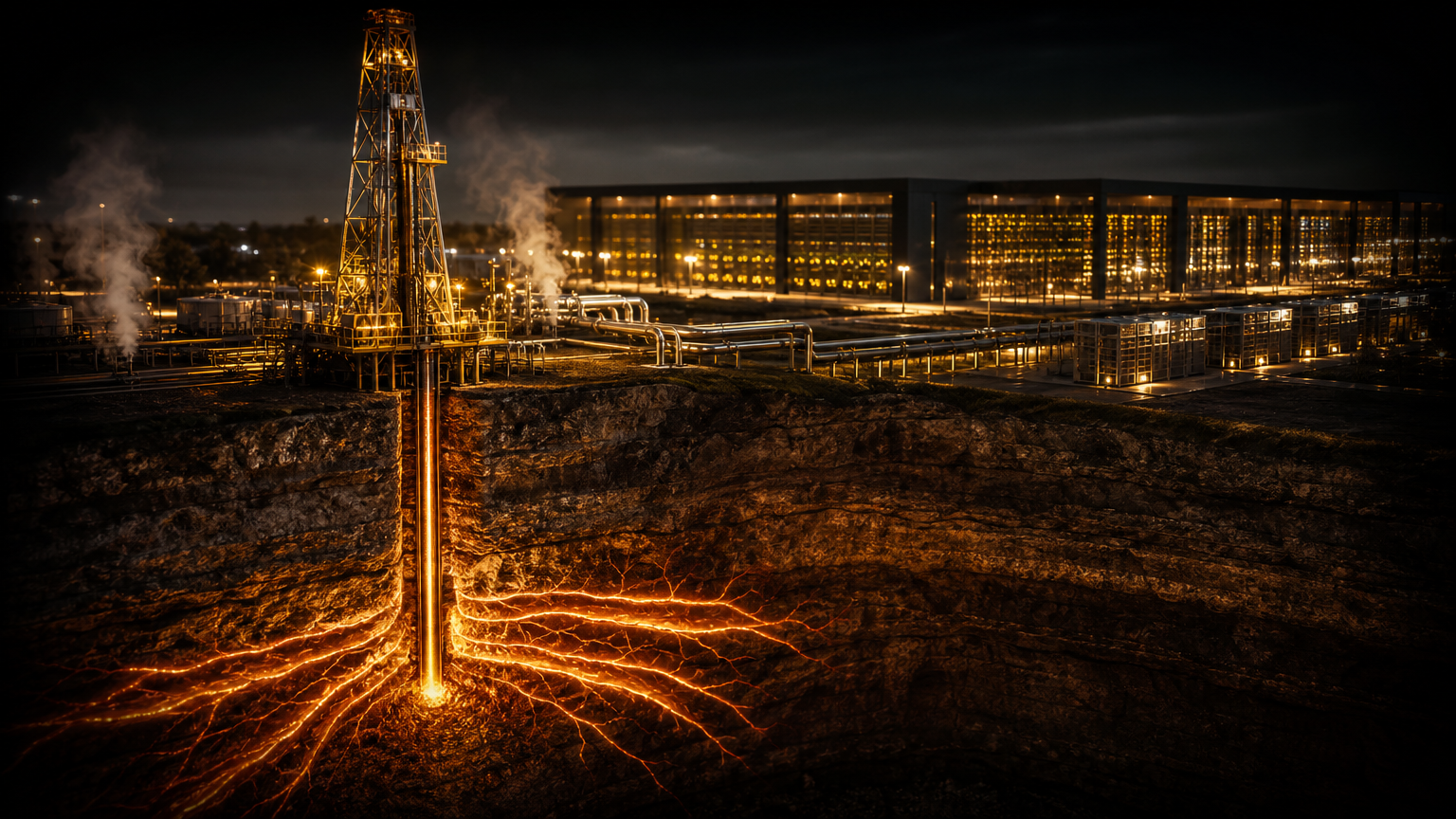
That is why geothermal matters. Enhanced geothermal systems are designed to produce steady power by drilling into hot rock, circulating fluid through engineered subsurface reservoirs and bringing heat back to the surface to generate electricity. Canary Media notes that Fervo’s approach is part of a broader effort to use tools and techniques derived from oil and gas drilling to access underground heat in more places than conventional geothermal allows .
For Google, the value is not just the clean attribute. It is the ability to align electricity supply with the always-on profile of cloud and AI workloads. Fervo’s announcement says the power is intended as a “foundational building block” for a potential Google data center in Utah, while also noting that final data-center plans remain subject to engineering feasibility, state and local approvals and commercial conditions . That caveat matters: Google has locked in power before it has finalized every detail of the load that may use it.
Cape Station becomes the test case
Cape Station is now the focal point of whether enhanced geothermal can graduate from promising technology to utility-scale power supply. Canary Media reported that Fervo is investing more than $2 billion in Cape Station, which it said could become the world’s largest next-generation geothermal system when completed in 2028 . The same report says Fervo is developing an initial 100 MW phase and expects to begin generating test power from a 33 MW unit in the fourth quarter of 2026 .
The Google PPA supports the next phase of that buildout. Fervo says the agreement is part of Cape Station’s expansion beyond its first 100 MW phase, using standardized “GeoBlock” execution to scale operations and reduce development costs . The company’s pitch is that geothermal can be industrialized in a way that resembles shale drilling: repeated designs, repeated wells, learning curves and supply-chain discipline.
That is the optimistic case. The risk case is also clear. Enhanced geothermal projects must still prove they can drill, stimulate reservoirs, manage subsurface performance, secure permits, interconnect and deliver power on schedule. Fervo’s SEC filing explicitly flags regulatory and permitting uncertainty, interconnection and transmission availability, construction risks and counterparty performance as factors that could affect the project . The deal validates demand, but it does not eliminate execution risk.
A deal shaped by Utah’s data-center politics
The filing also points to an unusually tailored delivery model. Fervo says the project is being developed to use flexible power-delivery pathways authorized under Utah Senate Bill 132, but still requires relevant regulatory approvals . Under that framework, the EGS project, supplemented by additional resources, could deliver generating capacity through a closed private generation system configured either in front of the meter or behind the meter to serve data-center load .
That language speaks to a larger tension around hyperscale computing. Data centers need huge amounts of power, but utilities and local communities are increasingly sensitive to who pays for grid upgrades and whether ordinary ratepayers subsidize corporate load growth. Fervo’s press release says the deal is intended to unlock new around-the-clock electricity capacity at no cost to existing ratepayers . The American Public Power Association also highlighted Fervo’s statement that Google and Fervo are committing to transparency, two-way dialogue with communities and sustained local investment .
Those promises will be tested locally. A potential Google data center in Utah could bring tax revenue, construction activity and long-term jobs, but it also raises familiar questions about water use, grid impacts, land use and industrial growth. The companies are trying to position geothermal as an answer to those concerns rather than an added burden: local firm generation paired with a large load, rather than a data center simply arriving and consuming scarce grid capacity.
From pilot project to hyperscaler infrastructure
The Google-Fervo relationship did not begin with Cape Station. Fervo says the partnership started with Project Red, its commercial pilot in Nevada, which came online in 2023 and delivers power to the local grid, including Google’s data centers in the state . The companies later worked with NV Energy on a 115 MW PPA in 2024 that helped pioneer a Clean Transition Tariff, a structure intended to bring geothermal power onto the Nevada grid while insulating everyday customers from project costs .
That progression matters. Google has moved from a small commercial pilot to a 115 MW utility-linked arrangement and now to a 396 MW Utah PPA with a route toward nearly 1 GW. The pattern shows how hyperscalers are beginning to treat firm clean power as core infrastructure, not as a sustainability side project.
Investors noticed. Canary Media reported that Fervo shares rose 15% on Tuesday morning after news of the Google power deal . The Motley Fool reported a larger move during Tuesday trading and noted that Fervo, which went public in May 2026, is still an early-stage company trying to convert backlog and project announcements into durable power revenue .
The bigger signal
The most important message of the deal is not that geothermal will replace wind, solar or batteries. It is that the next phase of clean power procurement is becoming more selective. Hyperscalers do not only need low-cost megawatt-hours; they need power that is available when servers are running, in locations where new campuses can actually connect.
That shifts value toward firm carbon-free technologies: geothermal, advanced nuclear, long-duration storage, clean fuels and hybrid portfolios. Fervo has not solved every technical or financial question facing enhanced geothermal, but Google’s commitment gives the sector a powerful demand signal. If Cape Station delivers on time and at scale, the deal could become a template for how AI infrastructure is powered. If it struggles, it will remind the market that firm clean power is valuable precisely because it is hard to build.
For now, Google has done what every AI hyperscaler is trying to do: reserve scarce power before the bottleneck tightens further. In Fervo, it is betting that the oilfield’s drilling playbook can be repurposed for a carbon-free grid — and that geothermal can become a dependable foundation for the next wave of computing.
Sources from the last 72 hours
- [1]Fervo Energy and Google Sign 396 MW PPASep 1, 2026, 12:00 PM UTC
- [2]frvo-20260826Sep 1, 2026, 12:00 AM UTC
- [3]Fervo and Google sign world’s largest deal for next-gen geothermal powerSep 1, 2026, 12:00 AM UTC
- [4]Fervo Energy, Google Sign 396-MW Geothermal Energy PPASep 1, 2026, 12:00 AM UTC
- [5]Google Just Locked Up the Largest Geothermal Power Deal Ever Made.Sep 1, 2026, 7:12 PM UTC
AI-generated article based on recent web research, then preserved as a dated editorial snapshot.
Comments
Be the first to comment.