
Daily Podcast full article
Radiant wins $750M Army reactor as microreactors move from pitch to procurement
Radiant’s up-to-$750 million U.S. Army award for 15 Kaleidos portable nuclear microreactors turns a long-promised advanced-nuclear idea into a defense procurement test: can factory-built reactors provide resilient power for military bases, then unlock civilian markets such as AI data centers, mines and disaster-response infrastructure? [1]
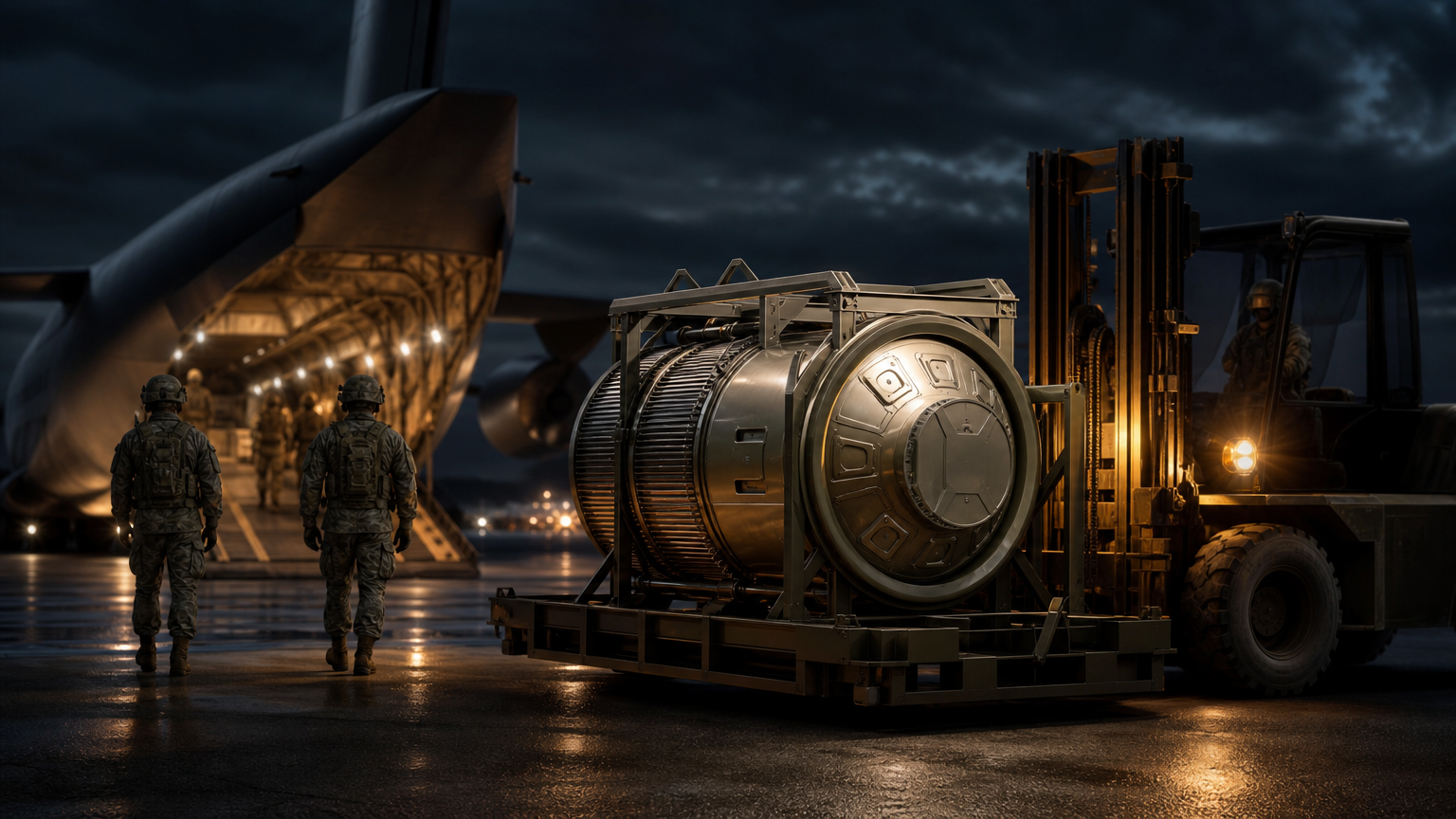
The milestone is the buyer
Radiant’s Army deal matters because it is not another demonstration grant, lab milestone or investor presentation. The company has won a U.S. Army contract worth up to $750 million to provide 15 portable nuclear microreactors under the Janus program, a procurement push aimed at resilient power for military installations and national-security missions . In a Bloomberg Tech interview distributed Monday, Radiant President and Chief Operating Officer Tori Shivanandan discussed the technology, the Army’s demand for resilient energy and the manufacturing scale-up now required .
The award places Radiant at the center of one of the most visible government tests of microreactors: compact nuclear plants designed to be manufactured, transported and operated as repeatable products rather than built as one-off civil-works megaprojects. Los Angeles Business Journal described the contract as a major win for El Segundo-based Radiant Industries and said the company is expected to deploy about 15 microreactors at military installations and for other critical national-security missions .
For advanced nuclear, the signal is unusually clear. The U.S. military is not merely watching microreactor startups; it is becoming an early anchor customer. Startup Fortune, in a fresh account of the Janus award, said the Army and the Defense Innovation Unit agreed to pay Radiant up to $750 million to develop and deploy 15 Kaleidos units, beginning with a three-unit installation at Fort Benning, Georgia, and moving toward 15 units by 2030 . That schedule, if met, would give Radiant something most nuclear startups still lack: operating fleet data from a real customer.
Why the Army wants portable nuclear power
The Army’s interest is practical. Modern bases depend on electric power for communications, surveillance, air defense, computing, logistics and increasingly autonomous systems. A base tied only to a fragile civilian grid has a strategic weakness. A base dependent on diesel has a different one: fuel convoys, storage, exposure to attack, price volatility and operational friction.
Janus is designed to reduce those constraints by putting reliable generation closer to the mission. The broader Army program involves five companies and a reported funding pool of up to $2.2 billion through fiscal 2031, with initial sites tied to Fort Bragg, Fort Campbell, Fort Hood, Fort Benning and Fort Drum . Radiant’s role is the most conspicuous because its own disclosed award is the largest named figure in the program: up to $750 million for 15 microreactors , .
This is also why the story reaches beyond defense. If a portable reactor can power a military base reliably, safely and at predictable cost, the same evidence will be watched by civilian customers that need dense, dependable electricity in places where the grid is constrained. Data centers, mines, ports, industrial campuses and disaster-response networks all share the same basic problem: electricity demand is rising faster than transmission and generation can be built in many locations.
What Radiant is trying to prove
Radiant’s product is Kaleidos, described by recent coverage as a factory-built nuclear microreactor in the roughly 1-megawatt class, transportable by land, sea or air and designed for customer-site deployment . Startup Fortune reported that the unit is intended to operate for up to five years before refueling, has a 20-year operating life, needs no cooling water and returns to Radiant for refueling and spent-fuel handling rather than leaving spent fuel at the customer site .
Those design claims are central to the business model. A reactor that requires years of bespoke construction at every site would be a smaller nuclear plant, not a scalable product. Radiant’s promise is different: manufacture the reactor, ship it, operate it as part of a fleet and bring it back into the company’s logistics system when fuel service is needed.
That is a powerful idea, but the Army contract now converts it into an execution test. Radiant must show that Kaleidos can be built repeatedly, licensed or otherwise authorized for military deployment, fueled, transported, installed, operated and maintained on a schedule that satisfies a customer with little tolerance for power uncertainty. The same reporting says Radiant’s manufacturing plan includes an R-50 factory in Oak Ridge, Tennessee, with ambitions to scale output after production begins . The contract therefore tests not only nuclear physics, but supply chains, manufacturing quality, site work, operator training, security, fuel management and cost control.
The technology angle: AI needs firm power
The timing is why the technology sector is paying attention. AI infrastructure is turning electricity into a strategic input. Large training clusters and inference-heavy data centers need firm power, not intermittent promises. Grid interconnection queues, local opposition, transformer shortages and transmission bottlenecks have made power availability a limiting factor for some digital infrastructure projects.
Radiant already has a civilian data-center connection. Los Angeles Business Journal reported that, before the Army deal, Radiant had signed an agreement with Equinix to develop and provide 20 microreactors for an undisclosed amount . Startup Fortune also linked the Army award to that broader commercial relevance, noting that Equinix’s order makes the Janus contract more than a defense story .
The point is not that military bases and hyperscale data centers are identical. They are not. Defense installations face security, command continuity and logistics needs that differ from commercial campuses. But both markets value the same energy attributes: high availability, compact footprint, fuel security, predictable output and independence from long grid-expansion timelines.
If Radiant performs at Fort Benning and other Janus deployments, the company can point civilian buyers to a working reference fleet rather than a theoretical model. That could accelerate investor confidence, customer procurement and regulatory learning. It could also sharpen competition among microreactor developers by giving one startup a rare early-market advantage.
The hard parts are still ahead
The contract does not eliminate nuclear risk; it concentrates it. Radiant still must execute across a chain where delays can compound. Fuel supply, factory readiness, safety analysis, environmental review, security planning, site preparation, operator protocols and emergency planning all matter. A portable reactor must be simple for the customer without being simplistic for the regulator, operator or surrounding community.
There is also a communications challenge. Microreactors are often presented as “plug-and-play,” but nuclear systems are never consumer electronics. The more portable the product, the more important it becomes to explain where it will sit, how it will be protected, who operates it, what happens during an accident scenario and how spent fuel is managed. Radiant’s reported model of returning units for refueling and spent-fuel handling may address some site concerns, but it will still need public and institutional trust .
The Army’s contractor-owned, contractor-operated approach also changes the usual procurement logic. Instead of simply buying equipment, the government is buying an energy outcome tied to private operation and long-term performance. That can align incentives, but it also places durability, liability and lifecycle cost at the center of the deal.
A reference market for compact nuclear
Radiant’s $750 million Army award is best understood as a reference-market moment. The military has a real need for resilient power, and it can tolerate early adoption where commercial utilities may move slowly. In return, Radiant gets a demanding customer, a named deployment path and the credibility that comes from procurement rather than publicity.
If the company delivers, the Janus program could become a bridge between advanced-nuclear startups and the customers now searching for firm, dense electricity. If it stumbles, the award will become a reminder that manufacturing a nuclear product is harder than selling the concept.
For now, the direction is unmistakable. Portable nuclear microreactors have entered a phase where schedules, factories, sites and operations matter more than renderings. Radiant has won the contract. The next story is whether it can turn 15 promised reactors into a working fleet.
Sources from the last 72 hours
- [1]Radiant Wins $750 Million US Army Nuclear Reactor DealAug 31, 2026, 6:57 PM UTC
- [2]Radiant Snags $750M U.S. Army DealAug 31, 2026, 12:00 AM UTC
- [3]Radiant Wins 750 Million Dollar Army Deal to Power Bases With Nuclear MicroreactorsSep 1, 2026, 12:15 AM UTC
AI-generated article based on recent web research, then preserved as a dated editorial snapshot.
Comments
Be the first to comment.