
Daily Podcast full article
Nvidia and Qualcomm go on-device
Nvidia’s $3.5 billion MediaTek investment and Qualcomm’s new Snapdragon-powered Horizon Ultra AI PC point to the same market shift: AI is moving from remote cloud services into PCs, developer desktops, edge boxes and vehicles. The difference is strategic. Nvidia is trying to make its software and interconnects the default substrate even when customers design custom XPUs, while Qualcomm is leaning on power-efficient client silicon to make local inference a selling point at the endpoint.
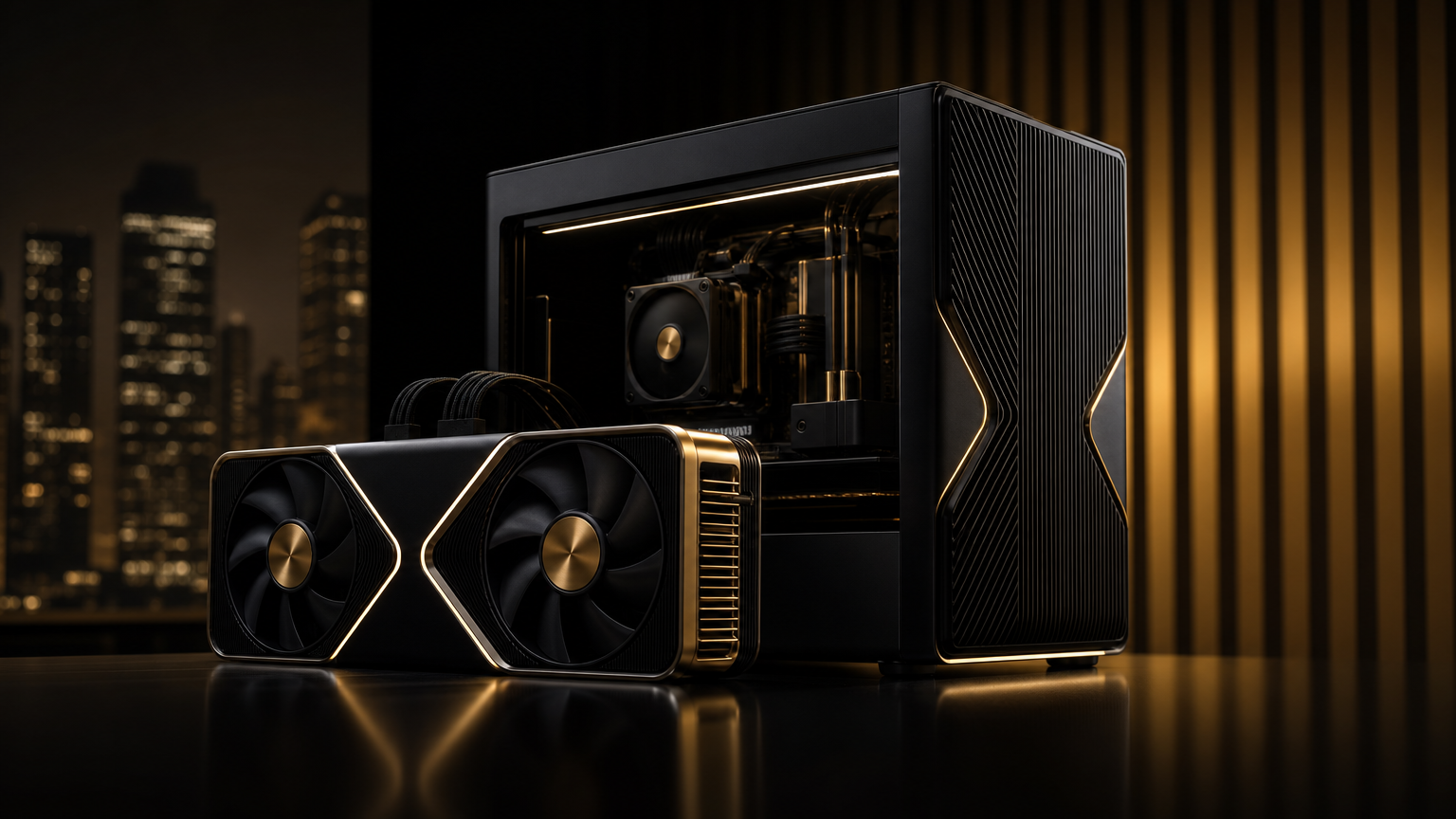
The on-device AI race moves from slogan to platform
Nvidia and Qualcomm are now pushing the AI PC and edge-computing story from two sides of the same market. Nvidia’s latest move is not a direct Qualcomm partnership but a deeper alliance with MediaTek: Nvidia said on August 31 that MediaTek will adopt NVLink Fusion and that Nvidia has invested $3.5 billion in convertible bonds issued by MediaTek . Qualcomm, on the same day, unveiled the HUMAIN Horizon Ultra AI PC, a Snapdragon X2 Elite system that puts CPU, GPU and NPU resources together for on-device AI . Taken together, the announcements make clear that the next phase of AI hardware competition will be fought not only in hyperscale data centers, but also on desks, in laptops, in edge systems and inside vehicles.
The Nvidia-MediaTek deal is the bigger strategic swing because it links local AI computing to Nvidia’s rack-scale infrastructure business. Nvidia says the expanded collaboration covers three areas: AI infrastructure, local AI computing and automotive platforms . MediaTek will use NVLink Fusion to give hyperscalers, cloud providers and frontier model developers a “prevalidated path” for custom XPUs that can connect into Nvidia NVLink-connected rack-scale AI factories . That matters because many of Nvidia’s largest customers want more control over AI silicon, but they do not necessarily want to rebuild the surrounding interconnect, memory, packaging and systems stack from scratch.
Why NVLink Fusion is the center of the deal
NVLink Fusion is the technical hinge. It is designed to let custom processors and accelerators plug into Nvidia’s scale-up fabric rather than sit outside it. Nvidia describes the platform as a prebuilt and prequalified foundation for multi-die XPU development, including the NVLink Fusion chiplet, NVLink-C2C connectivity and NVHBM memory capabilities . StorageReview’s analysis frames the same point in more practical engineering terms: custom accelerators for rack-scale systems require difficult work across high-speed SerDes, HBM integration, advanced packaging, thermal design and system qualification . By offering a validated route through MediaTek, Nvidia reduces that burden while keeping the end system aligned with its own infrastructure.
That is why the deal should not be read as Nvidia retreating from GPUs. It is Nvidia adapting to a world where major AI labs and cloud companies increasingly want workload-specific silicon. TechCrunch reported that the partnership gives MediaTek access to Nvidia’s NVLink Fusion ecosystem at a time when major cloud and AI companies are investing in their own chips to reduce dependence on general-purpose Nvidia GPUs . Reuters made a similar point in business terms: MediaTek customers will be able to use Nvidia technology to design AI chips that connect directly to Nvidia’s larger computing systems . In other words, Nvidia can concede some custom compute while defending the higher-value system architecture around it.
The financial structure reinforces that ecosystem strategy. Reuters reported that Nvidia’s $3.5 billion MediaTek investment is part of MediaTek’s record $3.9 billion overseas convertible bond offering, and that Alphabet also participated without disclosing the size of its investment . The deal therefore looks less like a narrow supplier arrangement and more like an attempt to position MediaTek as a semi-custom design bridge between AI customers and Nvidia-compatible infrastructure.
RTX Spark brings the story back to the PC
The second part of the announcement is more visible to consumers and enterprise buyers: local AI computing. Nvidia and MediaTek said they will continue collaborating on multiple generations of RTX Spark and DGX Spark PC chips for consumer PCs, AI developer supercomputers and enterprise-class workstations that integrate Nvidia GPUs with MediaTek SoCs . StorageReview noted that the companies previously worked on the GB10 Grace Blackwell Superchip powering DGX Spark, and that the effort is now extending into client systems through RTX Spark .
This is the “go on-device” part of Nvidia’s strategy. DGX Spark addresses developers and edge environments; RTX Spark targets the broader PC category. Nvidia’s proposition is that local machines should be able to run generative and agentic AI workloads with lower latency, more privacy and less dependence on a constant cloud connection. That does not eliminate the cloud. Instead, it creates a hybrid model: routine or sensitive tasks can run locally, while larger jobs can still escalate to cloud or data-center infrastructure.
The architectural logic is consistent from rack to laptop. In the data center, Nvidia wants custom XPUs connected through NVLink Fusion. On the client, it wants Nvidia GPUs paired with MediaTek’s SoC expertise to make AI PCs credible beyond marketing labels. In both cases, the company is trying to keep developers anchored to the Nvidia software stack, even as compute moves into more diverse form factors.
Qualcomm’s parallel move shows the same endpoint thesis
Qualcomm’s Horizon Ultra announcement shows that Nvidia is not alone in pushing this direction. Qualcomm and HUMAIN introduced a flagship AI PC powered by Snapdragon X2 Elite with an 18-core Qualcomm Oryon CPU, combining CPU, GPU and NPU compute for on-device AI and launching first with Microsoft Windows . Qualcomm said local processing can support use cases where responsiveness, connectivity, privacy or data-handling requirements make on-device execution valuable, while keeping cloud connectivity available when more power is needed .
That language mirrors the PC industry’s broader pitch: AI should become part of the device architecture, not just a cloud feature accessed through an app. Qualcomm’s route is different from Nvidia’s. It starts with power-efficient Snapdragon client platforms, NPUs and Windows-on-Arm momentum. Nvidia’s route starts with accelerated computing, CUDA-era developer gravity, RTX graphics, DGX-style developer systems and now MediaTek’s SoC design capacity. But both converge on the same product promise: local inference, private agents, multimodal workflows and enterprise endpoints that can do more when offline or when data cannot leave the device.
Horizon Ultra also underlines the commercial timing. Qualcomm said the system will be available for enterprise purchase beginning September 20, 2026 . Nvidia and MediaTek have not framed RTX Spark merely as a one-off chip; they describe multiple generations of RTX Spark and DGX Spark PC chips . This suggests that the AI PC refresh cycle is becoming a platform roadmap rather than a single launch season.
What MediaTek gains
For MediaTek, the Nvidia deal offers a path into higher-end AI computing. MediaTek is already known for mobile, connectivity and efficient SoC design, but the Nvidia announcement places it in the middle of custom AI infrastructure, client AI PCs and software-defined vehicles . The company can bring custom XPU designs from customers into a Nvidia-compatible environment, while relying on Nvidia’s connectivity, memory architecture, packaging and rack-scale technologies for production deployment .
That is strategically valuable because custom AI silicon is no longer just about making a chip. It is about making a chip that can be manufactured, packaged, cooled, connected and deployed at scale. StorageReview emphasized that MediaTek’s role includes tailoring performance profiles, memory densities and power targets while managing complex packaging, physical implementation and supply-chain logistics . If that works, MediaTek can move up the value chain from client and mobile SoCs into semi-custom AI systems.
The competitive question: openness or controlled expansion?
The central question is whether NVLink Fusion represents openness or controlled expansion. Nvidia’s argument is that it gives customers freedom to design differentiated AI systems at scale . Data Center Knowledge quoted Nvidia’s Dion Harris saying the goal is to let customers innovate without rebuilding the entire AI factory around custom silicon . That is true from an engineering standpoint: validated interconnects and system designs can reduce time-to-market and technical risk.
But the same structure also strengthens Nvidia’s control over the surrounding AI infrastructure. A custom accelerator that plugs into NVLink Fusion may be customer-specific at the compute level, but it still lives inside Nvidia’s ecosystem. TechCrunch described this as Nvidia ceding some ground to custom silicon while maintaining leadership in data-center scaffolding . For customers, that may be an acceptable trade: less lock-in at the chip level, more lock-in at the system level, and faster deployment overall.
For the PC market, the implication is simpler. The next upgrade cycle will be sold around local AI, not just faster CPUs. Qualcomm is positioning Snapdragon systems around integrated NPUs and on-device intelligence . Nvidia, through MediaTek, is positioning RTX Spark as a client platform that brings its AI and graphics stack into consumer PCs, developer systems and workstations . The winners will be the vendors that can turn “AI PC” from a label into useful local workloads: private assistants, document agents, creative pipelines, coding tools, multimodal search and enterprise copilots that do not always need to send data to the cloud.
The bottom line
Nvidia’s $3.5 billion MediaTek investment is best understood as a bridge between two fronts of the AI market. At the high end, NVLink Fusion lets custom XPUs enter Nvidia-connected AI factories without forcing customers to rebuild the entire infrastructure stack . At the endpoint, RTX Spark and DGX Spark extend Nvidia-MediaTek silicon into local AI PCs and workstations . Qualcomm’s Horizon Ultra shows the same market pressure from another direction: endpoint devices are being redesigned so AI can run directly where users and data already are .
The result is a clearer picture of the post-cloud-only AI era. Hyperscale training and frontier inference will still demand enormous data centers. But the devices around those data centers are becoming more capable, more private and more AI-native. Nvidia wants to own the fabric that connects custom compute to AI factories and the stack that powers local AI PCs. Qualcomm wants efficient endpoint silicon to make on-device intelligence practical. Both are betting that the next AI battleground is not just bigger clusters, but smarter local machines.
Sources from the last 72 hours
- [1]NVIDIA and MediaTek Deepen Long-Standing Partnership to Build AI Edge to Cloud Computing PlatformsAug 31, 2026, 12:00 AM UTC
- [2]NVIDIA MediaTek Partnership Deepens With $3.5 Billion Investment, NVLink Fusion XPUs, and RTX Spark PCsAug 31, 2026, 12:00 AM UTC
- [3]Nvidia to invest $3.5 billion in chipmaker MediaTek, expand partnershipAug 31, 2026, 8:52 AM UTC
- [4]Nvidia’s $3.5B MediaTek bet reveals its plan for tackling Big Tech’s AI chip buildoutAug 31, 2026, 3:15 PM UTC
- [5]Qualcomm and HUMAIN Unveil Horizon Ultra AI PC at LEAP 2026, Bringing AI Directly to the DeviceAug 31, 2026, 12:00 AM UTC
- [6]Nvidia Opens NVLink to Custom XPUs as AI Goes HeterogeneousAug 31, 2026, 12:00 AM UTC
AI-generated article based on recent web research, then preserved as a dated editorial snapshot.
Comments
Be the first to comment.