
Daily Podcast full article
Elon's Genius New Move Proves He's Playing a Different Game
SpaceX’s reported push to manufacture gas-turbine blades and vanes in Bastrop, Texas, turns the AI infrastructure race into something larger than a chip race: a battle over who can control the physical bottlenecks that decide when compute actually comes online.
The headline is not chips anymore
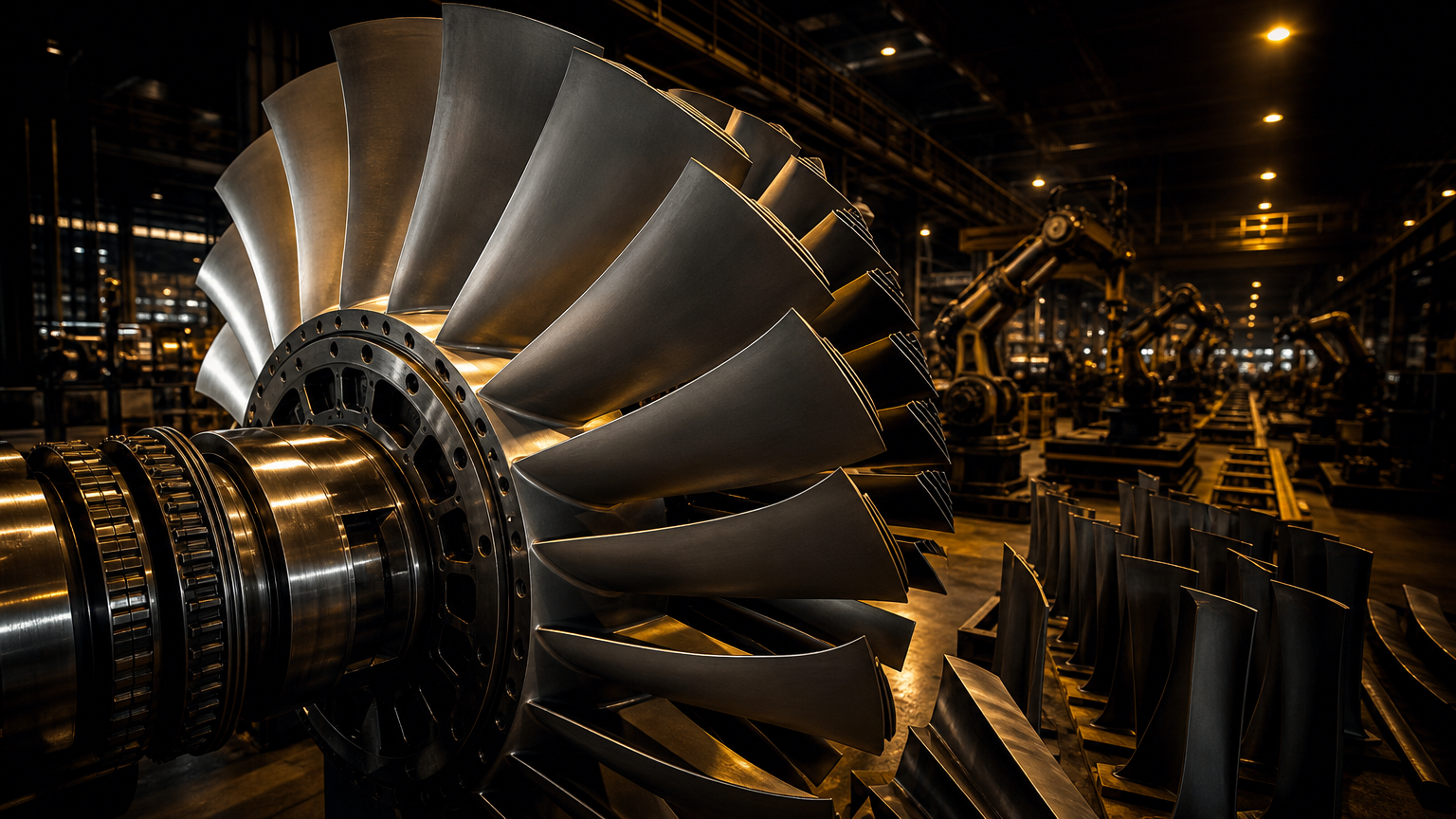
Elon Musk’s newest move looks strange only if the AI race is still viewed as a contest over GPUs. The current signal from SpaceX points somewhere more industrial: the company is preparing to make turbine blades and vanes in-house in Texas, aiming at one of the hardest constraints in getting power to large AI data centers . Musk said the point is to accelerate natural-gas turbines coming online by as much as 18 months, because the limiting factor in production is the casting of blades and vanes .
That is why the move matters. A data center full of accelerators is not useful infrastructure until it has firm electricity, transformers, switchgear, fuel supply, permits and commissioning. Recent reporting framed Musk’s warning sharply: roughly 15 gigawatts of AI compute expected to be manufactured next year may not be powered up during 2027 . In other words, the industry may soon own enough silicon to promise a step-change in AI capacity, while lacking enough energized sites to turn that silicon into revenue-generating compute .
The market has spent years asking who can get the most Nvidia chips. Musk is asking a different question: who can get a megawatt energized on a reliable date?
Why blades and vanes became strategic assets
The SpaceX plan, as reported, centers on a foundry in Bastrop, Texas, near the company’s existing Starlink industrial footprint . The Information reported that SpaceX was laying groundwork for a facility to build turbine vanes and blades for data-center power needs, and Musk responded by saying in-house casting could shorten the timeline for natural-gas turbines by up to 18 months . Separate coverage said SpaceX job postings referred to a “blades and vanes foundry” and to an industrial gas turbine blades-and-vanes manufacturing line in Bastrop .
This is not a commodity metalworking problem. The hottest turbine blades operate in extreme temperatures and require specialized casting, coatings and cooling designs that let the component survive where ordinary alloys would fail . Tom’s Hardware noted that turbine blade and vane manufacturing can take 60 to 90 weeks from start to finish, because the parts face intense heat, force and reliability requirements even when the turbines are used as stationary generators rather than aircraft engines .
The strategic insight is simple: if the queue is controlled by a tiny group of expert suppliers, buying finished turbines is not enough. Musk’s wager is that SpaceX can attack the upstream constraint directly. That is the same vertical-integration instinct behind rockets, satellites and high-volume manufacturing: when a supplier’s timeline becomes the mission’s timeline, the supplier becomes part of the mission.
A power race disguised as an AI race
Recent coverage also connects the blade push to a broader shift in AI infrastructure. Electricity supply in the United States is now limiting how fast AI data centers can come online, and operators have increasingly turned to portable or on-site natural-gas generation to avoid waiting for grid interconnections . TechCrunch reported that hyperscalers and AI builders are turning toward private gas-fired power near data centers as grid delays and turbine shortages collide with the AI buildout .
Benzinga framed the move as an attempt to break the same bottleneck GE Vernova has been discussing with investors . It reported that GE Vernova is mostly sold out through 2030 and is trying to lift annual turbine production from roughly 20 gigawatts this year to 30 gigawatts by the end of the decade . The same report said GE’s planned step-up to 24 gigawatts of annual output in 2028 depends on additional castings and forgings arriving in 2027 .
That makes Musk’s target unusually precise. He is not merely trying to buy more power. He is trying to buy time by manufacturing a component that sits inside the delivery schedule of power itself.
The move is powerful, but not magic
The strongest version of the thesis is that SpaceX’s manufacturing culture can pull forward turbine deliveries for Musk-controlled AI facilities, including xAI-related infrastructure, before competitors can solve their own power queues . If SpaceX can make qualified turbine components at scale, it could reduce dependence on external blade-and-vane suppliers and shorten the path from ordered generator to energized data center .
But even favorable coverage adds important caveats. Blockspace noted that faster casting would shorten only one equipment queue, while complete power plants still require fuel infrastructure, emissions controls, electrical equipment, site work and commissioning . Benzinga similarly warned that SpaceX still has to prove it can manufacture these components reliably at scale, and that construction, permitting, fuel supply and other infrastructure can delay projects even when turbine components are available .
That distinction matters. Musk can attack a manufacturing bottleneck. He cannot repeal thermodynamics, environmental law, gas-pipeline logistics or substation lead times. The move is a serious attempt to compress one critical part of the schedule, not a guarantee that every stranded AI cluster will light up on command.
The pollution problem comes with the shortcut
The gas-turbine path also carries a political and environmental cost. TechCrunch reported that more gas turbines coming online quickly would intensify existing concerns around emissions from data-center power, citing disputes over turbines used to power Musk-linked Colossus data centers in Memphis . The same report said the NAACP has accused the company of operating turbines without the permits or pollution controls required by federal law, and raised concerns about smog-forming compounds and hazardous chemicals such as formaldehyde .
That is the tension at the center of the story. Musk’s argument is that natural gas is needed to supplement and bootstrap solar for several years, even as SpaceX and Tesla pursue large solar manufacturing ambitions . Critics will answer that temporary fossil infrastructure has a way of becoming durable infrastructure, especially when it is tied to the profitability of billion-dollar AI campuses.
The genius of the move, if it works, is industrial. The controversy, if it grows, will be civic. The same turbine that energizes GPUs also emits pollutants, demands permits, needs fuel and sits near real communities.
Why this proves he is playing a different game
Most AI companies are optimizing inside a familiar procurement stack: chips, racks, networking, land, interconnection and power-purchase agreements. Musk appears to be optimizing the stack itself. By targeting turbine blades and vanes, SpaceX is moving from being a customer of scarce power equipment toward being a maker of the scarce component inside that equipment .
That is why this story is bigger than a factory in Bastrop. It suggests the AI winners of 2027 may not be the companies with the cleanest model demos or the largest chip orders, but the ones able to convert hardware into energized, permitted, usable compute. The 15-gigawatt warning captures that shift: the danger is not that the chips cannot be made, but that they cannot be switched on fast enough .
Musk’s new move proves he is playing a different game because he is not waiting at the end of the queue. He is trying to rebuild the queue.
Sources from the last 72 hours
- [1]Musk Responds to The Information’s Report About SpaceX Setting Up a Turbine Blade FactoryAug 30, 2026, 7:11 AM UTC
- [2]Musk’s faster path to more gas turbines comes with pollution problemAug 30, 2026, 4:54 PM UTC
- [3]SpaceX starts in-house turbine blade manufacturing to boost gas-powered generator output for Elon's AI data centers — new manufacturing strategy cuts generator delays by 18 monthsAug 30, 2026, 2:49 PM UTC
- [4]Elon Musk Is Trying to Break GE Vernova's AI Power BottleneckAug 31, 2026, 2:16 PM UTC
- [5]Musk’s SpaceX turbine plan targets one bottleneck in costly AI data center buildoutAug 31, 2026, 12:00 AM UTC
- [6]Musk's 15-Gigawatt Warning Reshuffles the 2027 AI BetAug 30, 2026, 2:49 PM UTC
- [7]Elon Musk on X: SpaceX and Tesla are each building 100GW/year of solar production capacity as fast as possibleAug 29, 2026, 8:14 PM UTC
AI-generated article based on recent web research, then preserved as a dated editorial snapshot.
Comments
Be the first to comment.