
Daily Podcast full article
NASA launches $4.3B Roman telescope on Falcon Heavy to map the hidden universe
NASA’s Nancy Grace Roman Space Telescope is now on its way to deep space after a SpaceX Falcon Heavy launch from Kennedy Space Center, opening a flagship mission built to survey dark energy, dark matter, exoplanets and rare cosmic events at a scale Hubble and Webb were not designed to cover.
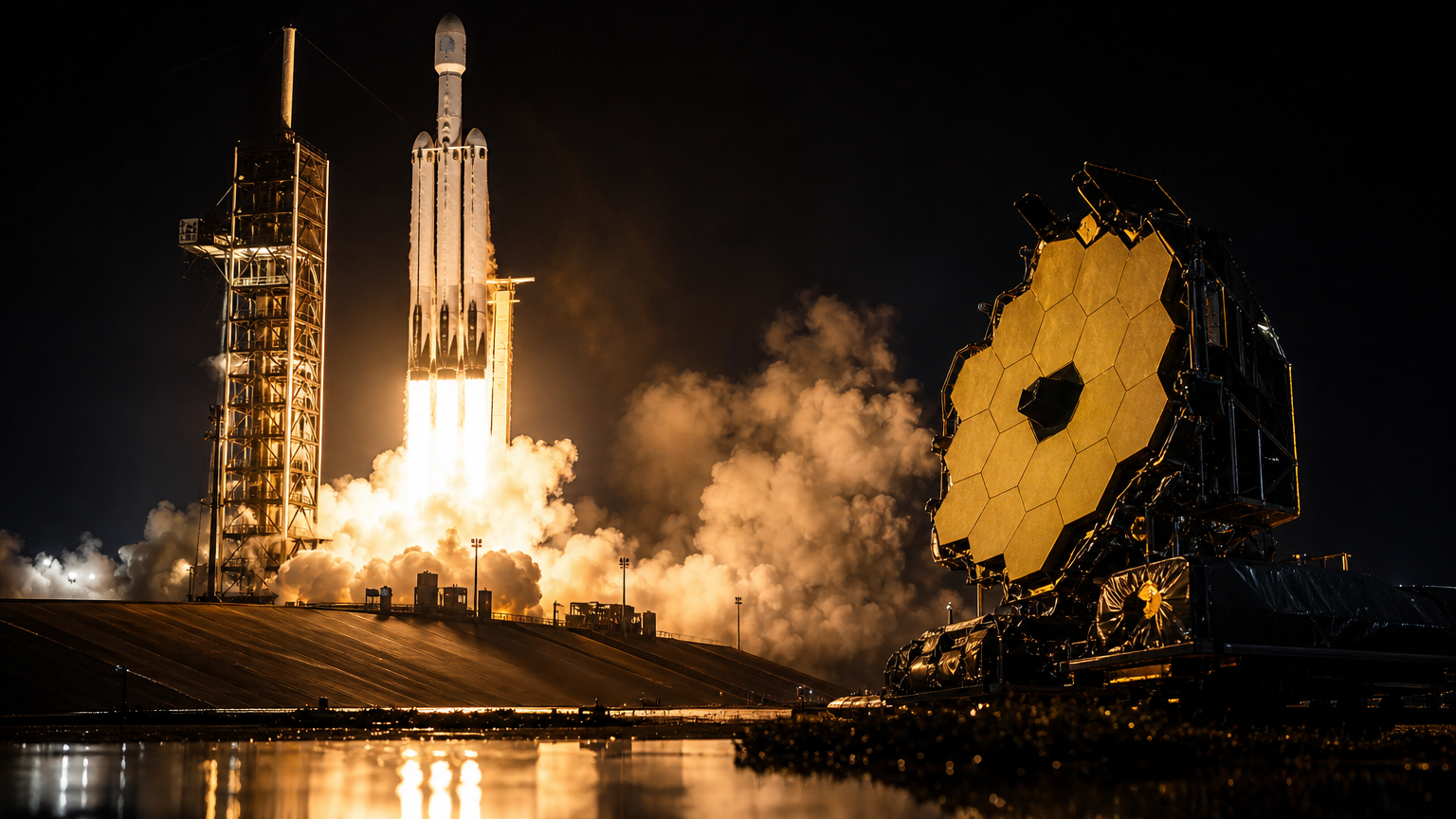
A flagship observatory leaves Earth
NASA’s $4.3 billion Nancy Grace Roman Space Telescope lifted off Sunday, August 30, 2026, aboard a SpaceX Falcon Heavy from Launch Complex 39A at Kennedy Space Center in Florida, beginning a roughly three-month trip toward its observing post about one million miles from Earth . The launch occurred at 7:26 a.m. EDT, and NASA said Roman is now headed for the second Sun-Earth Lagrange point, or L2, the same broad deep-space region used by the James Webb Space Telescope .
The early post-launch sequence was clean. NASA reported that ground controllers at Goddard Space Flight Center began receiving telemetry seven minutes after liftoff, that the Falcon Heavy performed as expected, and that Roman separated from the rocket 31 minutes into flight . A separate NASA launch update said the telescope was flying independently at 7:57 a.m. EDT and had established communications through a NASA Tracking and Data Relay Satellite during ascent .
For NASA, the event marks the arrival in space of a major astrophysics mission that has been framed as a wide-field partner to Hubble and Webb rather than a replacement for either. Roman carries a Hubble-class 2.4-meter mirror but is built around a panoramic infrared survey capability, allowing it to observe enormous patches of sky rapidly while preserving sharp space-based imaging . That design is central to why scientists expect it to become a statistical engine: instead of lingering on a small number of exquisite targets, Roman will build large maps of stars, galaxies, supernovae and planetary systems .
What Roman will do differently
Roman’s scientific case begins with the “dark universe.” NASA says the telescope’s broad infrared surveys will help astronomers investigate dark matter, dark energy and exoplanets, while also supporting research beyond those headline goals . CBS News reported that Roman’s wide-field 300-megapixel camera will map the large-scale structure of the cosmos and search for clues about dark energy, the unexplained driver associated with the universe’s accelerating expansion .
The mission’s value is partly architectural. Hubble has delivered decades of deep, narrow, high-resolution views, and Webb is optimized for extremely sensitive infrared observations of selected targets. Roman is different: its strength is speed across area. The Associated Press reported that Roman’s field of view is more than 100 times wider than Hubble’s, and that NASA officials expect the mission to find thousands of supernovae, tens of thousands of planets, billions of galaxies and tens of billions of stars .
That scale matters because dark energy and dark matter are not best understood by looking at one galaxy at a time. Roman is designed to map how galaxies cluster and evolve across cosmic history, giving scientists a much larger statistical sample for testing how the universe expanded and how cosmic structure grew . If the measurements sharpen or complicate today’s cosmological tensions, Roman could become one of the missions that forces a rewrite of the standard model rather than merely filling in its details .
The exoplanet machine
Roman is also expected to transform the census of planets beyond the solar system. AP reported that Roman’s surveys could find tens of thousands of planets, while CBS News said the mission is expected to push the known exoplanet tally well above 100,000 by the end of its work , . The telescope will do this through broad monitoring of star fields, including searches for dips in starlight and gravitational microlensing events, in which the gravity of a foreground star magnifies light from a more distant star and can reveal the signature of an orbiting planet .
This approach is especially important because it can detect planets that are difficult to find with other methods. Transit surveys are strongest when a planet crosses directly in front of its star from our line of sight, while radial-velocity methods favor planets that tug detectably on their host stars. Microlensing can pick up colder, more distant worlds and can reveal planetary populations that current catalogs undercount .
Roman will not be a life-detection telescope. Its exoplanet role is broader and more foundational: to reveal how common different kinds of planets are across the Milky Way and to identify targets that other observatories can study in greater detail. AP reported that Webb could follow up some of the worlds Roman identifies, using its more sensitive narrow-field instruments to investigate selected targets .
A coronagraph for the next generation
Roman also carries an experimental coronagraph, a technology demonstration designed to block the glare of distant stars so that much fainter planets and surrounding material can be seen more directly . NASA’s Jet Propulsion Laboratory said the instrument was designed and built by JPL and is intended to demonstrate hardware that future missions, including concepts such as the Habitable Worlds Observatory, could use to image Earth-like planets around other stars .
That distinction is important. Roman’s coronagraph is not the mission’s main survey engine; the Wide Field Instrument is. But the coronagraph could be strategically important if it validates techniques needed for future direct imaging of smaller, dimmer planets. JPL said Roman’s coronagraph would take a step toward that future by attempting images of Jupiter-like exoplanets .
SpaceX’s heavy-lift moment
The launch also strengthens Falcon Heavy’s role as the U.S. government’s heavy-lift workhorse for high-value science payloads. NASA described Roman as the fourth primary NASA mission launched on a Falcon Heavy, and said its Launch Services Program worked with SpaceX earlier this year to accelerate the launch date because the telescope was completed early . That point is politically and operationally significant: flagship space telescopes are usually associated with delays, not early departures.
The rocket’s side boosters returned to the Cape after separation, while the center core was expended as planned to give the mission the performance needed for its trajectory , . CBS News reported that the Falcon Heavy’s 27 Merlin engines produced more than five million pounds of thrust at liftoff, and that the side boosters landed back at Cape Canaveral Space Force Station after separating about two and a half minutes into flight .
For SpaceX, the mission sits in a category distinct from routine commercial satellite deployments or crew and cargo flights. Roman is a flagship national science asset, and putting it safely on course reinforces Falcon Heavy’s place in the launch market for expensive, technically sensitive spacecraft that require high performance and a proven government interface.
What happens next
Roman is not ready to begin science immediately. NASA said the telescope is now beginning its journey to L2, with the Deep Space Network taking over communications after launch and guiding the observatory through the transfer . The agency also said the Near Space Network will later transmit Roman’s high-rate science data, while the Deep Space Network will provide tracking and navigation measurements, with additional downlink support from ESA and JAXA ground stations .
NASA and JPL said the first early deployments have already moved the spacecraft from launch survival mode into cruise and commissioning. JPL reported that Roman’s solar panels and lower instrument sun shade were successfully deployed one hour and 23 minutes after launch . In the coming days, teams plan to deploy the high-gain antenna and aperture cover, initiate the first of two mid-course correction maneuvers, and power on the Coronagraph Instrument .
The stakes are high because Roman’s promise depends on survey reliability as much as raw optics. A telescope that can map billions of objects must not only see sharply; it must return huge, well-calibrated datasets to Earth in a form scientists can use. If commissioning proceeds as planned, Roman will add a new layer to space astronomy: Hubble and Webb for depth and detail, Roman for breadth, population studies and rare events hiding in the statistical haystack.
That is why the phrase “the weird, the rare and the unusual” matters . Roman’s core mission is not simply to take beautiful pictures, though it almost certainly will. Its deeper purpose is to make the universe searchable at scale.
Sources from the last 72 hours
- [1]NASA’s Dark Universe-Seeking Nancy Grace Roman Space Telescope LaunchesAug 30, 2026, 12:00 AM UTC
- [2]NASA's Roman Space Telescope Flying on Its OwnAug 30, 2026, 11:58 AM UTC
- [3]NASA launches its Roman Space Telescope to explore the hidden universeAug 30, 2026, 8:54 PM UTC
- [4]NASA’s Dark Universe-Seeking Nancy Grace Roman Space Telescope LaunchesAug 30, 2026, 12:00 AM UTC
- [5]NASA’s newest space telescope launches on a quest to explore the hidden universeAug 30, 2026, 11:28 AM UTC
AI-generated article based on recent web research, then preserved as a dated editorial snapshot.
Comments
Be the first to comment.