
Daily Podcast full article
Elon Fires Back, Waymo Makes It Worse, OpenAI Has Public Meltdown
Tesla’s week has turned into a three-front stress test: Optimus is being framed as moving from promise to production, robotaxi expansion is approaching another public proving moment, and OpenAI’s decision to cut Cursor off after SpaceX’s acquisition has turned model access into a weapon in the AI platform wars.
A single story with three pressure points
The headline is not really three separate stories. It is one tightening loop around Elon Musk’s AI-and-automation strategy: Tesla wants to prove that robots and robotaxis are becoming real products, while OpenAI is trying to limit how much of its model infrastructure flows into a Musk-controlled coding platform. OpenAI said it intends to wind down its contract providing models to Cursor, the AI coding tool now owned by SpaceX, with a proposed shutoff date of November 12, 2026 . Bloomberg Law separately reported the planned termination and noted that OpenAI tied the move to Cursor’s acquisition by SpaceX .
That turns a commercial contract into a trust test. OpenAI’s public explanation was unusually direct: it said it could not be confident SpaceX would use OpenAI technology within its terms of service, citing its past experience with Musk-controlled companies and contract violations . In the same statement, OpenAI said its Cursor agreement included a limited cancellation window after a change of control and that it would not provide future models to Cursor . For developers, the immediate question is workflow continuity; for the industry, the bigger question is whether frontier-model access is still neutral infrastructure or now a competitive moat.
Musk answers with contempt, not compromise
Musk’s response did not read like a negotiation opener. RTHK reported that he responded on X by writing that he “couldn’t care less,” while accusing Sam Altman and OpenAI president Greg Brockman of being untrustworthy and repeating his claim that OpenAI had abandoned its original open-source nonprofit purpose . NDTV Profit also reported the same broad response, saying Musk dismissed the cutoff and attacked OpenAI’s leadership after the company confirmed it was ending its Cursor relationship .
Cursor’s side of the exchange tried to make the operational damage look contained. Michael Truell, Cursor’s co-founder and now an executive at SpaceX, said OpenAI models serve about 5% of Cursor user traffic and that Cursor was speaking with OpenAI to resolve the matter . But the 5% figure cuts both ways. If OpenAI models are only a small part of total usage, Cursor may survive the cutoff without a major product shock. If that 5% is concentrated in high-value enterprise coding tasks, image features, or frontier-model workflows, the loss could matter more than the headline percentage suggests.
Anthropic immediately became part of the story because the gap OpenAI leaves is an opportunity for Claude. Digital Trends reported that Anthropic co-founder Tom Brown said Cursor had been a trusted Anthropic partner since Sonnet 3.5 and that Anthropic would continue increasing compute to support Claude models in Cursor . That contrast is why this episode feels like a public meltdown rather than a routine vendor dispute: OpenAI is making a trust-and-safety case, Cursor is framing the move as a breach of neutrality, Musk is escalating the personal feud, and Anthropic is positioning itself as the practical refuge for developers.
Waymo’s critique gives Tesla bulls another target
The autonomy fight is running in parallel. Yahoo Finance, carrying Stocktwits reporting, said New Street Research analyst Pierre Ferragu reaffirmed a Buy rating and $600 price target on Tesla after Waymo defended its sensor-heavy robotaxi architecture . According to that report, Waymo argued that cameras alone are insufficient for safe autonomy at scale and defended a stack built around cameras, lidar, radar, high-definition maps, larger models, and a separate validation layer .
That was supposed to be a technical argument for redundancy. Instead, it handed Tesla supporters a familiar contrast. Ferragu reportedly called Waymo’s posture “defensive” and said it made him more bullish on Tesla’s vision-based approach . His argument is not that Waymo has no achievements; Waymo’s driverless mileage gives it a powerful credibility base. The investor argument is different: if Tesla’s lower-cost, vision-led system can scale faster across a huge fleet, then a sensor-heavy rival may look overbuilt even if it looks safer or more explainable today.
This is why “Waymo makes it worse” lands with Tesla bulls. The more Waymo insists that lidar, radar, maps, and layered validation are necessary, the more Tesla advocates hear an incumbent defending expensive architecture. The more Tesla moves toward a steering-wheel-free Cybercab, the more Waymo’s “black box” warnings sound like an attempt to frame the regulatory debate before Tesla’s next launch moment .
Cybercab and Nevada raise the stakes
Tesla’s robotaxi story is no longer just about a demo. Drive Tesla reported that Tesla received final approval to operate a commercial Robotaxi service in Nevada, removing an interim 10-vehicle cap and allowing up to 5,000 robotaxis over the next 12 months, even though Tesla said it expects to start with a smaller fleet and scale only if demand supports it . That matters because the market is shifting from “can the system work?” to “can it be permitted, deployed, and scaled city by city?”
The next public test is Cybercab. DigitalToday reported that Tesla’s September 3, 2026 Cybercab event in Austin could include a plan to deploy more than 1,000 robotaxis, while emphasizing that the real test will be how many vehicles are actually operating on public roads a month later . Tesla Briefing likewise framed the September 3 event around whether a two-seat vehicle with no steering wheel or pedals can clear real-world safety and regulatory hurdles .
That distinction is crucial. Tesla has often been strongest at turning product theater into investor conviction. Robotaxi scale, however, will be measured less by stagecraft and more by permits, insurance, uptime, intervention rates, service areas, and rider volume. A Cybercab with no manual controls forces regulators and rivals to stop treating Tesla’s autonomy program as just advanced driver assistance. It either becomes a transport network, or it remains a valuation story waiting for proof.
Optimus moves from spectacle to factory-risk story
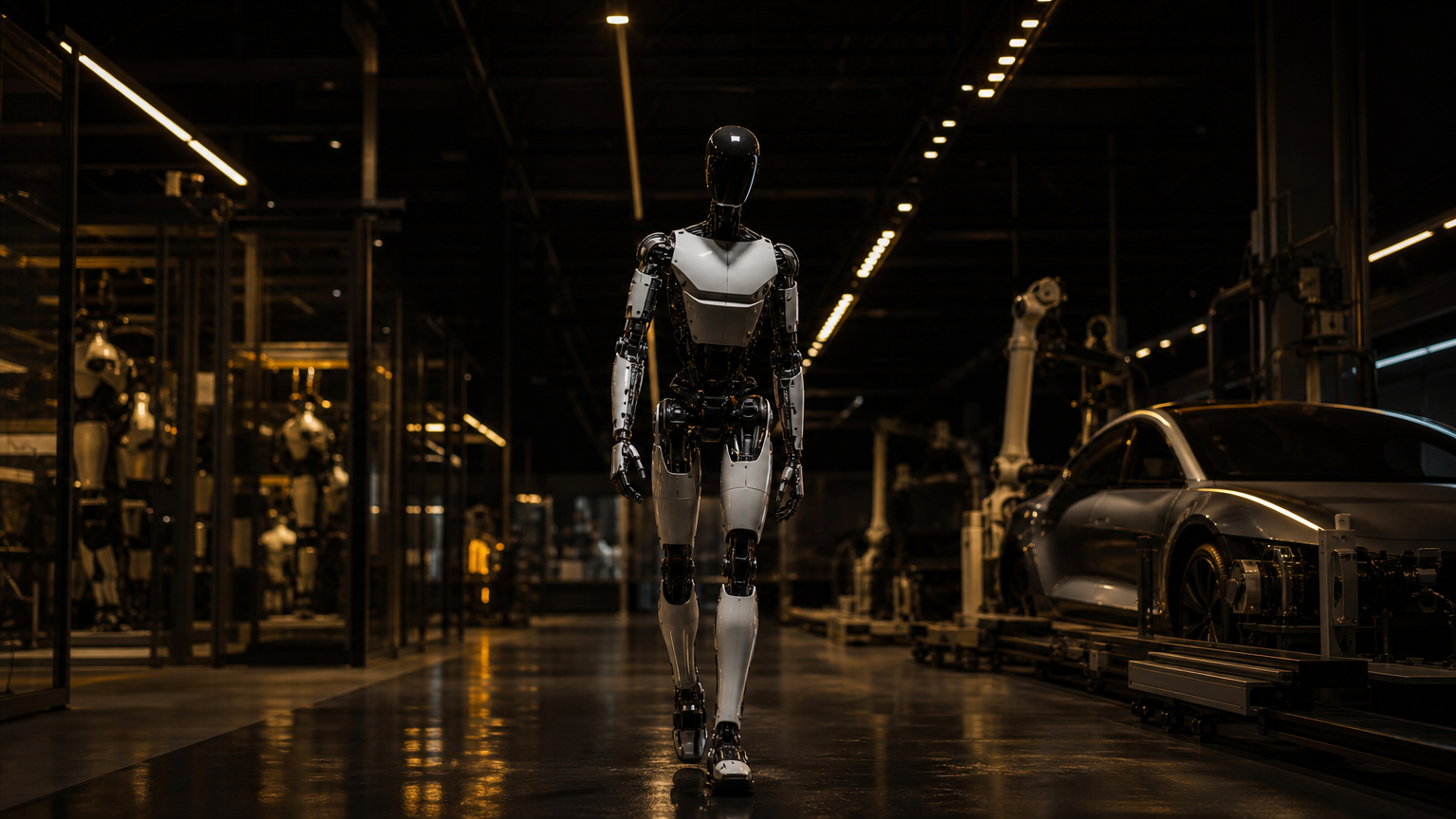
The robotics side has also sharpened. Tesla Briefing reported that Tesla has begun mass-producing Optimus humanoid robots on the retooled Fremont line that formerly built Model S and Model X vehicles, while warning that initial output is expected to ramp slowly . The same report said the first units are set to go into Tesla’s own “Optimus Academy,” where they would perform repetitive factory-floor tasks and create a feedback loop for further improvement .
That is the right near-term use case for Optimus. A humanoid robot does not need to solve every domestic chore on day one to become strategically important. If it can perform constrained, repetitive tasks inside Tesla factories, the company gets three things at once: labor substitution, real-world training data, and a controlled environment for debugging hardware and software. It also gives investors a way to evaluate Optimus without waiting for a consumer launch.
But the caveat is scale. Tesla Briefing said Musk had previously warned that predicting this year’s output rate was “essentially impossible” because Optimus has roughly 10,000 unique parts on an entirely new line . That makes Optimus less like another vehicle variant and more like a new manufacturing category. Even if the latest unreleased footage and insider reactions suggest rapid progress in novel tasks, the product question is not whether Optimus can impress in a clip. It is whether Tesla can build, maintain, train, and economically deploy large numbers of robots that improve through use.
The common thread: control
The common thread across OpenAI-Cursor, Waymo-Tesla, and Optimus is control. OpenAI wants control over where its models go and who can build on them . Waymo wants the industry to accept a controlled, redundant autonomy architecture . Tesla wants control of the full stack: robot body, robot brain, self-driving software, vehicle hardware, fleet deployment, and eventually the customer relationship .
That is why the weekend’s arguments matter. OpenAI’s move says model access can be withdrawn when ownership changes. Waymo’s argument says autonomy should be validated through layered engineering, not just fleet learning. Tesla’s response, implicit and explicit, is that vertical integration and scale will beat dependency and complexity.
The risk is that every side is partly right. OpenAI may be prudent to protect its models from a direct rival. Cursor may be right that developers expected model platforms to behave neutrally. Waymo may be right that redundancy is safer. Tesla may be right that cost and scale decide the market. The next phase will not be settled by posts, analyst notes, or launch events. It will be settled by whether Cursor users stay productive after November 12, whether Cybercab vehicles operate reliably after September 3, and whether Optimus units on Tesla’s factory floor can do useful work at a cost that makes the whole vision more than a spectacular demo.
Sources from the last 72 hours
- [1]Our decision on Cursor following its acquisition by SpaceXAug 28, 2026, 6:00 AM UTC
- [2]OpenAI to End Partnership With Cursor After SpaceX AcquisitionAug 29, 2026, 2:16 AM UTC
- [3]Altman-Musk row widens as OpenAI, Cursor fail to clickAug 29, 2026, 7:59 AM UTC
- [4]Elon Musk Hits Back At OpenAI Over Decision To End Cursor DealAug 29, 2026, 2:51 PM UTC
- [5]TSLA Stock’s 3-Week Rally Faces A Test — Why Waymo’s ‘Defensive’ Turn Makes This Bullish Analyst Love Tesla Even MoreAug 28, 2026, 7:09 AM UTC
- [6]Cybercab launch is 6 days out — what Tesla must prove without a steering wheelAug 29, 2026, 12:00 AM UTC
- [7]Tesla gets green light for up to 5,000 robotaxis in Nevada, but plans a much smaller startAug 29, 2026, 12:00 AM UTC
- [8]Tesla Cybercab launch event: key points to watchAug 28, 2026, 10:56 PM UTC
- [9]Stung by OpenAI pulling GPT models from Cursor? Anthropic offers a timely lifeline with higher Claude limitsAug 30, 2026, 9:06 AM UTC
AI-generated article based on recent web research, then preserved as a dated editorial snapshot.
Comments
Be the first to comment.