
Daily Podcast full article
SpaceX plans $100B spaceport in Louisiana marshland
SpaceX’s proposed “Starbase Louisiana” is no ordinary launch-site expansion: the company is pitching a $100 billion, company-controlled Gulf Coast spaceport in Vermilion Parish, with Starship pads, propellant infrastructure, power, housing and coastal works. The plan promises jobs and launch capacity, but it is already raising questions over financing, environmental review, public disclosure and whether Louisiana can turn a marshland megaproject into a durable aerospace economy.
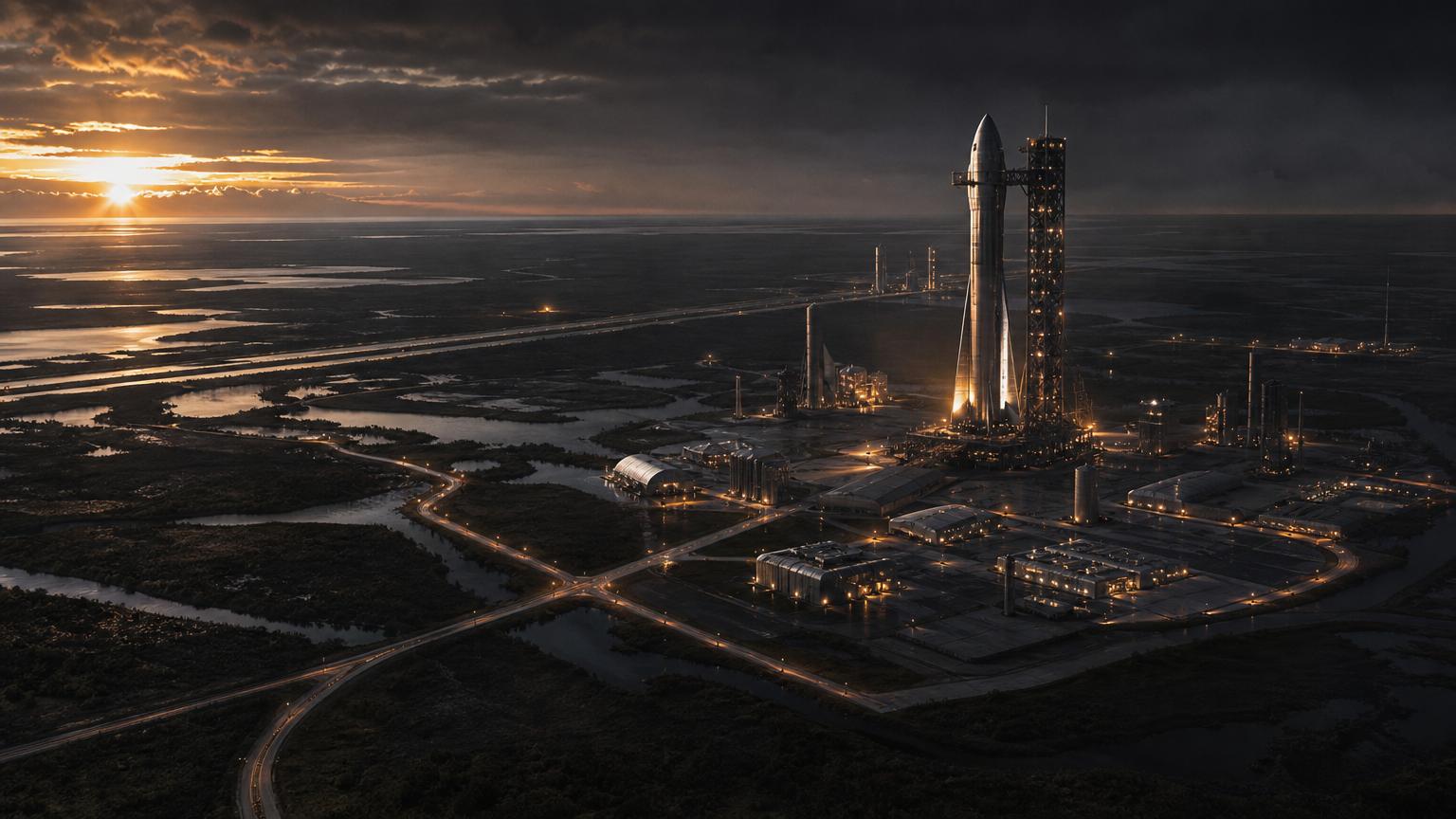
A private Kennedy-style bet on the Gulf Coast
SpaceX’s plan for a $100 billion spaceport in coastal Louisiana has moved from rumor to a major political and industrial project. The facility, branded Starbase Louisiana, is planned for Vermilion Parish near Pecan Island, on marshland that state and local leaders say could become the company’s largest launch site and one of the world’s most ambitious private space infrastructure projects .
The project’s logic is straightforward: SpaceX wants far more launch capacity than its existing footprint can comfortably provide. The Louisiana complex is described as a fourth and largest launch facility for the company, with construction expected to begin in 2027 and a first launch targeted as early as 2029 . At full buildout, the current plan calls for five launch complexes, each with two launch pads and a propellant farm, plus propellant production, power generation, vehicle processing, employee housing and other support infrastructure .
That architecture matters because Starship is not meant to fly like an occasional heavy rocket. It is designed around high cadence, reuse and large payload movement. If SpaceX is serious about thousands of annual Starship flights, it needs launch operations that look less like a conventional spaceport and more like a combined industrial port, refinery, factory, airport and range. Louisiana’s appeal lies in its Gulf access, its energy infrastructure and its industrial workforce, but also in the possibility of designing a site around SpaceX’s own operating model rather than fitting that model into an older federal range .
The scale: 10 pads, marsh acreage and a long ramp-up
The numbers explain why this proposal is being compared to a company-controlled Kennedy Space Center. Recent reporting describes a planned site of roughly 125,000 acres, only part of which SpaceX says it would develop, with large portions preserved as wetlands or habitat . The company’s leadership has said Starbase Louisiana could eventually include more than a dozen launch towers and support more than 30 Starship flights per day, which would place the site far beyond today’s launch cadence at any existing spaceport .
The nearer-term plan is less spectacular but still enormous. SpaceX is expected to start construction in 2027, with the first Starship launch possible in 2029 . The first years would likely be dominated by access roads, shoreline stabilization, site preparation, utilities, propellant systems and environmental work rather than rockets rising from every pad. For Louisiana, the schedule is important because the promise of jobs and vendor contracts will arrive in phases, not all at once.
The state’s pitch emphasizes employment. Current local reporting says the project could bring thousands of jobs to Acadiana and Southwest Louisiana, while nearby parishes are already trying to position themselves as logistics, tourism and supplier hubs . Jeff Davis Parish leaders, for example, are pitching Jennings and the I-10 corridor as a “gateway” to the future launch site and are already reaching out to suppliers and vendors before construction begins .
Why SpaceX wants control
The strategic value of Starbase Louisiana is control. Launch bottlenecks are no longer just a technical issue for SpaceX; they are a business constraint. Falcon 9, Starship, Starlink, lunar contracts and future orbital-infrastructure ambitions all require pad time, range coordination, regulatory clearance, ground systems and recovery logistics. A launch vehicle can be reusable, but a launch system is only as fast as its slowest permission, tank farm, tower, road, port or weather constraint.
A company-controlled spaceport gives SpaceX negotiating leverage and operational flexibility. It can design propellant production, power, deep-water logistics and processing flows around Starship from the start rather than adapting to legacy infrastructure . The plan also fits the company’s wider capital-intensive push into launch, satellites and artificial-intelligence-linked orbital infrastructure; one investor-focused report said analysts are already questioning how SpaceX will finance a $100 billion Louisiana facility alongside its other large initiatives .
Morgan Stanley analysis reported by Yahoo Finance framed the Louisiana site as a strategic milestone tied not only to Starship launches but also to the market’s understanding of the scale of SpaceX’s ambitions . That framing is important: the spaceport is not just a Louisiana real-estate story. It is a bet that launch cadence itself becomes a decisive industrial advantage.
Financing questions are now part of the story
A $100 billion commitment invites a simple question: how will SpaceX pay for it? Recent financial coverage says the Louisiana spaceport is drawing investor scrutiny because it adds to already extraordinary capital needs across launch systems, satellites and artificial intelligence . One report said analysts expect SpaceX may need significant debt financing to support its broader expansion, even if the Louisiana facility represents only a portion of total expected spending through 2035 .
That does not mean the project is financially impossible. SpaceX has repeatedly raised capital on the strength of Starlink, government contracts and the perceived long-term value of Starship. But a marshland spaceport is not software. It involves civil engineering, environmental mitigation, heavy transport, utilities, power, housing, propellant systems and launch infrastructure. Cost overruns, permitting delays, hurricane exposure and political opposition could all affect the timeline and final cost.
The financing debate also intersects with public incentives. Louisiana lawmakers signed a package of laws before the announcement to create aerospace tax incentives and legal protections . WBRZ reported that House Bill 1088 authorizes tax rebates for certain machinery and items at approved aerospace facilities, while other bills extend tax-exemption eligibility, shield aerospace companies from some lawsuits tied to flight activity and protect certain aerospace records from public disclosure . Supporters call that an economic-development toolbox; critics see it as a large public accommodation for a private company.
The environmental test: launchpads in fragile wetlands
The most immediate tension is environmental. Pecan Island and surrounding marshes are known for fishing, crabbing, duck hunting and migratory bird habitat . The area includes wetlands used by alligators, deer, native water birds, ducks and snow geese . SpaceX President Gwynne Shotwell has said the company will keep large portions of the 125,000 acres untouched so high-value wetlands remain habitat rather than infrastructure .
Environmental advocates are not satisfied by that promise alone. Rebecca Triche of the Louisiana Wildlife Federation questioned how much the public can learn about the site’s ultimate impact if environmental review requirements are weakened while nondisclosure agreements limit information flow . She argued that issues such as noise and wildlife impact should be answered through a permit process .
Those concerns have grown because federal space-launch policy is moving toward faster permitting. Local reporting says critics are worried about proposed rule changes that could waive multiple environmental and public-health laws for commercial space permits, including projects like Starbase Louisiana . SpaceX says launches and wildlife can coexist, citing its experience at other facilities, but Louisiana’s marshes will test whether coastal restoration, launch operations and public trust can be managed together .
Transparency, laws and local trust
The political challenge may be as significant as the engineering challenge. WBRZ reported that six bills were signed before the SpaceX announcement, including measures that create tax incentives, legal protections and public-record exemptions for aerospace activity . A longtime Abbeville resident quoted in the same report said locals still do not know how much noise or what effects they will experience .
Even officials who favor the project are calling for openness. Lieutenant Governor Billy Nungesser said the project could bring tourism dollars when people travel to watch launches, but he also said transparency is critical because “it’s their land” and “their community” . That statement captures the balance Louisiana now has to strike: the state wants a once-in-a-generation aerospace investment, but the people living near the marshes want clear answers before the first access road, tank farm or tower appears.
The bottom line
SpaceX’s Louisiana plan is best understood as a launch-cadence bet. If Starship becomes the workhorse for Starlink, lunar logistics, deep-space missions and orbital infrastructure, a dedicated Gulf Coast spaceport could become a critical node in the company’s future. If Starship’s cadence grows more slowly, or if regulatory, environmental and financing pressures accumulate, Starbase Louisiana could become a long, expensive test of how far private space infrastructure can scale.
For now, the current state of the project is clear: SpaceX has put forward a $100 billion plan, Louisiana has moved to support it with laws and local economic-development machinery, and communities around Vermilion Parish are beginning to ask what the transformation of marshland into a company-controlled spaceport will really cost and who will benefit .
Sources from the last 72 hours
- [1]Questions raised concerning effects of announced Vermilion Parish SpaceX facility on area wildlifeAug 27, 2026, 3:00 PM UTC
- [2]$100 billion SpaceX project brings SWLA opportunities and questions; Lt. Gov. Nungesser weighs inAug 27, 2026, 11:45 PM UTC
- [3]Package of new laws help clear the way for SpaceX deal in LouisianaAug 28, 2026, 10:35 PM UTC
- [4]SpaceX $100 billion Louisiana spaceport funding questionsAug 28, 2026, 12:41 PM UTC
- [5]Morgan Stanley sees SpaceX $100B Louisiana site as unpriced orbital AI catalystAug 28, 2026, 1:36 PM UTC
AI-generated article based on recent web research, then preserved as a dated editorial snapshot.
Comments
Be the first to comment.