
Daily Podcast full article
Roman Telescope Nears Launch on SpaceX Falcon Heavy
NASA’s Nancy Grace Roman Space Telescope is poised for an early Sunday liftoff from Kennedy Space Center, with SpaceX’s Falcon Heavy assigned to send one of the decade’s most important observatories toward Sun-Earth L2. The hardware is ready, the rocket is vertical, and the remaining uncertainty is Florida weather.
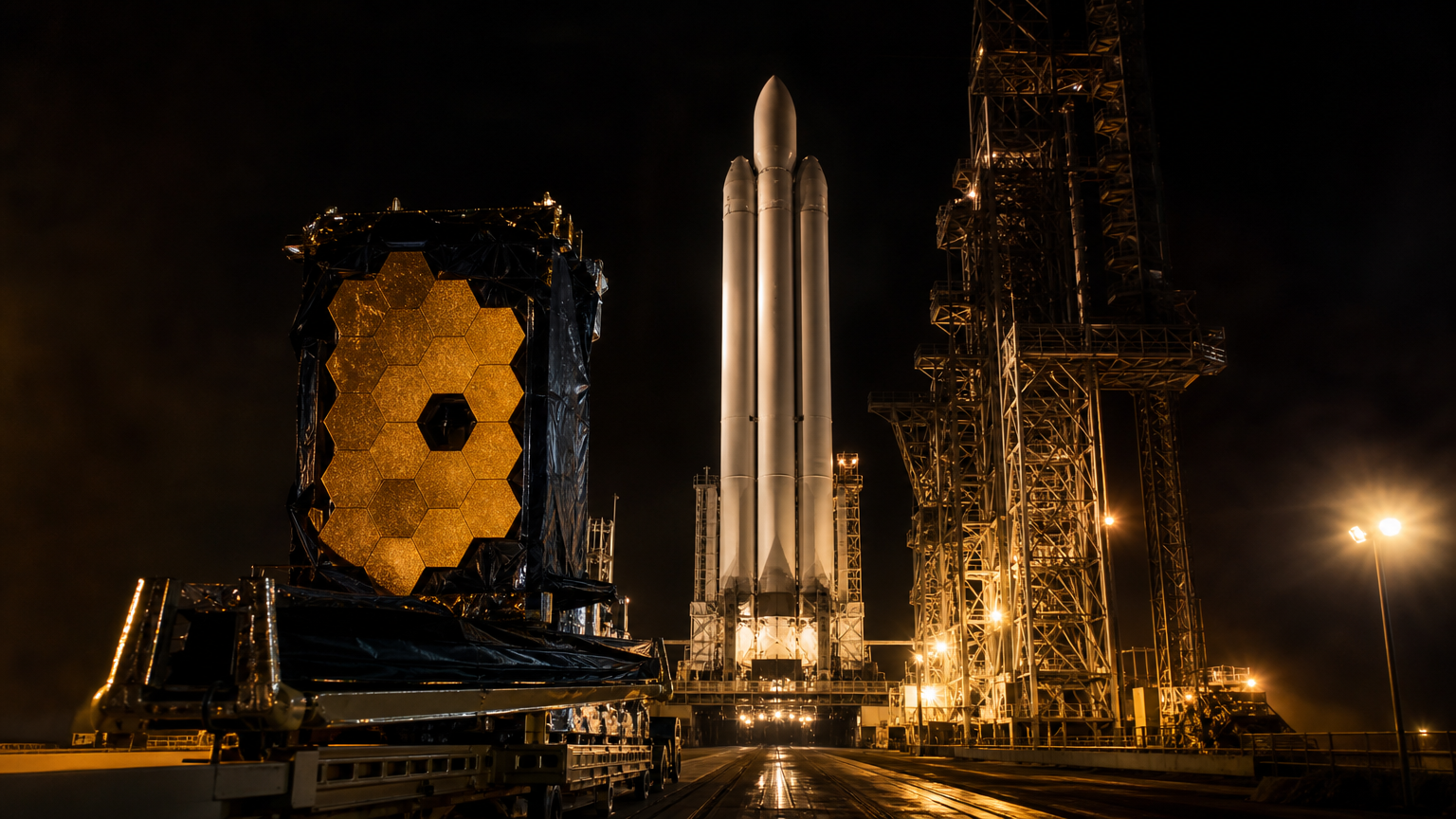
A flagship observatory reaches the pad
NASA’s Nancy Grace Roman Space Telescope has entered the final hours before launch, with NASA and SpaceX targeting an early Sunday liftoff from Launch Complex 39A at Kennedy Space Center in Florida aboard a Falcon Heavy rocket . NASA said the mission cleared its Launch Readiness Review on Friday, the final formal review before countdown operations proceed toward liftoff . The review covered the observatory, the Falcon Heavy, weather, and the support teams required to move the mission from pad operations into flight .
By Saturday morning, the Falcon Heavy carrying Roman had rolled from SpaceX’s hangar to Launch Complex 39A and had been raised vertical on the pad . NASA described the rocket as almost 230 feet tall and powered by 27 Merlin engines distributed across the center core and two side boosters, generating more than five million pounds of thrust . The mission’s public launch listings showed a narrow window around 11:25-11:26 UTC on August 30, equivalent to about 7:26 a.m. EDT, with the mission status marked “Go for Launch” .
Roman is not a routine satellite payload. It is NASA’s next flagship astrophysics observatory, designed for wide, deep surveys that will investigate dark energy, dark matter, exoplanets, black holes, galaxies, and objects across a huge range of cosmic distances . After separation from the rocket, the observatory is bound for the second Sun-Earth Lagrange point, or L2, roughly one million miles from Earth, where it can maintain a broad, stable view of the sky .
Weather is the launch-day variable
The main constraint heading into Sunday is not spacecraft readiness but Florida’s late-summer weather. NASA’s Friday update said the U.S. Space Force’s Space Launch Delta 45 Weather Squadron was predicting a 60% chance of favorable conditions for the targeted liftoff time . By Saturday’s prelaunch briefing, Space.com reported a more cautious 50% chance of acceptable launch weather, with launch weather officer Justin McReynolds identifying offshore cumulus clouds and possible showers or thunderstorms as the main concerns .
That shift does not mean the mission is in trouble. It means the launch team is dealing with the familiar Cape Canaveral problem: small weather cells, clouds, and lightning rules can matter more than the apparent calm at any one viewing site. Space.com reported that conditions were expected to improve for backup opportunities on Monday and Tuesday, when the weather violation probability was expected to fall to about 30%, implying a roughly 70% chance of acceptable conditions . A public launch tracker also showed the updated weather probability at 50% “GO” after an L-1 forecast update on Saturday afternoon .
For NASA and SpaceX, the timing is useful if the early window holds. Space.com noted that conditions were expected to deteriorate later in the day, giving the early-morning attempt a better chance than a later launch would have had . If Sunday’s attempt is delayed, Space.com’s live updates listed a Monday backup opportunity at 7:22 a.m. EDT .
Why Roman matters scientifically
Roman’s scientific promise rests on a combination of sharp infrared vision and enormous survey speed. Axios reported that the observatory is carrying two science instruments: the Wide Field Instrument and the Coronagraph Instrument . The Wide Field Instrument is a 300-megapixel near-infrared camera with a field of view 100 times larger than Hubble’s imaging field, allowing one Roman image to contain the visual data of many Hubble-scale views . The Coronagraph Instrument is intended for high-contrast imaging and spectroscopy of nearby exoplanets, demonstrating technologies that can suppress starlight enough to study worlds around other stars .
NASA framed Roman’s surveys as a way to map billions of galaxies, trace the effects of dark matter, and probe dark energy, the unknown driver associated with the accelerating expansion of the universe . The observatory will also help scientists search for and characterize planets beyond the solar system, including through gravitational microlensing surveys of the Milky Way . Space.com reported that Roman’s visible-to-near-infrared images will cover a field of view 50 times wider than that of the James Webb Space Telescope .
The mission will not deliver instant science images after launch. Space.com reported that Roman will spend roughly three months on instrument deployments, calibrations, and checkout activities as it travels toward and settles into operations around L2 . NASA expects the first science images to be released in early 2027, assuming launch and commissioning proceed as planned .
Falcon Heavy’s premium-science role
Roman also reinforces Falcon Heavy’s role as a launcher for high-value NASA science missions. NASA said this will be the sixth NASA primary mission launched with SpaceX on a Falcon rocket from Kennedy, following IXPE, Psyche, NOAA’s GOES-U, Europa Clipper, and IMAP . While not all of those were Falcon Heavy missions, the list shows how SpaceX has become embedded in NASA’s major science and exploration launch flow from the Space Coast .
For Roman specifically, Falcon Heavy offers the energy needed to send a school-bus-scale observatory toward L2. NASA’s Saturday update described Roman as roughly the size of a school bus and weighing about as much, requiring a powerful rocket to send it more than a million miles from Earth . The same update said the Falcon Heavy’s 27 Merlin engines and two side boosters provide more than five million pounds of thrust .
A public launch profile listed the center core as expended and the two side boosters as returning to landing zones, with one side booster identified as flight-proven . That profile underlines the hybrid nature of this mission: a premium NASA payload using a high-performance trajectory, while still preserving some of SpaceX’s booster-recovery routine . For commercial space, Roman is therefore not just another launch booking; it is a demonstration that reusable-era launch vehicles are now trusted with billion-dollar-class science infrastructure.
A political survivor reaches flight
Roman’s approach to launch carries an unusually vivid political backstory. Space.com reported that the telescope’s launch caps nearly two decades and about $4 billion of development . The same report described how President Donald Trump’s fiscal 2026 budget proposal threatened the mission with severe cuts after earlier proposals had repeatedly targeted Roman . Jamie Dunn, who served as Roman project manager from 2018 and later became director of NASA Goddard, told a National Academies committee that Roman had been “zeroed out” in the president’s budget in at least half of his eight years on the project .
Congress ultimately rejected the steep NASA science cuts and restored agency funding to the prior year’s level, according to Space.com . The telescope’s schedule then moved earlier, first toward September and then to late August, in part to get the mission launched within the fiscal year . NASA has described Roman as launching nine months ahead of schedule, turning a program that faced repeated budget danger into an early launch campaign .
That history matters because flagship observatories are long political and engineering bets. They require years of stable funding, specialized technical teams, and congressional willingness to protect science programs through changes in administration. Roman’s presence on the pad shows that the final launch campaign is also the end of a survival story.
The final question before liftoff
As of the latest prelaunch reporting before Sunday’s attempt, the mission itself is ready and the rocket is at the pad , , . The countdown is now a contest between operational discipline and Florida weather. If the sky cooperates, Falcon Heavy will push Roman away from Kennedy before breakfast on the U.S. East Coast, beginning a journey to L2 and a science campaign built to survey the universe at unprecedented scale , .
The stakes are high because Roman is both a scientific instrument and a policy symbol. It links NASA astrophysics, congressional budget fights, international and industrial partnerships, and SpaceX’s rise as the default launcher for many of the agency’s most demanding missions. For now, all of that comes down to a short Sunday window at Launch Complex 39A.
Sources from the last 72 hours
- [1]NASA’s Roman Space Telescope ‘Go’ for LaunchAug 28, 2026, 6:06 PM UTC
- [2]NASA Roman Arrives at Launch Pad, Mission Briefings ScheduledAug 29, 2026, 11:26 AM UTC
- [3]NASA's Roman Space Telescope is ready for launch aboard SpaceX Falcon Heavy rocketAug 29, 2026, 12:00 AM UTC
- [4]Trump tried to scrap NASA's Roman Space Telescope last year. Now it's ready to launchAug 27, 2026, 3:00 PM UTC
- [5]NASA's new telescope could unlock key mysteries of the universeAug 28, 2026, 3:05 PM UTC
- [6]Falcon Heavy | Nancy Grace Roman Space TelescopeAug 29, 2026, 3:22 PM UTC
- [7]Nancy Grace Roman Telescope live updates: Roman and Falcon Heavy delivered to launch padAug 28, 2026, 11:33 PM UTC
AI-generated article based on recent web research, then preserved as a dated editorial snapshot.
Comments
Be the first to comment.