
Daily Podcast full article
Xanadu and Pasqal lift quantum
Canada’s CAD $195 million commitment to Xanadu and Pasqal’s Nasdaq arrival point to the same inflection: quantum computing is moving from national research programs into factories, supply chains and public-market capital, even as the technology remains early and execution risk stays high.
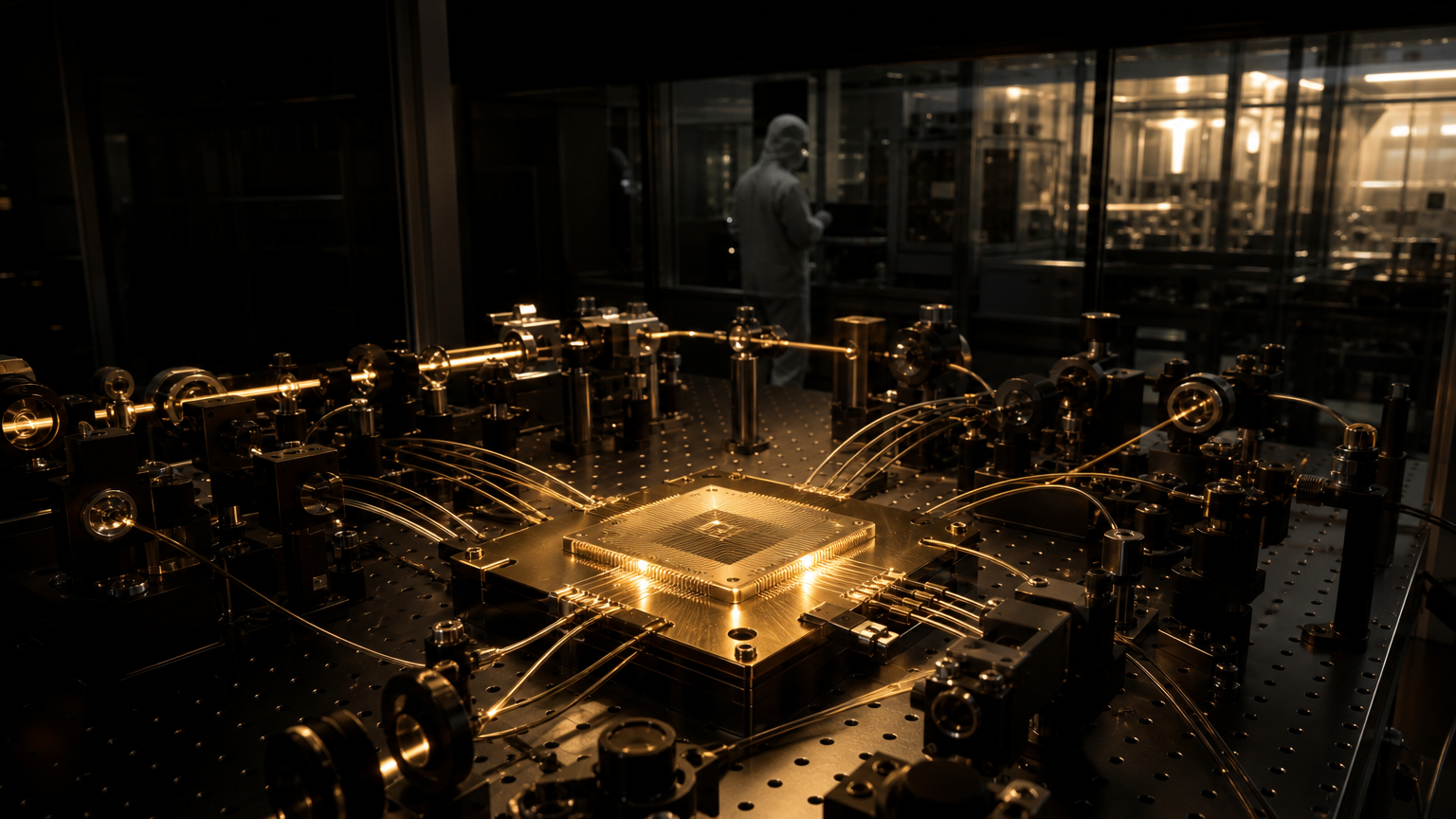
A quantum week defined by capital, not just science
Xanadu and Pasqal have given the quantum sector a sharper industrial storyline: build the machines, secure the supply chain and raise the capital before commercially useful systems arrive at scale. In Toronto, Xanadu secured CAD $195 million in federal backing for a CAD $893 million project to expand research and development and establish advanced quantum manufacturing capabilities in Canada . In Paris and New York, Pasqal completed its business combination with Bleichroeder Acquisition Corp. II, creating a public company expected to trade on Nasdaq under PSQL and PSQLW with about $360 million in cash available at closing .
The two announcements are not the same transaction, and they rest on different technologies. Xanadu is pursuing photonic quantum computing, using light as the basis for machines designed to operate at room temperature . Pasqal is focused on neutral-atom quantum processors and says it has deployed seven quantum processing units, with three more in production . But the strategic message is aligned: quantum companies are now being measured less by lab demonstrations alone and more by whether they can manufacture, integrate, test, sell and finance increasingly complex hardware.
Ottawa turns Xanadu into an industrial-policy test
The Canadian government framed the Xanadu award as a supply-chain and sovereignty investment, not merely a science grant. Innovation, Science and Economic Development Canada said the CAD $195 million will flow through the Strategic Response Fund into Xanadu’s CAD $893 million project, supporting 275 high-quality jobs and specialized facilities for developing, manufacturing and commercializing quantum technologies in Canada . Ottawa also linked the project to Canada’s National Quantum Strategy and Defence Industrial Strategy, describing domestic capacity in critical technologies as a matter of prosperity, security and sovereignty .
That framing matters. Canada has long had strength in quantum research, but the next test is whether it can retain the manufacturing value created by that research. Xanadu’s facility, named Inception, is intended as an advanced photonics research, development and manufacturing site within Project OPTIMISM . The company says the 158,000-square-foot Toronto site is being transformed for manufacturing, packaging and assembly of quantum computing components . In practical terms, this is about moving from customized laboratory builds toward repeatable processes for modules that could eventually fill quantum data centres.
Xanadu’s own language is ambitious. It says Inception is expected to include cleanrooms, high-precision quantum hardware equipment, round-the-clock test and measurement capabilities and heterogeneous integration that combines different photonic components onto scalable chips . The company has also named tooling and equipment partners, including ASMPT, Bluefors, DISCO, EVG, FiconTEC and MPI, underscoring that quantum hardware is becoming an advanced-manufacturing problem as much as a physics problem .
Why photonics is the strategic bet
Xanadu’s photonic approach is central to the Canadian story. Photonic quantum computing promises a pathway that can borrow from optical networking and semiconductor-compatible manufacturing, even if the sector has not yet solved all the problems required for broad commercial utility. Xanadu says it is building fault-tolerant quantum computers using light, with systems designed to operate at room temperature . That does not eliminate engineering complexity, but it changes the manufacturing equation compared with platforms that depend more heavily on extreme cryogenic environments.
The company has been explicit that the federal money is not the whole journey. According to reporting on the announcement, Xanadu plans to use the funds to help build the 158,000-square-foot Inception facility, whose first phase is targeted for completion by mid-2027, with additional capabilities expected over the following five years . Founder and chief executive Christian Weedbrook said the facility will support hardware production for a planned quantum data centre, which he wants to complete by 2030, and described the first data centre as a roughly US$1 billion ambition that will require more capital .
That makes the CAD $195 million commitment meaningful but not conclusive. It anchors a manufacturing base. It does not prove that the machines will reach fault-tolerant performance on schedule, that customers will pay at scale, or that Canada will capture the downstream economic value. Xanadu itself cautions that its plans involve forward-looking statements and risks, including technical challenges, future financing needs and uncertainty around commercialization .
Pasqal adds a public-market signal
Pasqal’s move adds a second, market-facing lift to the sector. The company and Bleichroeder said shareholders approved the business combination on August 25, 2026, and that the combined entity, Pasqal Holding SA, would begin trading on Nasdaq on August 28 under PSQL and PSQLW . Pasqal said the transaction leaves it with approximately $360 million in cash to accelerate deployment of its quantum computing platform, expand adoption and pursue fault-tolerant quantum computing .
The public debut was not quiet. Reuters, in a report carried by Boursorama, said Pasqal’s shares closed up 51.1% at $14.79 on their first day of Nasdaq trading . That market response is a data point rather than a verdict. It suggests investor appetite for quantum exposure, but it does not resolve the sector’s central challenge: turning expensive, delicate and error-prone machines into reliable computing infrastructure.
Pasqal’s governance announcement also shows how quantum firms are adapting to public-market scrutiny. The company said its nine-member board is chaired in a non-executive capacity by co-founder and 2022 Nobel physics laureate Alain Aspect, and includes executives and investors with experience across Michelin, Bpifrance, Inflection Point, Amazon, Google, Lambda, Brightspeed, SoftBank, Sprint and other institutions . For a company trying to sell neutral-atom quantum systems globally, that mix of science, industry and capital-markets experience is not decorative; it is part of the commercialization architecture.
Two technologies, one bottleneck: scale
Xanadu and Pasqal represent different bets in quantum hardware. Xanadu’s bet is that photonics can become manufacturable at the density, reliability and integration level needed for fault-tolerant computing. Pasqal’s bet is that neutral atoms can scale into useful processors and be deployed in environments close to the data-centre world customers already understand . Both are racing against the same bottlenecks: error correction, component yield, system integration, customer access, capital intensity and the lack of a large proven market.
The importance of Xanadu’s facility is therefore broader than one company. If Inception works as planned, Canada gains not just a flagship quantum firm but a domestic manufacturing node for photonic and semiconductor components used in quantum systems. The government said the project will support partnerships with Canadian research institutions and small and medium-sized businesses, aiming to turn Canadian ideas into Canadian products and jobs . That is the industrial-policy thesis: without local manufacturing capacity, intellectual property and talent can still leak into foreign supply chains.
Xanadu’s parallel work with Mitsubishi Chemical also shows why quantum hardware and semiconductor manufacturing are increasingly intertwined. On August 27, Xanadu said the next phase of its Mitsubishi collaboration would use quantum algorithms to advance simulations tied to extreme ultraviolet lithography, a key process in advanced chipmaking where radiation-induced blur remains a difficult modeling problem . The collaboration is separate from the federal funding announcement, but it reinforces the same point: quantum companies want to be relevant not only as computing vendors but also as tools for solving semiconductor and materials problems.
The sober read
The excitement around Xanadu and Pasqal should be read with discipline. The sector is still before the moment when quantum computers routinely beat classical systems on commercially valuable workloads. Reuters noted in its Pasqal coverage that quantum processors are being developed for specialized problems in areas such as drug discovery, materials science and financial modeling, while persistent errors still limit reliability at scale . That caveat applies across the field.
Still, the week’s developments are important because they shift quantum from promise to infrastructure. Xanadu’s CAD $195 million backing gives Canada a visible attempt to manufacture photonic quantum hardware domestically. Pasqal’s Nasdaq listing gives a European neutral-atom contender a public capital platform and a larger cash base. Together, they show that the quantum race is no longer only about which lab has the best demonstration. It is about who can build the factories, finance the roadmap, integrate the supply chain and survive long enough for useful machines to arrive.
Sources from the last 72 hours
- [1]Government of Canada invests in Xanadu to build up advanced quantum manufacturing in CanadaAug 28, 2026, 4:00 AM UTC
- [2]Xanadu Secures CAD $195 Million and Establishes Landmark Advanced Photonics FacilityAug 28, 2026, 6:04 PM UTC
- [3]Ottawa pumps $195 million into quantum manufacturing by XanaduAug 28, 2026, 5:00 PM UTC
- [4]Pasqal and Bleichroeder Acquisition Corp. II Complete Business CombinationAug 27, 2026, 8:05 PM UTC
- [5]Pasqal Announces the Board of Directors of the Combined Company Following Its Nasdaq ListingAug 26, 2026, 10:00 PM UTC
- [6]Pasqal, entreprise spécialisée dans l'informatique quantique, en hausse lors de son premier jour de cotation au NasdaqAug 28, 2026, 5:02 PM UTC
- [7]UPDATE -- Canada-Japan Support Advances Xanadu and Mitsubishi Chemical Partnership on Quantum Semiconductor ResearchAug 27, 2026, 4:00 AM UTC
AI-generated article based on recent web research, then preserved as a dated editorial snapshot.
Comments
Be the first to comment.