
Daily Podcast full article
SpaceX recovers Starship hardware
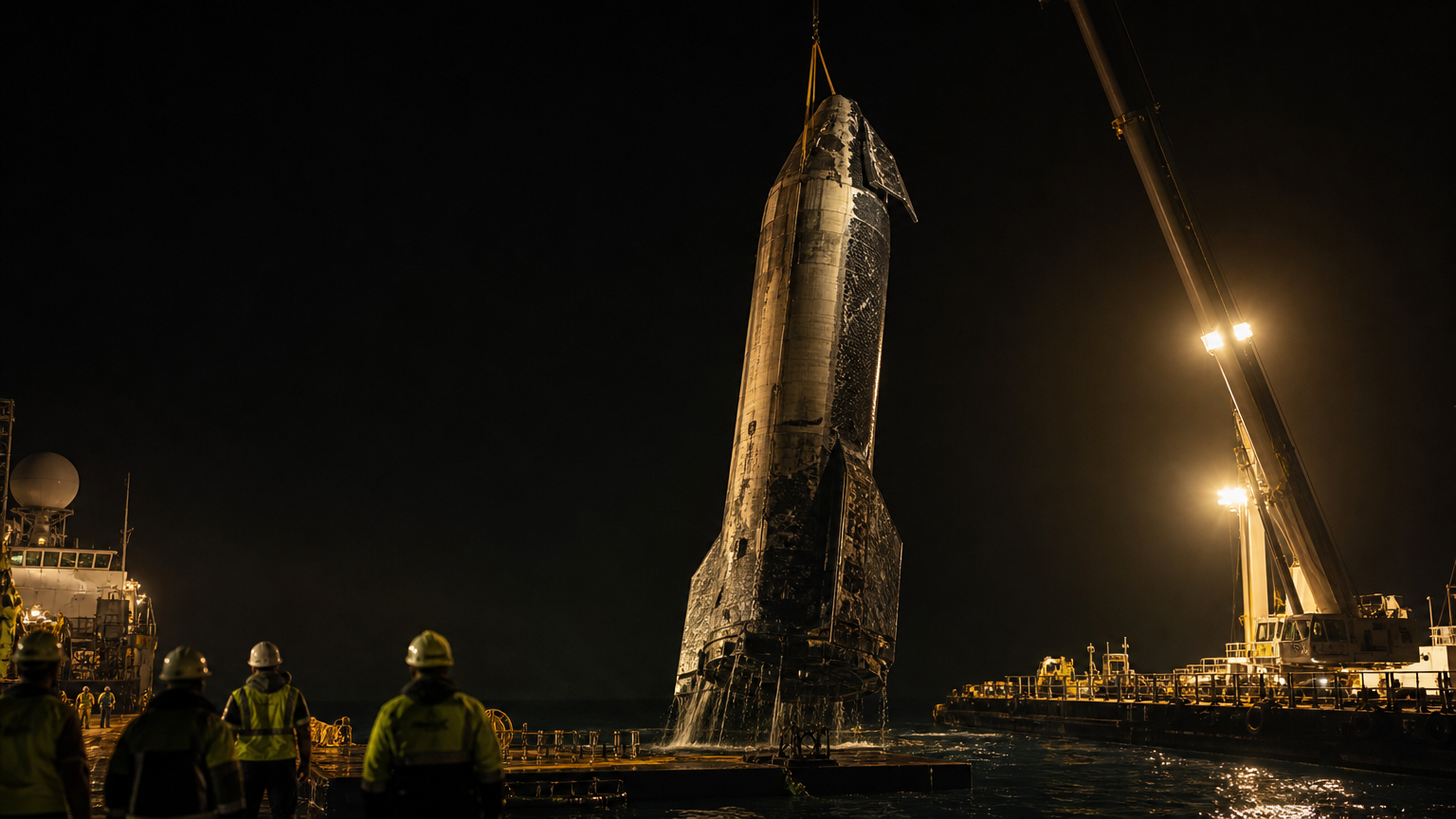
SpaceX has recovered the Starship upper stage that survived Flight 13’s Indian Ocean splashdown and has begun the long trip back to Texas, turning a dramatic salvage operation into a rare chance to inspect flown Starship hardware rather than infer performance only from telemetry.
A recovery, not yet reuse
SpaceX has pulled its most recently flown Starship spacecraft out of the Indian Ocean, the company’s most ambitious Starship salvage operation to date, and is now shipping the vehicle back toward its Texas base . The recovered hardware is the upper stage from Starship Flight 13, which launched from Starbase, Texas, on July 24 and survived an hourlong, space-skimming test flight before remaining intact and afloat after splashdown .
That distinction matters. This is not rapid reuse in the Falcon 9 sense, where a booster lands, is refurbished and flies again on an operational cadence. Instead, it is a recovery of test hardware after a high-energy flight, weeks in salt water and a complex ocean tow. But for a vehicle as large and experimental as Starship, bringing back a full-scale flown ship is still an important operational and engineering step.
SpaceX said Starship has been loaded onto a semi-submersible vessel in the Indian Ocean for a several-month journey back to Starbase . The loading took place off Christmas Island, where engineers had been able to examine the vehicle in calmer waters after the ship spent weeks at sea . At roughly 52 meters tall, the Starship upper stage is itself the size of a small building, which makes this return trip more like a maritime heavy-transport project than a conventional post-flight recovery .
Why the hardware matters
The central value of this recovery is physical evidence. SpaceX engineers spent several days inspecting Ship 40 near Christmas Island, collected heat-shield samples and gained direct insight into how the vehicle handled reentry, with improvements planned for future vehicles . That is a different class of evidence from telemetry. Sensors can report temperatures, loads, pressures and fault signatures, but recovered hardware can show what actually cracked, ablated, corroded, detached, leaked or survived.
For Starship, the heat shield is one of the biggest gating items between spectacular test flights and routine reuse. The spacecraft must survive orbital-class reentry heating while protecting a stainless-steel structure, tanks, plumbing, flaps, wiring and avionics. A flown vehicle gives engineers a map of local damage: which thermal-protection tiles remained bonded, which areas saw unexpected heating, whether edges or penetrations behaved differently from models, and whether water exposure after splashdown created secondary damage that could mask or reveal flight stresses.
The ocean environment adds complications, but it also adds data. Salt water is not the planned operating environment for a rapidly reusable Starship, yet the period afloat can still reveal how sealed compartments, connectors, engines, aerosurfaces and structural joints respond after reentry and landing loads. Engineers will have to separate splashdown and corrosion effects from flight effects, but the ability to touch, cut, scan and disassemble a real vehicle is still valuable.
SpaceX framed the recovery in exactly those terms, saying the operation gives engineers access to “a wealth of data” for Starship development . In practice, that data can include tile condition, structural deformation, engine bay contamination, flap hinge wear, residual propellant-system condition and the survivability of electronics after both flight and sea exposure.
Flight 13’s significance
Flight 13 was already notable before the salvage phase. It was the 13th full Starship test flight and, unlike previous full-stack attempts, the Starship upper stage survived the test and remained floating and intact afterward . Space.com reported that the upper stage deployed 20 next-generation Starlink Version 3 satellites during the mission and relit one of its six Raptor engines in space . Those achievements made the flight more than a splashdown test: it touched payload deployment, in-space engine restart and controlled atmospheric return.
That combination is central to Starship’s business case. SpaceX wants Starship to move far more mass per launch than Falcon 9, eventually with full and rapid reuse. The economics depend not only on building a bigger rocket, but on reducing the marginal cost of each additional launch. For that to work, the ship must return with minimal damage, be inspected quickly, refilled and flown again. Pulling a vehicle out of the ocean a month later does not prove that model. It does, however, provide real evidence about what stands between today’s test program and that future cadence.
The recovery also gives SpaceX a bridge between test outcomes and design changes. If a tile pattern failed, if a flap region overheated, if a weld line behaved unexpectedly or if avionics survived better than expected, engineers can use that information on the next ships. SpaceX’s development culture has long emphasized flight-test feedback; recovered Starship hardware compresses the gap between “we saw something in telemetry” and “we can inspect the exact part.”
A hard maritime operation
The recovery itself should not be treated as routine. SpaceX’s team had to manage a 52-meter spacecraft floating in the Indian Ocean, then get it to a position where engineers could inspect it and a semi-submersible ship could take it aboard . AP described the effort as SpaceX’s biggest salvage operation yet, and SpaceX publicly credited its recovery team for working through challenging conditions .
That operational lesson is part of the story. Even if future Starships are intended to return to launch sites or offshore platforms rather than drift for weeks, SpaceX has now exercised a set of contingency capabilities: locating a returned ship, maintaining or regaining control of hardware at sea, coordinating inspection teams, protecting useful evidence and arranging heavy transport across oceans. Those procedures may never become the primary recovery model, but they matter during a test campaign where vehicles can land far from home.
The several-month transport timeline also underscores why this is not reuse. A ship that takes months to return cannot support the launch cadence SpaceX ultimately wants. But the returned article can support the next design cycle. For an experimental rocket, a heavily traveled, salt-stained vehicle may be less useful as a reusable asset than as a forensic object.
What engineers will likely examine next
Once back in Texas, the most important work will be comparative. Engineers can compare preflight inspection data, in-flight telemetry, post-splashdown imagery and hands-on inspection. They can look for correlations: where temperature spikes matched visible tile damage, where structural loads left no obvious marks, or where apparent exterior damage did not affect internal systems.
The heat shield will probably receive the most attention because SpaceX has already highlighted heat-shield sampling near Christmas Island . But the analysis will not stop there. A recovered Starship can reveal whether the aft section protected engines and plumbing, whether flap mechanisms tolerated reentry and splashdown loads, whether tanks and domes showed unexpected stress, and whether avionics boxes, cabling and sensors retained useful data after weeks in a marine environment.
There is also a manufacturing lesson. Starship is meant to be built and flown at scale, so engineers will be looking not only for isolated failures but for patterns that can be fixed in production. If damage clusters around a specific tile geometry, fastener, seal, cable route or weld process, the result can feed directly into the next vehicles. That is why recovered hardware can be disproportionately valuable: one ship can expose weaknesses that would otherwise require several more flights to isolate.
The bigger picture
Starship remains a development program, not an operational reusable transportation system. AP noted that NASA is counting on Starship, alongside Blue Origin’s Blue Moon lander, for a return of astronauts to the lunar surface as early as 2028 . That external pressure makes the engineering value of Flight 13’s recovered hardware even more important, but it does not erase the distance still to travel.
The immediate milestone is therefore precise: SpaceX recovered Starship hardware from the Indian Ocean and is sending it back to Texas. The strategic importance is broader: the company now has a rare physical record of how a full-scale Starship behaved through launch, spaceflight, reentry, splashdown, weeks at sea and maritime recovery. If the next test vehicles fly with better heat-shield margins, stronger recovery procedures or more resilient systems, some of those improvements may trace back to the battered ship now making its slow way home.
Sources from the last 72 hours
- [1]SpaceX recovers Starship from Indian Ocean a month after launch, shipping it to Texas - ABC NewsAug 28, 2026, 5:23 PM UTC
- [2]Starship is coming home! SpaceX loads floating spacecraft onto huge ship in the Indian Ocean (photos)Aug 27, 2026, 4:45 PM UTC
- [3]Photo: SpaceX Recovery Team Guiding Flight 13's Starship Back to Port in Indian Ocean - WAX2026082707 - UPI.comAug 27, 2026, 12:00 AM UTC
AI-generated article based on recent web research, then preserved as a dated editorial snapshot.
Comments
Be the first to comment.