
Daily Podcast full article
The Next 20 Years: Tesla & SpaceX
A 20-year valuation thesis casts Tesla and SpaceX not as two separate growth stories, but as a possible infrastructure stack for transport, energy, compute, intelligence and labor. The latest 72-hour news flow does not prove that thesis, but it does show why the debate is moving from “cars and rockets” to operating networks, launch capacity, AI hardware, orbital compute and autonomous fleets.
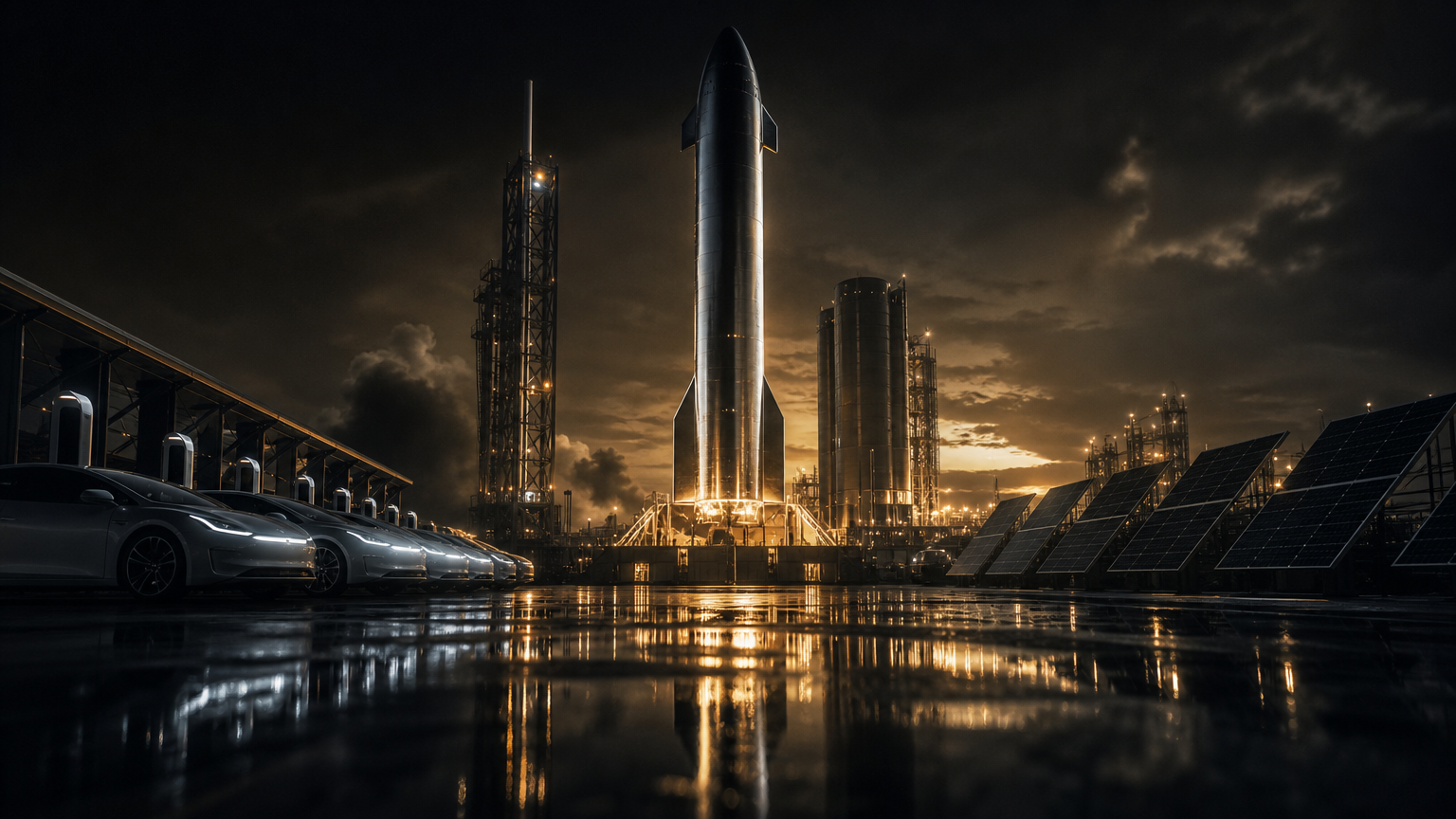
The thesis: two companies, one infrastructure argument
The long-range Tesla-and-SpaceX thesis is deliberately larger than a conventional stock model. It asks whether two already-large industrial companies could become core platforms for the movement of people, goods, energy, data, compute and eventually labor. In that framing, Tesla is not only an electric-vehicle manufacturer and SpaceX is not only a launch provider. Tesla becomes the physical-AI layer on roads, in depots, in factories and on grids; SpaceX becomes the orbital and communications layer, with launch, Starlink, satellite manufacturing and AI infrastructure reinforcing one another.
That is an ambitious base case, and it should be read as a systems thesis rather than a quarterly forecast. The question is not whether every product line succeeds perfectly. It is whether enough of the stack becomes real that the market stops valuing Tesla and SpaceX as product companies and starts valuing them as operating infrastructure.
The latest developments are useful because they stress-test that framing. In the 72 hours before August 28, 2026, the news was not about a formal Tesla-SpaceX merger. It was about the pieces that would make such a combined story plausible: Tesla extending autonomous ride operations, SpaceX adding launch capacity, Starlink continuing to densify, and SpaceXAI tying its compute ambitions to Nvidia hardware.
Tesla’s current signal: robotaxi is becoming an operating network
The freshest Tesla data point is operational, not rhetorical. Tesla’s Robotaxi service now runs from 6 a.m. to 10 p.m., seven days a week, in Austin, Dallas, Houston, Miami, Orlando and Tampa, according to reporting based on Tesla’s August 26 update . The same update said the unsupervised fleet had grown “a lot bigger” and that smarter vehicle distribution and routing should reduce wait times, although Tesla did not disclose a precise fleet count .
That matters because the 20-year thesis depends on autonomy turning from software capability into service economics. A supervised driver-assistance feature can command subscription revenue, but an unsupervised fleet can potentially sell miles, reposition itself, learn from dense usage and become a transportation network. A 16-hour operating window across six metro areas is still small relative to the global taxi, ride-hailing and logistics markets, but it is no longer just a demo.
The distinction between “FSD Supervised” and true unsupervised operation remains central. A dated explainer published August 27 says unsupervised FSD is live in six U.S. metros inside Tesla’s own robotaxi fleet, while the Bay Area still uses safety drivers and no customer-owned Tesla is permitted to operate unsupervised anywhere . That keeps the bull case grounded: the network exists, but the owner-operated robotaxi economy is not yet open.
For the long-term valuation model, the unresolved question is therefore not simply “Can the car drive?” It is “Can Tesla industrialize the whole operating layer?” That includes dispatch, charging, cleaning, insurance, remote support, city-by-city regulatory clearance, hardware eligibility and customer trust. The August 26 hours expansion supports the idea that Tesla is moving from capability to utilization; it does not yet prove global scalability .
SpaceX’s current signal: cadence is becoming industrial capacity
SpaceX’s side of the thesis received an even larger infrastructure signal. On August 25, SpaceX and Louisiana officials announced a plan for a $100 billion spaceport in Vermilion Parish, on 125,000 acres formerly owned by Exxon, with construction expected to begin in 2027 and first launch targeted as early as 2029 . The Associated Press reported that the site would become SpaceX’s fourth and largest launch site and could support thousands of launches a year, while state officials said the project would generate 3,000 jobs over a decade .
This is not just another real-estate announcement. If the long-range thesis depends on SpaceX turning Starship into a high-cadence transport system, then launch-site redundancy, coastal access, propellant logistics and permitting capacity are strategic constraints. A Louisiana Starbase would be a bet that demand for launch is not linear, but exponential: more Starlink satellites, more replacement cycles, more customer payloads, more orbital infrastructure, and potentially AI compute hardware going to space.
The risks are visible in the same reporting. Environmental advocates warned that the state was moving too fast on a project that could alter a fragile coastline, while SpaceX President and COO Gwynne Shotwell said the company planned to keep much of the site undeveloped and assist with restoration and protection efforts . That tension is part of the investment case. SpaceX’s moat is not only engineering; it is the ability to secure, build and operate massive physical infrastructure under political and environmental scrutiny.
Meanwhile, SpaceX’s existing launch machine is still doing the unglamorous work that funds the larger story. SpaceX launched 27 Starlink satellites from Vandenberg on August 26, the 101st Falcon 9 liftoff of 2026, with the booster completing its 24th flight . Space.com also reported that Falcon 9 had flown 101 times so far in 2026, including 78 Starlink missions, and that the Starlink constellation had more than 11,000 active spacecraft .
The day before, a Florida Starlink mission marked the 100th Falcon 9 launch of the year, set a new company reuse record with a booster’s 37th flight, and was described as the last Falcon 9 Starlink mission from Florida before those missions shift to Starship from that state [6]. That transition is exactly the kind of handoff the 20-year thesis assumes: Falcon proves cadence and reusability; Starship is supposed to turn that cadence into industrial throughput.
Compute and intelligence: the riskiest bridge
The most speculative part of the Tesla-SpaceX thesis is also the part attracting the most attention: AI infrastructure. Tom’s Hardware reported on August 25 that SpaceXAI will deploy Nvidia Vera CPUs for Grok agentic workloads and use a space-optimized Vera Rubin NVL72 system in the first Starmind satellite, with launch targeted for the fourth quarter of 2027 and scaling described for 2028 . The article also noted that neither company disclosed the number of CPUs, the value of the deal or the start date for a broader data-center rollout .
This is where the upside and the engineering risk sit side by side. Orbital compute sounds powerful in narrative form: solar energy, proximity to satellite networks, sovereign infrastructure and a new layer of AI distribution. But the hardware must survive radiation, launch vibration, heat rejection without terrestrial liquid-cooling infrastructure, and the absence of hands-on servicing . Those constraints are not footnotes; they are the difference between a visionary platform and an expensive science project.
For Tesla, compute is tied to physical AI: vehicle inference, robotaxi routing, fleet learning and eventually humanoid robotics. For SpaceX, compute is tied to Grok, Starmind, Starlink backhaul and the possibility of selling intelligence infrastructure at planetary scale. The thesis becomes explosive only if those domains compound. Tesla vehicles and robots create data and demand for inference; SpaceX provides connectivity, launch and possibly compute; both consume energy storage, chips and manufacturing scale.
The honest read: infrastructure evidence, valuation uncertainty
The current news supports the shape of the thesis, not its final valuation. Tesla’s robotaxi network is widening hours and operating across multiple cities, but customer-owned autonomous revenue remains unlaunched . SpaceX is planning a massive new Starship site, but its first Louisiana launch is targeted no earlier than 2029 and the project faces environmental and permitting scrutiny . Starlink launch cadence remains extraordinary, but the transition from Falcon 9 to Starship is still a transition, not a completed state [6]. SpaceXAI’s orbital compute plan is now tied to named Nvidia hardware, but cost, scale, cooling, radiation and serviceability are still open questions .
That is precisely why the “Next 20 Years” thesis is compelling and dangerous. It is not a story about one product launch. It is a claim that Tesla and SpaceX may be assembling the infrastructure layers of a more automated economy. The latest 72-hour evidence shows those layers becoming more concrete. It does not remove the execution risk. It sharpens it.
Sources from the last 72 hours
- [1]Tesla Robotaxi Runs 6 AM to 10 PM Seven Days a WeekAug 26, 2026, 12:00 AM UTC
- [2]What is unsupervised FSD, and where is it actually live?Aug 27, 2026, 12:00 AM UTC
- [3]SpaceX sends Starlink satellites to orbit on predawn launch from CaliforniaAug 26, 2026, 12:00 AM UTC
- [4]SpaceX's final Falcon 9 Starlink launch from Florida creates gorgeous 'jellyfish' over New York City (video)Aug 26, 2026, 12:00 AM UTC
- [5]Elon Musk’s space company to build new rocket launching site in LouisianaAug 25, 2026, 6:29 PM UTC
AI-generated article based on recent web research, then preserved as a dated editorial snapshot.
Comments
Be the first to comment.