
Daily Podcast full article
Neuralink: The Brain Implant Is Here — Should We Be Afraid? | Eric Larchevêque and Nathan Pissaro
A new Fracture episode with Eric Larchevêque and Nathan Pissaro uses Neuralink as the sharpest symbol of the AI era: not just software that reorganizes work, but a technology that could move the interface between humans and machines inside the body itself.
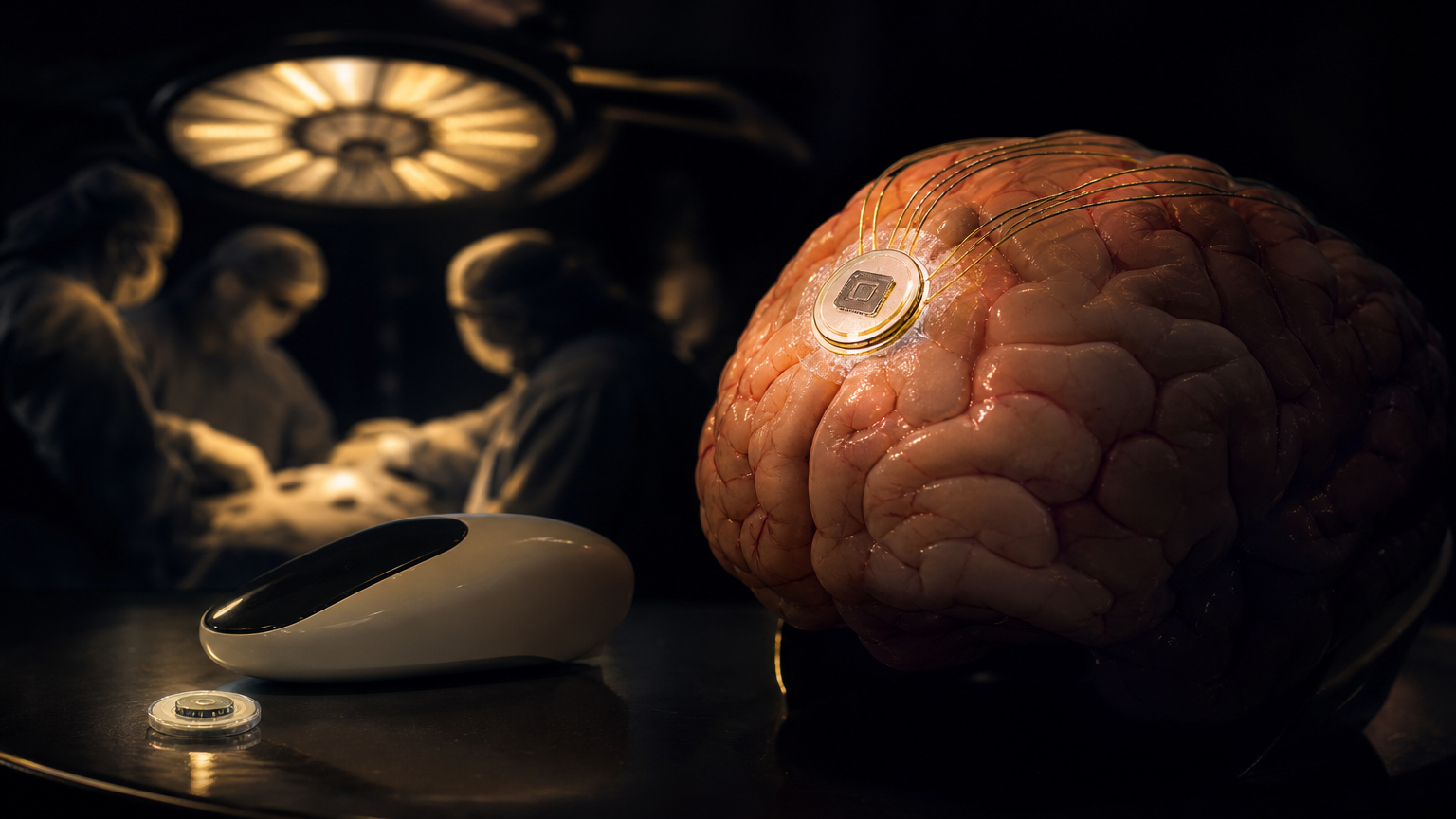
The question is no longer science fiction
“Should we be afraid?” is often the wrong first question in technology. It invites panic, resignation, or tribalism. Yet in the case of Neuralink, it is also unavoidable. A brain implant is not another app, another chatbot, or another cloud platform. It is a device that turns neural activity into machine-readable signals and places the governance of that translation at the center of the next technological frontier.
The 8news subject published on August 27 frames the conversation through Eric Larchevêque and Nathan Pissaro’s discussion of AI disruption, Elon Musk’s fight with OpenAI, work, investing, state productivity, universal income, and finally transhumanism and Neuralink . Apple Podcasts likewise lists the Fracture episode as a current release titled around AI, universal income and whether people will still work in ten years, with its final chapter explicitly devoted to “Neuralink: the brain implant is coming, should we be afraid?” .
That sequence matters. Neuralink is not being discussed in isolation. It arrives at the end of a broader argument about artificial intelligence: who controls it, who profits from it, which jobs it compresses, and whether institutions can adapt fast enough. The implant is the endpoint of the same anxiety. If AI can already reorganize knowledge work from the outside, what happens when the interface moves closer to the nervous system?
What the current record says
The most important current fact is also the most sobering: Neuralink is still a clinical-trial story, not a mass-market consumer story. A current trial record for the PRIME study lists Neuralink Corp as sponsor, identifies the study code as NCT06429735, shows a recruiting status, and names the N1 Implant and R1 Robot as the interventions . The same record lists conditions including tetraplegia, quadriplegia, cervical spinal cord injury and amyotrophic lateral sclerosis, and states that healthy volunteers are not accepted .
A separate current record for VOICE, Neuralink’s communication-restoration study, also lists Neuralink Corp as sponsor, shows recruiting status, identifies the N1 Implant and R1 Robot as interventions, and describes the study as an early feasibility effort for communication restoration . The VOICE record also applies to adults aged 22 to 70-plus and excludes healthy volunteers .
These details should calm one exaggerated fear and sharpen another. They calm the fear that Neuralink is already a consumer enhancement product about to be sold to healthy people who want better memory, instant messaging by thought, or superhuman cognition. The current publicly surfaced trial information is medical, narrow, and focused on people with serious neurological or motor impairments , . But it sharpens the governance question because medical necessity is often how powerful technologies first gain legitimacy before their future uses broaden.
Why Larchevêque and Pissaro’s AI frame is useful
The Fracture discussion, as summarized by 8news, begins with the Musk-OpenAI dispute and the question of whether a mission originally presented as serving humanity can later become a private profit engine . That may seem far from a brain implant, but it is directly relevant. If public trust in AI companies is already strained by governance, ownership and profit incentives, trust becomes even more fragile when the technology is implanted in the body.
AI tools for coding, design, translation or legal research can be switched off, replaced, regulated through procurement rules, or challenged in court. A brain-computer interface raises harder questions: Who owns the data? What happens if the company changes strategy? What if the device depends on cloud services, proprietary software or long-term corporate maintenance? What if the medical benefit is real but the platform logic is extractive?
This is where fear should become precision. A vague fear of “the chip in the brain” is less useful than a concrete checklist: safety, reversibility, cybersecurity, informed consent, data minimization, liability, long-term support, and the right not to be upgraded.
The medical promise is real
The case for Neuralink is not a cartoon villain story. The current trial records point toward patients with profound unmet needs: paralysis, spinal cord injury, ALS and severe communication impairment , . For someone who cannot move, speak, type, or independently interact with a computer, even limited control through thought could mean work, communication, privacy and dignity.
That is why the discussion cannot simply end with “be afraid.” Medical technology has always involved trade-offs. Pacemakers, cochlear implants, deep-brain stimulation and prosthetics all place hardware into intimate relation with the body. The ethical burden is not to block invention by reflex. It is to ensure that vulnerability does not become a business model.
The promise is especially powerful because AI changes what a brain-computer interface can do. The implant may record signals, but machine learning systems interpret, classify and translate them into actions. In other words, the device is not only hardware. It is a stack: surgery, sensors, robotics, data pipelines, models, user interfaces, clinical supervision and corporate governance. Every layer needs scrutiny.
The fear should focus on dependency
The deepest concern is not that a patient will suddenly become less human. The more immediate concern is dependency. If an implanted interface becomes central to a person’s ability to communicate or work, continuity becomes an ethical obligation. What are the guarantees if a company is sold, pivots, goes bankrupt, changes subscription terms, loses regulatory approval, or sunsets a product line?
The Fracture episode’s broader AI discussion includes software businesses, productivity shocks and the pressure on institutions to reorganize . Neuralink adds a more intimate version of the same theme: once a technology is embedded into daily function, the user is not merely a customer. The user becomes dependent on an ecosystem.
That is why the answer to fear cannot be left to charisma, branding or admiration for founders. Elon Musk’s presence guarantees attention, but attention is not oversight. A technology that reads neural signals and may one day write back to the nervous system requires governance that outlives any one company or personality.
What should be demanded now
The current trial status suggests society still has time to shape the rules before mass adoption , . The priorities are clear.
First, clinical transparency: adverse events, device performance, explantation outcomes and long-term durability should be reported in ways that patients and independent researchers can understand.
Second, data protection: neural data should be treated as among the most sensitive categories of personal information, even when it is imperfect, noisy or task-specific.
Third, patient rights: participants should have enforceable guarantees around device maintenance, software support, medical follow-up and exit options.
Fourth, separation between therapy and enhancement: trials for people with severe disability should not be used as emotional cover for a future consumer market without a separate ethical debate.
Fifth, public accountability: if these systems become medically necessary, regulators should examine not only surgical safety but also platform dependency, cybersecurity and corporate continuity.
Should we be afraid?
Yes, but not in the cinematic sense. Fear is justified if it produces sharper institutions, better law and more honest public debate. Fear is dangerous if it turns into blanket rejection of a technology that could restore autonomy to people who have lost it.
The current picture is therefore neither utopia nor dystopia. Neuralink is here in the sense that the implant is now part of active clinical research, with recruiting studies involving the N1 Implant and R1 Robot , . It is not “here” as a normal consumer product, nor should it be treated as inevitable that healthy workers, students or investors will soon be expected to merge with machines.
Larchevêque and Pissaro’s broader point about AI is that disruption is less a battle of heroes and villains than a test of organization, judgment and adaptation . Neuralink makes that test biological. The question is not only whether a brain implant can work. It is whether society can build rules strong enough for a technology that may one day make the boundary between intention and machine action feel almost invisible.
We should not be afraid of disabled people gaining autonomy. We should be afraid of intimate infrastructure without democratic control. That distinction is the whole debate.
Sources from the last 72 hours
- [1]Neuralink: The Brain Implant Is Here — Should We Be Afraid? | Eric Larchevêque and Nathan Pissaro · AI · 8news.aiAug 27, 2026, 4:00 PM UTC
- [2]Fracture - Podcast - Apple PodcastsAug 27, 2026, 9:30 PM UTC
- [3]Precise Robotically IMplanted Brain-Computer InterfacEAug 27, 2026, 12:00 AM UTC
- [4]VOICE: An Early Feasibility Study of a Precise Robotically Implanted Brain-Computer Interface for Communication RestorationAug 27, 2026, 12:00 AM UTC
AI-generated article based on recent web research, then preserved as a dated editorial snapshot.
Comments
Be the first to comment.