
Daily Podcast full article
Musk’s Texas TeraFab moves from megaproject headline to land, tax and workforce reality
In Grimes County, the Musk-linked TeraFab is no longer only a $16.8 billion promise. Fresh filings and local reporting show rapid land accumulation, newly posted tax-limitation paperwork and early workforce planning around a semiconductor campus that could reshape a rural Texas county.
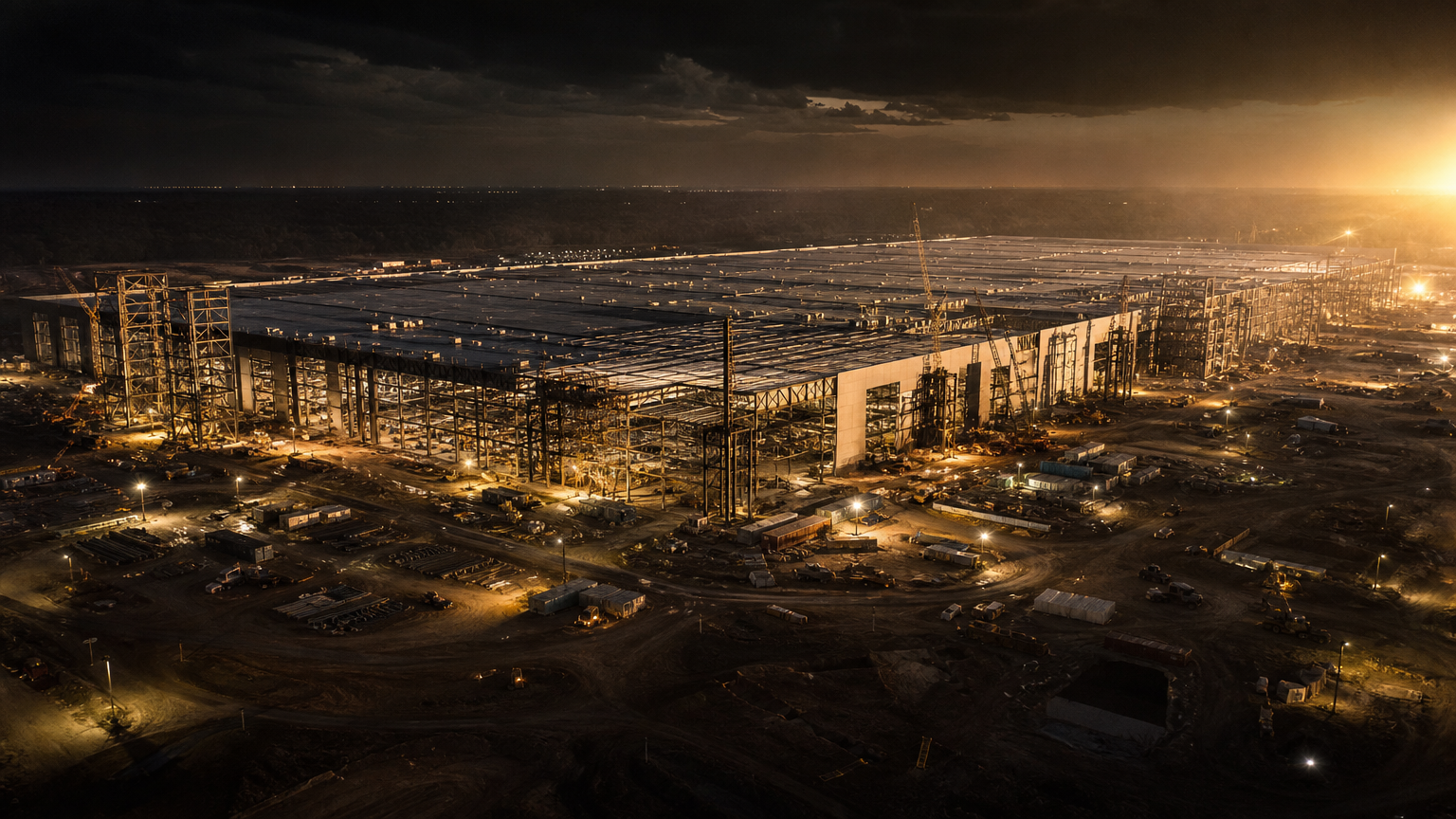
A headline-scale fab becomes a county-level test
The proposed TeraFab in Grimes County, Texas, is moving into a more concrete phase. In the past 72 hours, local reporting and state postings have added three important pieces to the picture: the land footprint is expanding quickly, the state’s school-tax incentive paperwork is being posted, and regional educators are already framing what kind of workers a semiconductor plant would need , , , .
The project remains unusually opaque for something described as a $16.8 billion first-phase investment, but the newest information sharpens the stakes. Houston Business Journal reported on August 25 that the Texas comptroller’s office had published Jobs, Energy, Technology and Innovation Act agreement terms tied to TeraFab, and that the agreements signed August 21 involve the state, Anderson-Shiro CISD and Iola ISD . The same report highlighted a striking gap between the scale of the project and the formal jobs floor in the tax documents: a 10-job minimum and a wage minimum around $66,000 for a project publicly associated with a $16.8 billion capital figure .
That does not mean the plant would employ only 10 people. It means the enforceable threshold in that incentive framework appears far smaller than the job totals discussed in public messaging. For local taxpayers, that distinction matters. In megaproject politics, the difference between a headline promise and a contractual minimum is often where public risk is concentrated.
The land footprint is growing fast
The clearest sign that TeraFab is moving beyond renderings is land. KBTX reported on August 24 that WIT TECH LLC, described as a Musk-connected company tied to the SpaceX TeraFab project, now holds 41 parcels totaling 7,720.697 acres in Grimes County . That is up from 4,619 acres confirmed by the station four days earlier, meaning the holdings grew by more than 3,100 acres and 21 parcels in less than a week .
KBTX’s review of Grimes Central Appraisal District records also found that the holdings now amount to roughly 1.5% of the county . The station reported that 26 of the 41 parcels appear as active on the county GIS map, while 15 are inactive because they are being combined with adjacent tracts already owned by the company . That pattern is consistent with a large site assembly rather than a single-property transaction.
The acreage figure is important because semiconductor fabs are not just buildings. A plant of this kind requires roads, substations, water systems, chemical handling, wastewater treatment, security buffers, construction staging, supplier access and often dedicated power infrastructure. Even if only part of the acreage becomes cleanroom or manufacturing space, the land assembly signals an industrial campus, not a conventional factory.
The tax deal is now part of the story
The Texas comptroller’s TeraFab postings also changed the information environment. The comptroller’s page for application J0035 lists Anderson-Shiro CISD and TeraFab AI, LLC and shows an agreement posted on August 25, 2026 . Separate comptroller pages for other TeraFab-related applications show agreement postings dated August 21 for Iola ISD and Anderson-Shiro CISD . The state paperwork matters because school-tax value limitations are a central part of how Texas competes for capital-intensive projects.
Houston Business Journal’s August 25 report said the JETI agreement terms require “a fraction” of what state officials and the company had publicly discussed . That framing underscores the core policy question: what should local districts and the state demand, in binding terms, when a project’s announced investment is measured in tens of billions of dollars?
Supporters will argue that semiconductor manufacturing is capital intensive and that the fiscal upside comes from long-term tax base expansion, construction spending, suppliers and wages. Skeptics will focus on enforceability, infrastructure costs, water and power demand, and whether local services must scale before revenue arrives. Both views can be true at once, which is why the posted agreements deserve closer reading as they become available.
Workforce: engineers, technicians and the middle path
The workforce discussion is also becoming more specific. KBTX reported on August 24 that, as SpaceX continues clearing land for the TeraFab facility, semiconductor jobs are becoming an immediate planning issue for Grimes County and nearby school districts . Clayton Huber of the Texas A&M Semiconductor Institute told KBTX that new fab jobs typically split roughly 50-50 between technicians and engineers . Arum Han of Texas A&M’s College of Engineering said many roles would not require a four-year degree and pointed to needs such as electricians, piping knowledge, chemical safety and IT security .
That point is crucial for the region. A semiconductor plant is often perceived as a workplace only for PhDs and chip designers. In practice, fabs also depend on process technicians, maintenance staff, facilities teams, safety specialists, logistics workers and construction trades. KBTX reported that technician roles typically start between $45,000 and $65,000 a year, while figures presented at an economic briefing showed TeraFab entry-level positions above $70,000 .
For Grimes County, the workforce question is not simply whether jobs arrive. It is whether local residents can qualify for them before the hiring wave begins. Iola ISD’s superintendent told KBTX the district is excited about a Career and Technical Education pathway into TeraFab-related programs . If that pathway becomes real, the project could become a regional skills engine. If it does not, the best jobs could flow to commuters and imported specialists while the county absorbs the disruption.
Why this matters beyond Texas
TeraFab sits at the intersection of three strategic trends: the reshoring of semiconductor capacity, the AI compute race and Elon Musk’s preference for vertical integration. The latest reporting does not answer which process technologies will run at scale, which entity will finance each phase, or how much of the project is Tesla, SpaceX, xAI or TeraFab AI. But the current facts show a project that is acquiring land, entering incentive paperwork and prompting workforce institutions to adapt , , , .
That is already consequential. A $16.8 billion semiconductor campus in rural Texas would compete for construction labor, electrical equipment, water rights, gas and power capacity, cleanroom suppliers, semiconductor tools and technical talent. It would also test whether local government can negotiate with a Musk-linked entity on terms that protect residents while capturing investment.
The immediate story, then, is not simply “Musk plans a giant chip plant.” It is that Grimes County is being reorganized around the possibility of one. The land map is changing, school-tax agreements are surfacing, and educators are being asked to build a pipeline before the plant exists at full scale , , , .
The open questions
The biggest uncertainties remain unresolved. The public still needs clarity on final ownership, financing, construction schedule, water demand, power sourcing, environmental permitting, supplier commitments and enforceable job creation. The newly posted and reported tax terms raise another question: if the project is as large as advertised, why are some minimum obligations in the incentive framework so modest , ?
For now, the prudent reading is neither hype nor dismissal. TeraFab is not just a speculative Musk statement anymore; recent land and incentive developments show movement on the ground and in state systems , , . But a semiconductor megaproject is only proven by permits, power, tools, workers, yields and customers. Grimes County is at the beginning of that test, not the end.
Sources from the last 72 hours
- [1]SpaceX’s Grimes County land holdings nearly double in just four daysAug 24, 2026, 10:13 PM UTC
- [2]Texas unveils Terafab's property tax deal: 10 jobs, $66K wage minimum for $16.8B projectAug 25, 2026, 4:25 PM UTC
- [3]The jobs semiconductor plants need most and how to get oneAug 25, 2026, 1:40 AM UTC
- [4]Application DetailsAug 25, 2026, 5:00 AM UTC
AI-generated article based on recent web research, then preserved as a dated editorial snapshot.
Comments
Be the first to comment.