
Daily Podcast full article
Apple’s 2nm M6 turns the Mac into a local AI battleground
Apple’s first 2-nanometer Mac chip arrives in the new Mac mini alongside an M5 Ultra Mac Studio, reframing the desktop Mac around on-device AI, memory bandwidth and performance per watt rather than only classic creative workloads.
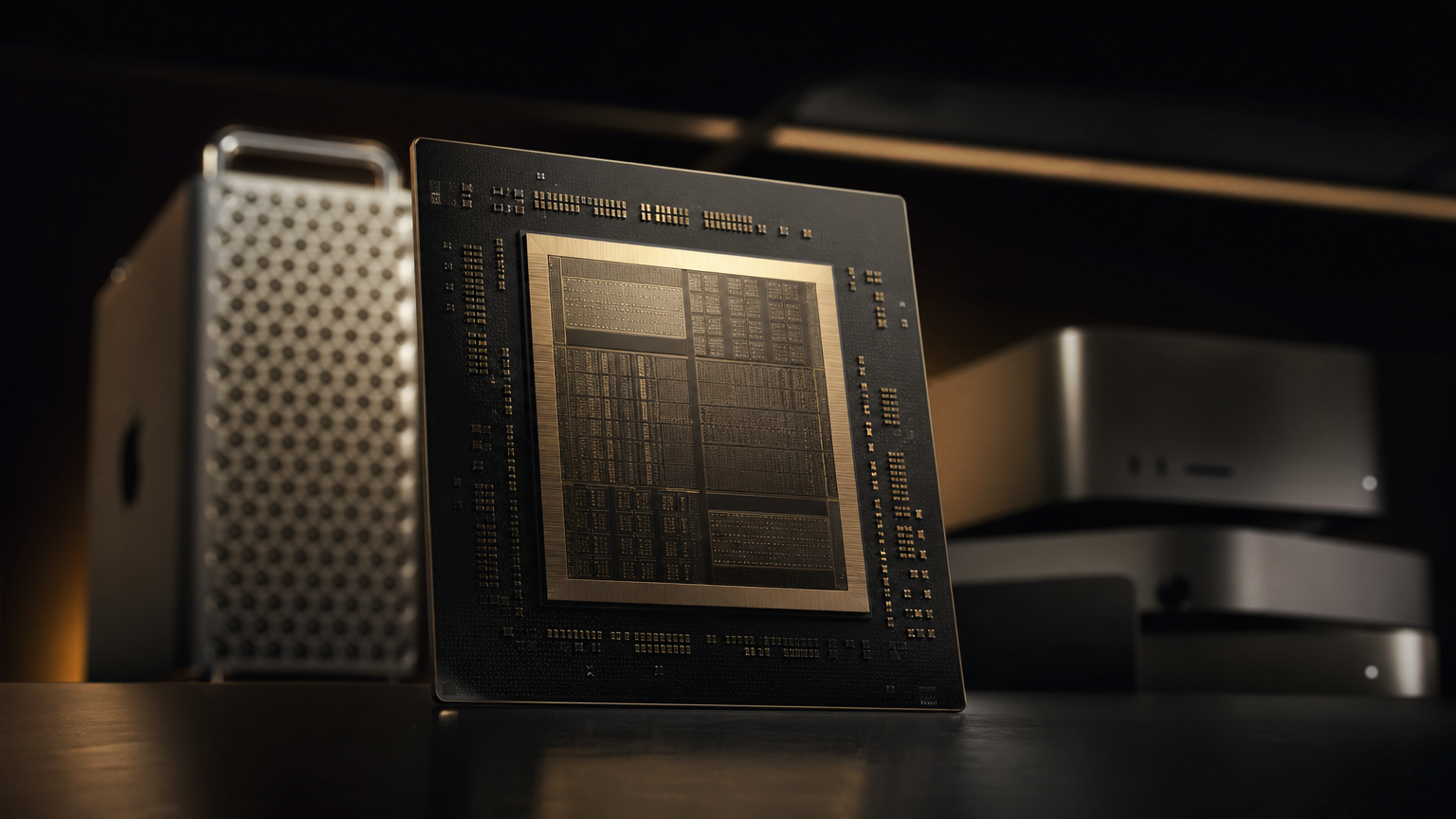
The news: Apple moves M6 to 2nm
Apple has pushed its Mac silicon roadmap into 2-nanometer territory with the M6, introduced for the new Mac mini, while also unveiling the M5 Ultra for the updated Mac Studio . The company describes M6 as its first “state-of-the-art” 2nm chip, built around a 12-core CPU, a 12-core GPU, a Dual 16-core Neural Engine and up to 170GB/s of unified memory bandwidth . The Verge reports that the chip raises core counts from the M5 generation and is designed specifically to improve on-device AI workloads as well as general performance and efficiency .
The immediate product story is straightforward: the M6 comes first to the Mac mini, while the M5 Ultra lands in the Mac Studio . But the strategic story is larger. Apple is using the desktop Mac refresh to define premium PC performance around local inference, high-bandwidth unified memory and energy efficiency — the same terrain where Intel, AMD and Qualcomm are trying to prove that Windows PCs can keep pace in the AI era.
What changes inside M6
The M6 has two more CPU cores than M5, with a 12-core layout that The Verge describes as two “super” cores, four performance cores and six efficiency cores . Apple says the CPU delivers the world’s fastest single-threaded performance and up to 1.2 times faster multithreaded performance than M5 . MacRumors separately reports that the 2nm process gives Apple greater transistor density in a smaller die, contributing to the company’s claimed gains in performance and power efficiency .
The GPU also moves to 12 cores, two more than M5, and adds a Neural Accelerator in each core . MacRumors says Apple is claiming nearly 30% higher peak GPU compute for AI than M5 and more than eight times the M1 level, with faster prompt processing for on-device large language models . That matters because Apple is no longer treating AI acceleration as a side feature attached to the Neural Engine. It is distributing matrix-style acceleration across the GPU, Neural Engine and system frameworks so more workloads can run locally.
The most conspicuous AI change is the Dual 16-core Neural Engine. MacRumors reports that Apple says this doubles peak Neural Engine compute compared with previous generations and that system frameworks can use both engines simultaneously . In practice, that signals where Apple wants developers to go: local summarization, image generation, coding assistants, media classification and personal-agent workflows that do not need to send every prompt to a cloud model.
M5 Ultra is the other half of the story
The M6 grabs attention because it is Apple’s first 2nm Mac chip, but M5 Ultra may be the more important part for workstation users. Apple says M5 Ultra is its most powerful chip yet and its first M-series quad-die architecture . MacRumors reports that Apple builds it by connecting two dual-die M5 Max chips through a next-generation UltraFusion design, with more than 4.4TB/s of inter-die bandwidth and more than six times the connection density of the previous generation .
The resulting Mac Studio configuration scales to a 36-core CPU, with 12 super cores and 24 performance cores, plus an up-to-80-core GPU . Apple also brings Neural Accelerators to every GPU core in an Ultra chip for the first time, with MacRumors reporting Apple’s claim of up to 4.3 times the peak AI compute performance of M3 Ultra . The chip also includes a 32-core Neural Engine and a larger media engine able to play as many as 33 streams of 8K ProRes 422 at 30 frames per second .
For AI developers, the headline is memory. M5 Ultra supports up to 512GB of unified memory and up to 1.2TB/s of memory bandwidth, a 50% increase over M3 Ultra . MacRumors reports Apple’s claim that this allows users to keep large datasets locally, raise tokens per second and run large language models with hundreds of billions of parameters entirely on device . That is the clearest statement yet that Apple sees the Mac Studio not only as a video, music and 3D workstation, but also as a desk-side AI machine.
The new desktops and the price signal
Apple’s new Mac mini and Mac Studio are already available for preorder in the United States and 30 other countries and regions, with most configurations shipping and appearing in stores on September 22, 2026 . The new Mac mini starts at $899 with M6, while the M5 Pro Mac mini starts at $1,699 . The Mac Studio starts at $2,499 with M5 Max, and the M5 Ultra configuration starts at $5,499 .
Those prices show the cost of Apple’s AI-era positioning. MacRumors notes that the $899 M6 Mac mini is $300 above the original launch price of the M4 model, though only $100 above Apple’s June repricing . The publication also reports that the M5 Ultra Mac Studio with 512GB of unified memory will not arrive until late October, and Apple has not yet announced pricing for that configuration . In other words, the most AI-relevant memory tier is both central to the product’s appeal and not immediately available.
The ports and desktop details still matter. MacRumors reports that the new Mac mini keeps the same general design but adds Wi-Fi 7, Bluetooth 6 and 2.5Gb Ethernet as the default wired connection . The M6 Mac mini keeps Thunderbolt 4, while the M5 Pro Mac mini uses Thunderbolt 5 . Both the Mac mini and Mac Studio now support genlock over USB-C, a niche but important feature for multi-camera and virtual-production environments .
Why the 2nm move matters
A move from 3nm-class chips to 2nm is not just a marketing number. Apple’s claim is that a smaller process gives M6 a denser die, better performance and better power efficiency . That helps explain why Apple is debuting 2nm not in a fanless laptop first, but in the Mac mini, where it can make a desktop case for sustained local AI without requiring a tower-class thermal envelope.
The timing also gives Apple a narrative advantage. By putting 2nm silicon in a shipping desktop line, Apple can argue that its Mac roadmap is still ahead of much of the premium PC market on performance per watt. The pressure on Intel, AMD and Qualcomm is not that every user will compare nanometers. It is that Apple can sell a simple story: more AI work locally, less dependence on the cloud, and fewer compromises in acoustic and power behavior.
For businesses, that message aligns with privacy and cost control. Local inference can reduce the amount of sensitive material sent to remote services, while also limiting exposure to cloud AI capacity constraints. Apple’s pitch is therefore not only “faster Mac.” It is “the Mac as private AI infrastructure,” with the Mac mini covering smaller local-agent workloads and Mac Studio targeting teams that need larger models, more memory and higher sustained throughput.
The competitive read
This launch does not eliminate the need for cloud AI. Even a 512GB Mac Studio is a specialized, expensive device, and frontier training remains a data-center business. But Apple is narrowing the gap between consumer hardware and local AI development workstations. The Mac mini gives developers an entry point to Apple’s 2nm architecture, while the M5 Ultra Mac Studio gives research, media and software teams a machine designed to keep large models and large media projects on the desk .
The unanswered questions are benchmarks, thermals and real application support. Apple’s figures are vendor claims, and independent testing will have to confirm how the M6 and M5 Ultra perform in sustained AI inference, GPU compute, 3D rendering and media pipelines. The software layer will matter as much as the chips: developers need Core ML, Metal and third-party frameworks to expose the hardware without forcing users into awkward model conversions.
Still, the direction is clear. Apple’s first 2nm Mac chip is not being framed as a routine speed bump. It is being used to reposition the desktop Mac for the next phase of personal computing: local AI that is fast enough to be useful, private enough to fit Apple’s brand, and efficient enough to put pressure on the rest of the PC industry.
Sources from the last 72 hours
- [1]Apple introduces M6 and M5 Ultra for a big leap in performance and AI computeAug 25, 2026, 7:35 AM UTC
- [2]Apple’s new M6 chip gets more cores and more AI computeAug 25, 2026, 1:00 PM UTC
- [3]Apple Reveals M6 as First-Ever 2nm ChipAug 25, 2026, 1:05 PM UTC
- [4]Apple Debuts M5 Ultra as Most Powerful Chip EverAug 25, 2026, 1:12 PM UTC
- [5]Apple's New Mac Mini and Mac Studio Are Now Available to Pre-OrderAug 25, 2026, 1:48 PM UTC
- [6]Apple Announces New Mac Mini With M6 and M5 Pro Chips and MoreAug 25, 2026, 1:11 PM UTC
- [7]New Mac Mini and Mac Studio: 13 Things You Might Have MissedAug 25, 2026, 1:00 PM UTC
AI-generated article based on recent web research, then preserved as a dated editorial snapshot.
Comments
Be the first to comment.