
Daily Podcast full article
Washington squeezes Asian chip supply chains
Washington’s latest pressure on Seoul is not just a bargaining tactic over one more factory. It is a sign that semiconductor policy is moving from “secure access” to “domestic anchoring,” forcing South Korea’s memory champions to balance U.S. demands, Korean regional-development plans and the hard infrastructure of fabs, water and chemicals.
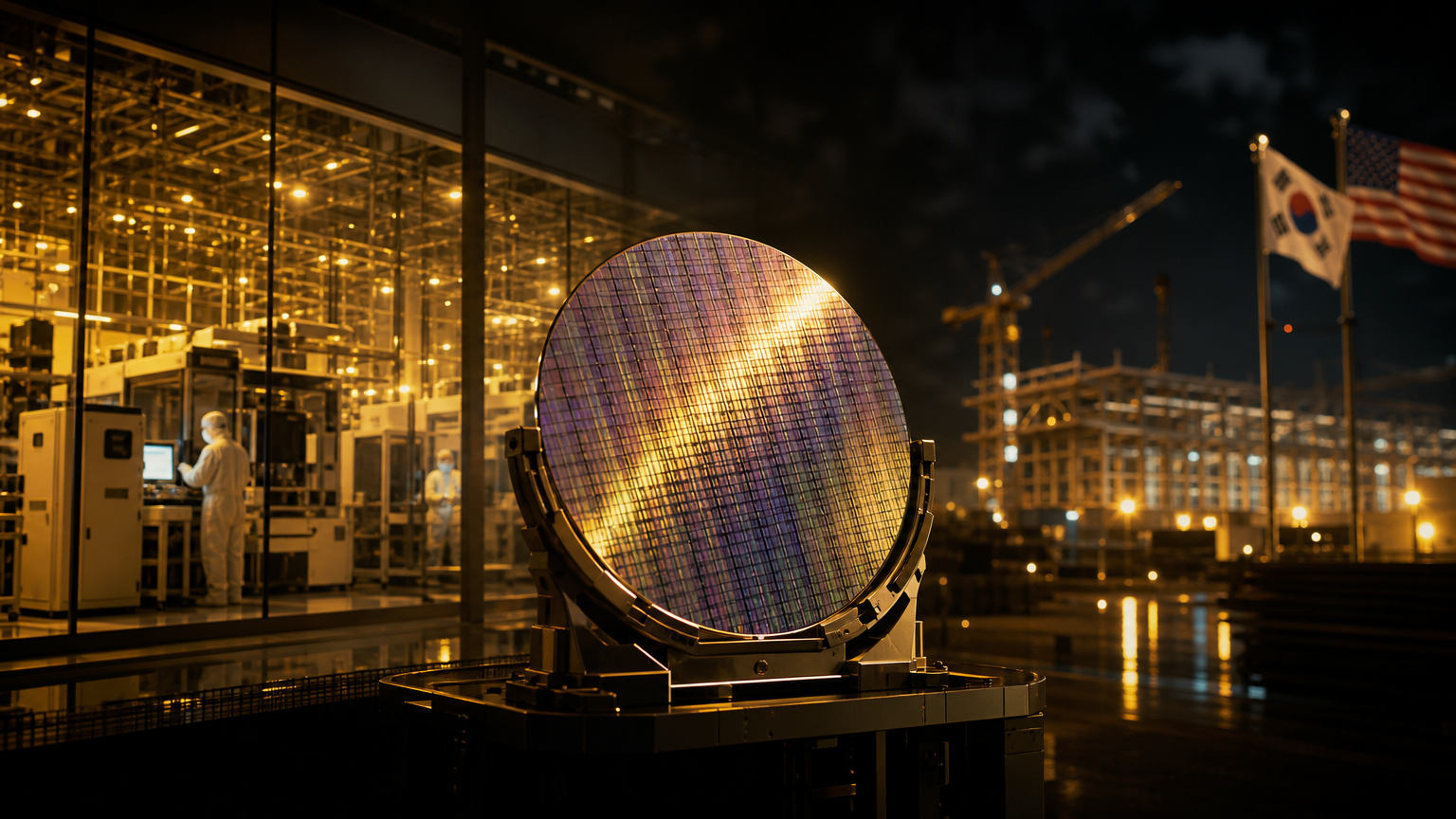
A new phase in U.S. chip pressure
Washington is pressing South Korea to turn semiconductor cooperation into more production on American soil, with U.S. officials reportedly asking Seoul and Korean companies to invest in local memory-chip facilities and to guarantee stable memory supply volumes . The request matters because it moves beyond a familiar U.S. objective — getting allied chipmakers to diversify away from China — and toward a more assertive demand: that allied capacity be physically embedded inside the United States.
According to the latest Korean reporting, U.S. dissatisfaction has sharpened after Seoul promoted its 800 trillion won Honam Semiconductor Cluster, a domestic mega-project meant to spread advanced manufacturing beyond Korea’s established chip belt . The political message from Washington is clear: if Korean public policy can mobilize capital, land and permits for fabs at home, U.S. negotiators want comparable urgency for American sites.
The immediate pressure is aimed at the two companies that make South Korea indispensable to the AI hardware chain: Samsung Electronics and SK hynix . Samsung is already investing more than 37 billion dollars in a foundry project in Taylor, Texas, while SK hynix is pursuing a 3.87 billion dollar advanced packaging facility in Indiana . Yet Washington’s reported focus on memory production would go further, because Korea’s global leverage lies not only in foundry services or packaging but in DRAM, NAND and high-bandwidth memory used by AI accelerators.
Seoul’s double bind
For Seoul, the timing is awkward. Korean officials are trying to show that the 350 billion dollar U.S.-bound investment framework remains on track, while also arguing that new U.S. semiconductor demands are separate from that package . The government plans to announce its first U.S. investment project in September, but unresolved negotiations could make chips the late-stage variable that reshapes the package .
Korean companies face a more practical dilemma. Samsung and SK hynix have already been asked to shoulder large domestic commitments connected to the Honam cluster, and additional U.S. memory fabs would add another layer of capital intensity . Fabs are not movable promises; they are multi-year bets on land, power, water, tool supply, skilled labor and customer demand. Once announced, they lock balance sheets and supplier networks into a location for years.
The political pressure is also not confined to the executive branch. House Foreign Affairs Committee Chairman Brian Mast publicly criticized South Korea for what he described as failure to provide more semiconductors and ships to support the United States, linking industrial promises to broader alliance grievances . That public criticism illustrates how chip supply, shipbuilding, digital-market disputes and security policy are increasingly being bundled together in Washington’s Korea debate.
Memory supply as strategic leverage
The reported U.S. requests include not only investment in local facilities but also memory supply guarantees . That is a crucial distinction. A fab commitment addresses medium-term capacity; a supply guarantee addresses immediate allocation, pricing power and customer security.
Korean reporting says U.S. companies are increasingly using long-term supply agreements with deposits to secure memory volumes, and that Washington’s restrictions on Chinese semiconductors have intensified pressure to lock in Korean supply . For Samsung and SK hynix, such contracts can stabilize revenue and reduce demand uncertainty. But they can also weaken price flexibility if companies commit too much volume under long-duration terms while the memory cycle turns.
That is why the issue is sensitive in Seoul. An industry source cited in Korea warned that U.S. government involvement could effectively intervene in memory semiconductor prices . The phrase captures a deeper anxiety: if the United States can use market access, tariff risks and alliance politics to influence where Korean firms build and to whom they sell, the commercial logic of the memory cycle becomes partially geopolitical.
Honam: domestic sovereignty meets alliance politics
The Honam project is now more than a Korean regional-development plan. It has become a test of whether Seoul can pursue domestic chip sovereignty while satisfying Washington’s demand for allied onshoring.
A separate Korean report says South Korea’s Defense Ministry has begun negotiations with the United States over the relocation of U.S.-related facilities at Gwangju Military Airport so the site can be cleared for the Honam Semiconductor Cluster . About 742,000 square meters of the airport is designated as a U.S. zone under the Status of Forces Agreement, making military coordination part of the semiconductor timetable . In other words, the geography of chip production is now colliding with the geography of the security alliance.
That is an important shift. Semiconductor clusters used to be discussed mainly in terms of tax credits, labor pools and ecosystem effects. The Gwangju case shows that advanced manufacturing policy can now require defense negotiations, airport relocation, land conversion and local compensation. Chip sovereignty is becoming an infrastructure statecraft project.
The hidden supply chain: water and chemicals
The squeeze on Asian tech supply chains is not limited to headline companies. Every fab pulls a long tail of suppliers in construction, specialty gases, wet chemicals, ultrapure water systems and wastewater treatment.
IndexBox reported on August 24 that the silicone antifoams for water treatment market is projected to grow at a 5.8 percent compound annual rate from 2026 to 2035, with the market index rising from 100 in 2025 to roughly 178 by 2035 . It identified semiconductor and electronics manufacturing as a high-value segment, estimating it at about 25 percent of global silicone-antifoam consumption and noting that fabs use ultrapure water extensively for rinsing, etching and cleaning wafers .
This is where industrial policy becomes tangible. The same pressure that pushes Samsung or SK hynix to choose between Korea and the United States also affects chemical formulators, water engineers and suppliers of high-purity consumables. IndexBox says semiconductor antifoams must meet strict purity requirements, including minimal ionic residue and particle counts below 0.1 micrometers, because foam can create defects and process instability . That means fab location decisions shape demand for highly specialized materials that cannot be swapped easily.
The report also notes that long qualification cycles favor incumbent suppliers . That matters for resilience. Governments can announce fabs quickly, but process chemicals, ultrapure water components and qualified vendors develop more slowly. If Washington wants allied capacity inside U.S. borders, it also has to attract the less visible ecosystem that keeps fabs running.
What this means for Asia
For Asian chip economies, the lesson is uncomfortable. The United States is no longer satisfied with friendly suppliers located offshore. It wants friendly suppliers to build, reserve capacity and bind parts of their supply chains to U.S. territory.
South Korea is the immediate target because its memory firms are essential to AI computing, but the same logic applies across Asia. Taiwan’s logic capacity, Japan’s materials base, Korea’s memory leadership and Southeast Asia’s packaging capacity are all being revalued through a national-security lens. The result is not simple decoupling from Asia; it is selective relocation and duplication, with Washington trying to internalize the most strategic pieces while still relying on Asian expertise.
The risk for Seoul is that it becomes squeezed from both sides. If it resists, it may face tariff threats, political criticism and doubts about alliance burden-sharing. If it complies too fully, it could dilute domestic cluster ambitions, overextend corporate capital spending and shift future value creation abroad.
The bottom line
Washington’s pressure on South Korea shows that the semiconductor map is being redrawn by states as much as by companies. The question is no longer only who can make the most advanced chips. It is where the capacity sits, who gets first call on output, who controls the infrastructure underneath and how much industrial sovereignty allies are willing to trade for market access and security guarantees.
For Samsung and SK hynix, the next challenge is not just building more. It is deciding how much of Korea’s memory advantage can be internationalized without weakening the domestic base that made those companies strategic in the first place.
Sources from the last 72 hours
- [1]Exclusive: U.S. Pressures South Korea to Invest in Local Semiconductor FacilitiesAug 24, 2026, 8:00 PM UTC
- [2]Korean Semiconductor Firms Juggle U.S. and Domestic Investment DemandsAug 24, 2026, 3:51 PM UTC
- [3]Exclusive: Defense Ministry Accelerates Gwangju Military Airport Relocation TalksAug 24, 2026, 8:00 PM UTC
- [4]U.S. Lawmaker Slams South Korea's Treatment of U.S. Firms, Unkept PromisesAug 24, 2026, 2:01 PM UTC
- [5]Silicone Antifoams for Water Treatment Market to Reach 178 Index by 2035 on Semiconductor Fab ExpansionAug 24, 2026, 12:00 AM UTC
AI-generated article based on recent web research, then preserved as a dated editorial snapshot.
Comments
Be the first to comment.