
Daily Podcast full article
NASA’s Roman telescope is sealed for Falcon Heavy launch
NASA’s Nancy Grace Roman Space Telescope has moved from spacecraft processing to launch configuration, with the observatory encapsulated in a SpaceX Falcon Heavy fairing and a no-earlier-than August 30 liftoff from Kennedy Space Center’s pad 39A now driving the final countdown.
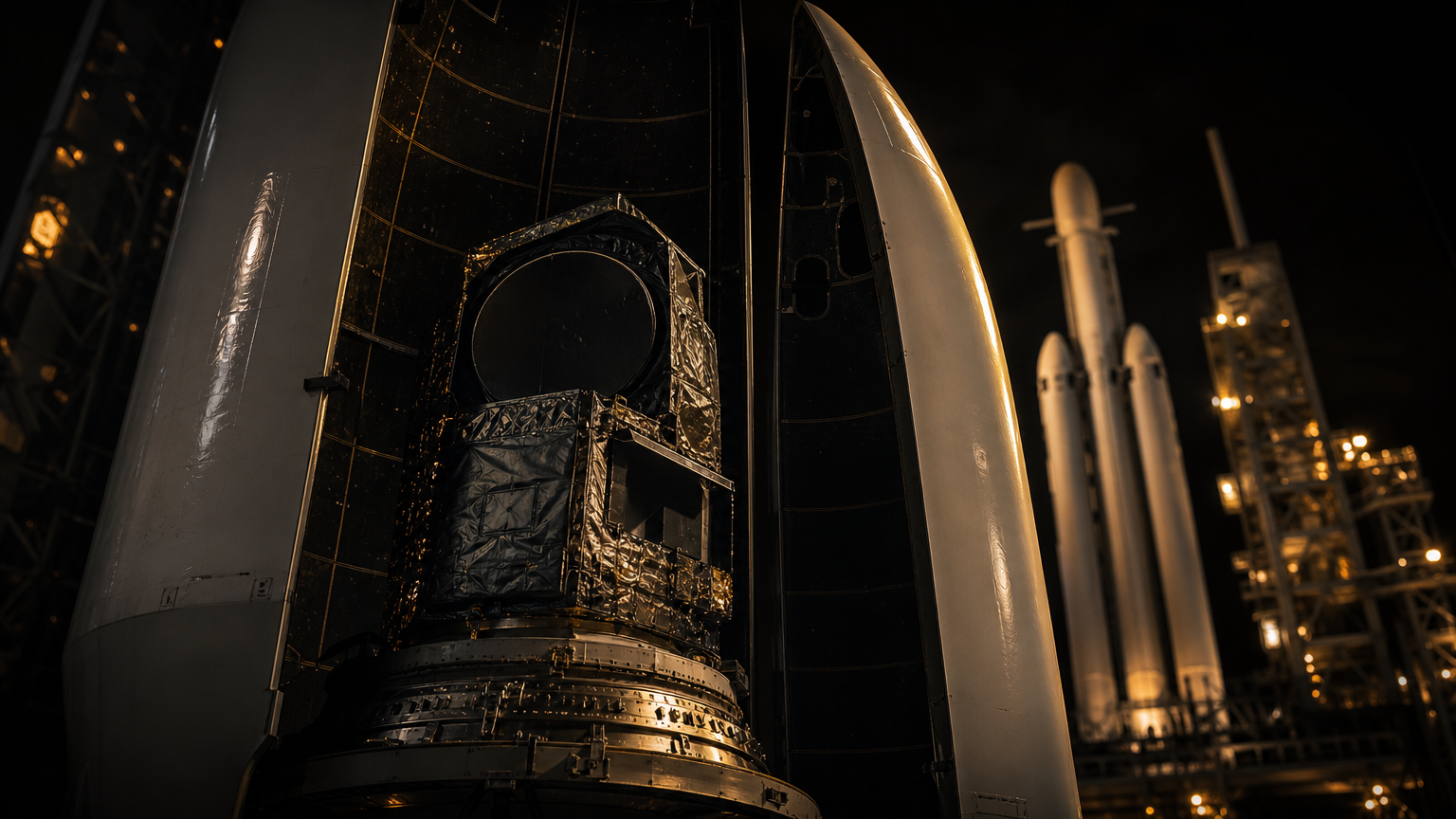
A flagship observatory enters its launch shell
NASA’s next major space observatory is now physically enclosed for flight: teams encapsulated the Nancy Grace Roman Space Telescope inside the payload fairing of a SpaceX Falcon Heavy rocket at Kennedy Space Center’s Payload Hazardous Servicing Facility, completing one of the last visible milestones before launch integration . The encapsulation took place on August 21, and NASA’s August 24 update said the fairing and its ground-support systems will keep Roman in a controlled environment as it is transported and prepared for mating to the rocket .
That step matters because Roman is no longer simply a finished spacecraft awaiting a ride; it is now in the configuration that will protect it through the harshest minutes of launch. NASA described the Falcon Heavy fairing as a 43-foot-tall structure mounted atop the rocket, shielding the observatory from acoustic vibration, aerodynamic pressure and heating while the vehicle climbs through Earth’s atmosphere . A few minutes after liftoff, once Roman is above the densest atmosphere, the fairing halves are expected to separate, with SpaceX recovering them while the telescope continues toward its deep-space destination .
The current target is liftoff no earlier than 7:26 a.m. EDT on Sunday, August 30, from Launch Complex 39A at NASA’s Kennedy Space Center in Florida, with NASA launch coverage scheduled to begin at 6:20 a.m. EDT . NASA’s latest coverage advisory also confirms that Roman is encapsulated at Kennedy ahead of mating to Falcon Heavy, tying the payload-processing milestone directly to the launch-week schedule .
What happens before the rocket rolls out
The next phase is a tightly choreographed ground campaign. NASA says the encapsulated observatory is to be moved to SpaceX’s hangar at pad 39A, attached to Falcon Heavy, and then rolled out to the launch pad for final prelaunch operations . A separate launch-readiness summary published on August 24 said teams had cleared Roman for final launch preparations after a review of the spacecraft, rocket, launch site and overall mission status .
The launch-day plan gives the mission a public rhythm. NASA has set a mission science briefing for Saturday, August 29, followed by a prelaunch news conference and launch-day coverage on August 30 . If the launch proceeds on the current timeline, the postlaunch briefing is scheduled for 9:30 a.m. EDT, with NASA leadership, Roman mission managers and the Launch Services Program represented .
Space-industry observers are treating Roman as the headline launch of the week. Astronomy’s August 24 launch roundup lists Roman as the final major scheduled launch between August 24 and August 30, identifying it as an 18,000-pound observatory bound for the second Sun-Earth Lagrange point and flying as the lone payload on Falcon Heavy . That matters operationally: there is no ride-share complexity here, only a single high-value spacecraft, a heavy-lift vehicle and a trajectory aimed beyond low Earth orbit.
Why Roman is not “another Webb”
Roman is often discussed alongside the Hubble and James Webb space telescopes, but its strength is different. NASA’s launch coverage describes Roman as pairing sharp infrared vision with a field of view at least 100 times larger than Hubble’s, designed for sweeping surveys that can investigate dark energy, dark matter, exoplanets, black holes and objects from the solar system to the edge of the observable universe . NASA’s August 24 media material says a single Roman image will be so large that it would require about 37 individual 4K Ultra HD screens to display at native resolution .
That scale is the mission’s defining feature. Webb is a specialist in deep, detailed, narrow-field infrared observation; Roman is built to map enormous areas quickly. NASA’s August 24 visual-material release says Roman will repeatedly photograph wide swaths of space, creating high-resolution time-lapse views of cosmic change . It also says the observatory is expected to generate 1.4 terabytes of data per day, with the data made publicly available .
The spacecraft’s science plan is broad because its field of view is broad. NASA says Roman’s surveys will help probe dark energy, the mysterious driver associated with the universe’s accelerating expansion, while also studying dark matter and distant planetary systems . The agency’s media summary says repeated infrared surveys of the Milky Way should create the largest census yet of stars and planets near the crowded galactic core, revealing around 100,000 new worlds .
The industrial story inside the science mission
Roman also carries a clear industrial message: U.S. flagship science missions now rely heavily on a commercial launch and hardware ecosystem. NASA and SpaceX are executing the launch campaign, while NASA says the mission is managed at Goddard Space Flight Center with participation from the Jet Propulsion Laboratory, Caltech/IPAC, the Space Telescope Science Institute and a wider science team . NASA’s coverage advisory identifies BAE Systems, L3Harris Technologies and Teledyne Scientific & Imaging as primary industrial partners, and also lists contributions from ESA, JAXA, CNES and the Max Planck Institute for Astronomy .
L3Harris used its August 24 update to highlight the Optical Telescope Assembly, calling it Roman’s optical eye and describing a 2.4-meter primary mirror with a field of view approximately 100 times larger than Hubble’s . The company says the optical telescope assembly and telescope electronics were designed and manufactured in Rochester, New York, and frames the hardware as central to Roman’s ability to produce large data volumes while preserving image quality .
Roman also includes a technology-demonstration coronagraph. NASA’s August 24 media material says the instrument is designed to block most of the light from nearby stars so faint planets and debris disks can be imaged more directly, with the demonstration intended to support future observatories that could search for smaller Earth-like worlds . L3Harris likewise describes Roman as conducting a broad exoplanet census while contributing to the dark-energy investigation .
A Falcon Heavy role with symbolic weight
For SpaceX, Roman is another example of Falcon Heavy’s place in NASA’s science-launch portfolio. The rocket is not merely lofting a large satellite to orbit; it is sending a flagship astrophysics observatory toward the second Sun-Earth Lagrange point, about one million miles from Earth . Once Roman separates from the rocket, NASA says it will travel to L2, where the mission has a five-year primary lifetime and a goal of operating for 10 years .
That destination reflects the observatory’s need for thermal stability, uninterrupted views and efficient communications for a data-heavy survey mission. L3Harris says the Optical Telescope Assembly must perform after traveling nearly one million miles to L2, a location whose gravitational balance supports deep-space observations . NASA’s launch coverage adds that Roman’s science data will be publicly available after processing, reinforcing the mission’s role as a shared survey engine rather than a closed instrument for a small team .
The encapsulation milestone therefore means more than a payload disappearing under a white shell. It marks the point where years of telescope development, industrial integration and launch-provider coordination converge into a single stack. Between now and August 30, the visible work will be rocket mating, rollout, countdown rehearsals and weather calls; the deeper story is that NASA is preparing to put a panoramic survey machine at L2, using Falcon Heavy as the bridge from a clean room in Florida to a decade of astrophysics.
If the schedule holds, Roman will leave Kennedy before most of the U.S. East Coast has finished its Sunday morning coffee. The fairing that now hides it from view is temporary; the survey era it is designed to open could last far longer.
Sources from the last 72 hours
- [1]NASA’s Roman Telescope Enclosed in SpaceX Falcon Heavy Rocket FairingAug 24, 2026, 8:00 PM UTC
- [2]NASA Sets Coverage for Roman Space Telescope Launch from FloridaAug 24, 2026, 9:26 PM UTC
- [3]NASA Interview Opportunity: NASA’s Groundbreaking New Space Telescope Is Days Away From Launching!Aug 24, 2026, 12:00 PM UTC
- [4]L3Harris Technology Set to Help Unlock the Universe as NASA's Roman Space Telescope Nears LaunchAug 24, 2026, 12:00 PM UTC
- [5]NASA is about to launch a powerful new eye on the universeAug 24, 2026, 12:00 PM UTC
- [6]NASA’s Roman Space Telescope takes flight and Starlink enduresAug 24, 2026, 12:00 PM UTC
AI-generated article based on recent web research, then preserved as a dated editorial snapshot.
Comments
Be the first to comment.