
Daily Podcast full article
Unitree confronts humanoid hype after Beijing’s 9.39-second robot sprint
A 9.39-second humanoid 100 meters in Beijing has become the robotics world’s loudest marketing moment of the week. But the more important story is not whether a machine has “beaten” Usain Bolt; it is whether companies such as Unitree can turn spectacular demos into durable, autonomous work.
A record built for headlines
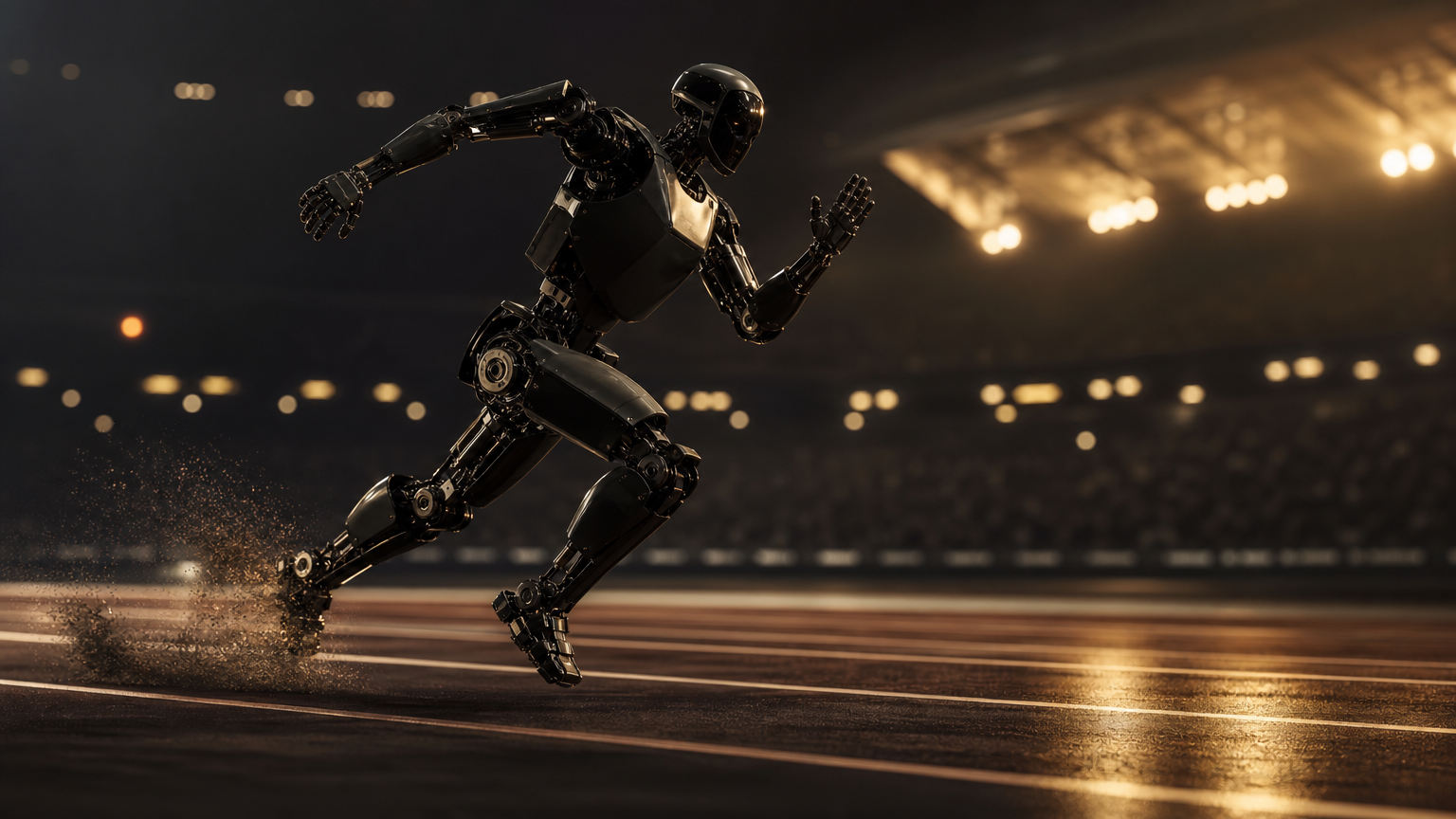
The 2026 World Humanoid Robot Games in Beijing delivered exactly the kind of image that investors, engineers and state media love: a humanoid robot covering 100 meters in 9.39 seconds, a time numerically faster than Usain Bolt’s 9.58-second human world record from 2009 . The robot, Tiangong Ultra, was developed by the Beijing Humanoid Robot Innovation Center and won its preliminary heat at the opening of the Games’ second edition, according to organizers cited by ABC News . Another machine, Honor’s Lightning, finished the same heat in 9.47 seconds, also under Bolt’s benchmark .
The symbolism is powerful. Humanoids have long been associated with awkward shuffling, short battery life and carefully staged lab videos. A sub-10-second sprint suggests that legged platforms are advancing quickly in motors, balance control, energy delivery and high-speed stabilization. The Games themselves are no small exhibition: Associated Press described more than 2,000 humanoid robots running, playing table tennis and soccer, and setting records in Beijing .
Still, the headline needs calibration. This was a robot race, not a human athletics event. The comparison with Bolt is useful as a public yardstick, but it does not mean the same thing as a human world record. Human sprinting is bounded by biology, doping controls, standardized bodies, competitive pressure and track regulations. A robot sprint is bounded by different constraints: actuator heat, battery discharge, surface conditions, rules on autonomy, remote assistance, body morphology and whether the machine can stop safely after the line.
Unitree’s awkward place in the spotlight
The week’s viral sprint was not a Unitree victory. South China Morning Post reported that Unitree Robotics’ robot finished last in the heat with a time of 12.41 seconds, while Tiangong Ultra clocked 9.39 seconds and Lightning finished in 9.47 seconds . That detail matters because Unitree is one of the best-known names in the humanoid race, and the company now faces a familiar dilemma: the entire sector benefits from spectacle, but the spotlight also sharpens scrutiny.
Unitree’s brand has been built on athletic demonstrations, low-cost platforms and viral videos of robots dancing, flipping or fighting. Yet the Beijing result shows how quickly the competitive field is moving. A company can be synonymous with humanoid visibility one month and find itself compared unfavorably with a rival’s racing machine the next. In a market driven partly by online clips, losing a heat can become as memorable as launching a product.
But the sprint should not be read as a definitive ranking of commercial capability. A 100-meter dash rewards a narrow set of engineering choices: leg length, stride frequency, control stability, high peak power and tolerance for hard braking. It says less about manipulating tools, maintaining uptime over a factory shift, sensing cluttered environments, complying with safety standards or surviving months of customer use. If Unitree is being forced to “confront humanoid hype,” it is because the company’s real test is no longer whether its robots can attract attention; it is whether they can perform useful work repeatedly.
The real benchmark: work, not spectacle
Reuters, in a report carried by Dawn, framed the next challenge plainly: robots may now outrun humans, but the real question is whether they can handle packaging, warehouse operations and precision tasks such as connecting cables . The Beijing Games include 51 events, split between 30 sports competitions and 21 scenario-based contests, with more than 40% requiring full autonomy, according to Huawei, a technology partner of the Games . ABC News also noted that the 2026 edition added robotic-hand challenges such as tightening screws, opening bottles and picking up beads with tweezers .
That is where the commercial value lies. Factories, hospitals, warehouses and homes do not need a humanoid that can impress a stadium for 10 seconds. They need systems that can identify objects under imperfect lighting, recover from slips, use the right amount of force, avoid damaging equipment, obey human instructions and continue operating when the environment is not exactly as mapped. A machine that runs fast but cannot reliably plug in a cable is a research milestone, not a labor platform.
The same Reuters report highlighted that braking remained a visible issue in the sprint events, with machines hitting thick mats placed several meters beyond the finish line . That is not a minor detail. In a stadium, a padded wall is a reasonable engineering workaround. In a warehouse aisle, a hospital corridor or a domestic kitchen, uncontrolled stopping becomes a safety and liability problem.
Speed is still meaningful
Skepticism should not turn into dismissal. Sprinting robots are not merely circus acts. To run at these speeds, humanoids need real-time control loops, high-performance joints, balance recovery, robust frames and enough power density to move rapidly without immediate failure. Those capabilities can transfer into less glamorous applications: walking up ramps, recovering from trips, moving quickly between workstations or stabilizing while carrying loads.
The improvement curve is also striking. ABC News reported that Tiangong Ultra’s 9.39-second run compared with a 21.50-second winning time at the previous year’s inaugural Games . Reuters also reported a 400-meter humanoid run in 39.7 seconds, faster than Wayde van Niekerk’s human world record of 43.03 seconds, although such comparisons again require context . These results show that the hardware envelope is expanding quickly, even if the definition of “athletic record” remains different for machines and people.
The problem for the industry is that public attention tends to compress all progress into a single question: “Can robots beat humans?” The better question is more specific: “Can robots do a valuable task, in a messy environment, with acceptable safety, cost and reliability?” On that test, the field is still much younger than its sprint times suggest.
Wang Xingxing’s cautionary message
Unitree founder and CEO Wang Xingxing has sounded more cautious than the viral mood around humanoids might imply. Fortune reported that Wang said the industry’s “ChatGPT moment” could arrive in two to three years at the fastest, or five to ten years at the slowest . He defined that breakthrough as a point at which a robot can be placed in an unfamiliar environment, including a home, and complete about 80% of tasks using voice or text commands alone .
That is a sober standard. It shifts the debate from locomotion to generalization. A robot trained for a specific demo can succeed by narrowing the world: fixed route, known surface, controlled props, predictable lighting, human operators nearby. A useful general-purpose humanoid must do the opposite. It must handle unknown layouts, ambiguous language, varied objects, partial failures and human unpredictability.
Wang’s caution also contrasts with market enthusiasm. Fortune reported that investors sent Unitree’s stock up 460% when it listed on Shanghai’s STAR Market earlier in the week . That gap between technical caution and financial excitement is the central tension now surrounding Unitree and its peers. Robotics demos create belief. Customers create reality.
Beyond the 100 meters
The Beijing sprint is a valid milestone, but it is not the finish line. It proves that humanoid platforms are becoming faster, stronger and more visually persuasive. It does not prove that they are ready to become everyday workers. The next generation of benchmarks should measure hours between failures, autonomous recovery rates, safe interaction with humans, cost per completed task, thermal endurance, battery swaps, maintenance burden and performance in unfamiliar environments.
For Unitree, the lesson is especially sharp. The company does not need to own every record to remain important. But it does need to show that its robots can move from viral athleticism to repeatable utility. In that sense, the 9.39-second sprint is less a defeat for humans than a challenge to humanoid makers: stop racing the stopwatch, and start proving the work.
Sources from the last 72 hours
- [1]Humanoid robots sprint, play soccer and set records at Beijing games, in photosAug 23, 2026, 7:33 PM UTC
- [2]Ultra quick: Chinese robots beat Usain Bolt’s 100m world record at Beijing gamesAug 23, 2026, 9:30 AM UTC
- [3]Robots can outrun humans, but can they plug in a cable?Aug 23, 2026, 8:43 AM UTC
- [4]CEO of viral backflipping robot company says robots are still years from ‘ChatGPT moment,’ even after investors sent his stock soaring 460%Aug 21, 2026, 3:05 PM UTC
- [5]Chinese humanoid robot beats Usain Bolt's 100 metres world recordAug 22, 2026, 1:38 PM UTC
AI-generated article based on recent web research, then preserved as a dated editorial snapshot.
Comments
Be the first to comment.