
Daily Podcast full article
Tesla Optimus Gen 3: 2027 sales target, not 500-task proof
Fresh reporting points to a more cautious Optimus story than the viral “500 insanely complex tasks” framing: Tesla is telling analysts Gen 3 is moving toward production, but external sales are still framed as a second-half 2027 possibility, with proof of useful real-world work still the key missing milestone.
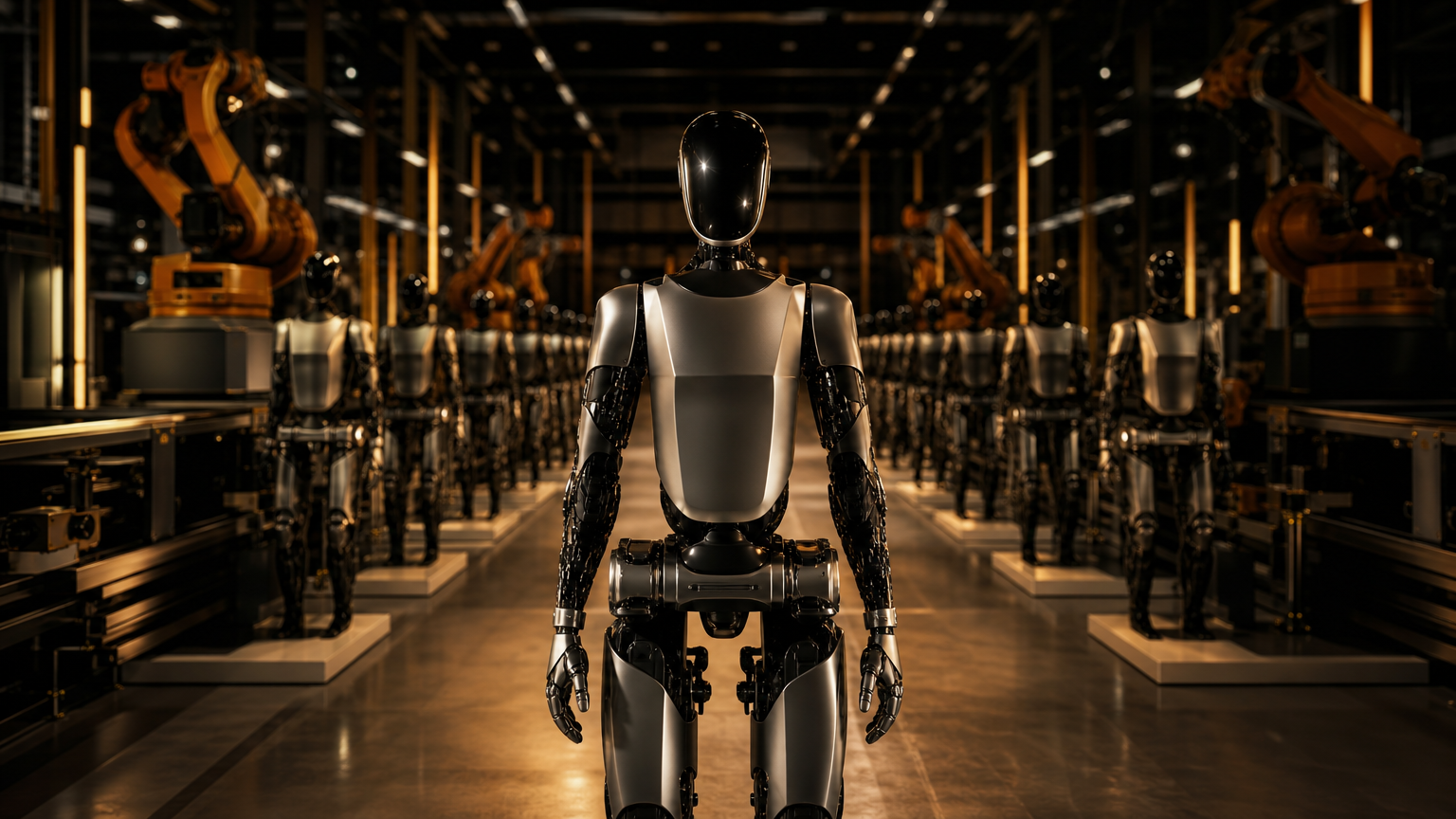
The headline versus the evidence
The latest available reporting does not confirm a “Tesla Bot Gen 3 Special Edition” that has demonstrably learned 500 complex tasks. What it does show is more important: Tesla is still trying to turn Optimus from a demo platform into a manufacturable humanoid robot, and the company is now telling analysts that external commercial sales may begin as early as the second half of 2027 . That is a roadmap, not a finished product.
The distinction matters because Optimus sits at the center of Tesla’s attempt to be valued not only as an automaker, but as an AI, autonomy and robotics company. Fresh reports say Tesla described the Optimus Gen 3 design as completed, its supply chain as effectively finalized, and its production line as being installed in the former Model S and Model X area at Fremont . But the same reports also stress that the 2027 sales window remains a target, not proof that the robot can already perform hundreds of household or industrial tasks reliably .
What Tesla is telling Wall Street now
The current update comes through a JPMorgan visit to Tesla’s Fremont factory, where analysts were briefed on FSD v15, Cybercab and Optimus . Tesla reportedly presented FSD v15 as a “step-change” built around seven core technologies, with about 40% of those technologies already running in the Austin robotaxi fleet . That matters for Optimus because Tesla’s robotics thesis increasingly mirrors its autonomy thesis: use vision-heavy AI systems, real-world data and vertically integrated hardware to create a general-purpose platform.
On the Optimus side, Tesla’s message is that Gen 3 is entering an industrial phase. The company says the design is finalized, the supply chain is essentially locked in, and the Fremont line is being fitted for production . It also describes long-term capacity ambitions of roughly 1 million Optimus units at Fremont and up to 10 million in Texas . Those numbers are strategically significant, but they are capacity ambitions, not current output.
Tom’s Hardware Italia captured the same tension: Tesla is indicating possible external sales of Optimus Gen 3 in the second half of 2027, while also noting that the long-term production figures are not tied to precise production deadlines . That is the most sober reading of the moment. The plan is becoming clearer; the evidence of scale is not yet here.
Why the “500 tasks” claim needs caution
The “500 tasks” framing is attractive because it gives the robot a measurable achievement. But the fresh sources do not provide a verified task list, a benchmark, an independent test, or a published reliability rate for 500 learned tasks. A robot that can perform a task once in a controlled video is very different from one that can repeat it safely, cheaply and autonomously across homes, factories and warehouses.
The current reporting is therefore best read as an industrial readiness update, not a capability certificate. Tesla is saying it has moved closer to a production-intended Optimus Gen 3, but the reports still point to a commercialization path that begins internally and moves outward later . The immediate challenge is not whether a robot can fold a shirt or hand over a bottle in a demonstration. It is whether Tesla can build a robot that reliably perceives messy environments, plans multi-step actions, handles objects with human-like dexterity and recovers when something goes wrong.
That is also why the FSD v15 discussion matters. Tesla’s approach appears to rely on the same broad AI logic across cars, robotaxis and humanoids: perception first, neural control second, continuous improvement through data. Fresh reporting says Tesla claims AI4 can support unsupervised driving, while AI4.5 adds about 10% more compute and roughly doubles memory . Those hardware claims are relevant because Optimus will need local intelligence, fast perception and robust control loops if it is to work beyond staged demos.
Fremont becomes the proving ground
The conversion of Fremont is symbolically powerful. A factory space associated with Tesla’s premium vehicles is now being reframed around humanoid robotics. Fresh reports say the Optimus line is going into the former Model S and Model X facility . If Tesla can turn that space into a repeatable robot production system, Optimus becomes more than a research project.
But manufacturing a humanoid robot is not like manufacturing a car. A car moves mostly as one rigid system on roads designed for vehicles. A humanoid robot must balance, walk, grasp, manipulate, avoid people, understand context and act safely in environments built for humans. Every joint, actuator, sensor, tendon, hand mechanism and compute unit becomes a potential bottleneck.
That explains why investors should treat the 1 million and 10 million capacity figures carefully. They describe the scale Tesla wants, not the scale it has already achieved . The real milestone will be evidence of sustained production, internal deployment and measurable task reliability. Until then, the Gen 3 story remains promising but unfinished.
A 2027 robot story, not a 2026 victory lap
The biggest change in the fresh reporting is timing. Instead of a near-term consumer breakthrough, the active message is that outside commercial sales could start in the second half of 2027 . That places Optimus alongside Tesla’s broader autonomy calendar, where Cybercab expansion is also expected to accelerate from late 2026 into early 2027 .
For Tesla bulls, this is still a compelling convergence: FSD v15, Cybercab and Optimus all moving toward commercialization in a similar window. For skeptics, it is another set of ambitious dates in categories where Tesla has often promised faster progress than it later delivered. The prudent view is between those extremes. Tesla appears to be organizing hardware, supply chain and factory space around Optimus Gen 3, but it has not yet produced public evidence that the robot is ready for broad external deployment.
What to watch next
Three checkpoints matter most. First, Tesla needs to show the actual Gen 3 robot in sustained, uncut, useful work rather than short demonstrations. Second, it needs to disclose whether Fremont production has moved from installation to repeatable output. Third, it needs to clarify the first customer use cases: Tesla factories, third-party industrial buyers, or eventually households.
Until those answers arrive, the best reading is this: Optimus Gen 3 is advancing toward a production architecture, but the viral “500 tasks” and “best of 2027” framing gets ahead of the evidence. The real story is not that Tesla has already won humanoid robotics. It is that Tesla is trying to compress AI software, dexterous hardware and mass manufacturing into one product category — and 2027 is now the year by which the company wants that promise to start facing customers.
Sources from the last 72 hours
- [1]Tesla signals 'major leap' with FSD v15, eyes Optimus sales from second half 2027Aug 21, 2026, 1:59 AM UTC
- [2]Tesla Calls FSD v15 a Step-Change, Targets Optimus Sales in 2027Aug 22, 2026, 12:00 AM UTC
- [3]Tesla scommette su AI4, ma la guida autonoma resta da dimostrareAug 22, 2026, 8:00 AM UTC
AI-generated article based on recent web research, then preserved as a dated editorial snapshot.
Comments
Be the first to comment.