
Daily Podcast full article
SpaceX reaches 100 Falcon launches in 2026 as Starlink scale becomes the story
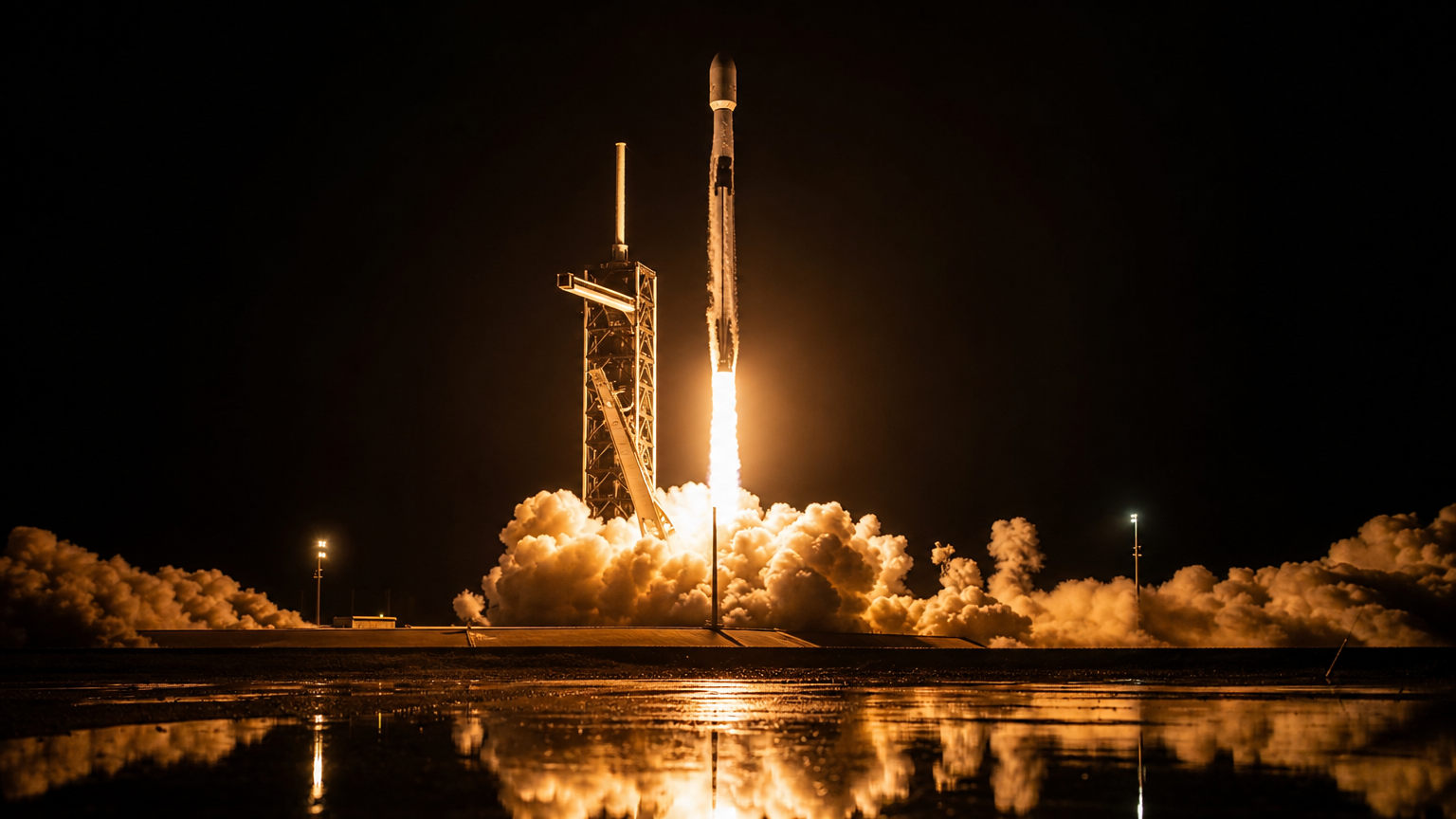
SpaceX’s Aug. 22 Falcon 9 mission from Vandenberg carried 27 more Starlink satellites and completed the company’s 100th Falcon-family launch of 2026, sharpening a larger point: reusable rockets have turned Starlink deployment into a high-frequency industrial system, not a conventional satellite program [1].
A milestone measured in launch tempo
SpaceX crossed another threshold before dawn on Aug. 22, when a Falcon 9 lifted off from Space Launch Complex 4 East at Vandenberg Space Force Base in California carrying 27 Starlink satellites to low Earth orbit . The launch took place at 3:25 a.m. EDT, or 07:25 UTC, and Space.com reported that the upper stage deployed the satellites on schedule just under 62 minutes after liftoff .
The flight was not merely another Starlink batch. It was the 99th Falcon 9 liftoff of 2026 and, when combined with one Falcon Heavy mission earlier in the year, the 100th Falcon-family mission of 2026 . Le360, citing SpaceX’s own X post, reported the same tally and quoted the company’s framing that the mission completed its “100th Falcon launch of the year” .
That distinction matters. SpaceX had already reached 100 total company missions for 2026 earlier in the week when Starship test flights were counted separately, but the Aug. 22 flight put the operational Falcon fleet itself at the century mark . In practical terms, the milestone belongs to Falcon 9’s reuse model: one largely standardized booster design, rapid post-flight processing, two coastal launch ranges, and a large internal customer that can fill launch slots continuously.
The flight profile: routine, but revealing
The Aug. 22 mission followed the now-familiar Starlink pattern. The rocket departed Vandenberg on a low Earth orbit deployment trajectory; the first stage, booster B1100, returned to the Pacific and landed on the droneship “Of Course I Still Love You” about eight and a half minutes after launch . It was B1100’s ninth flight, according to both Space.com and Le360 .
Local reporting before launch showed how routine these operations have become on California’s Central Coast. KEYT reported on Aug. 21 that Vandenberg had set a four-hour launch window beginning at 12:25 a.m. local time on Aug. 22, that the mission would carry 27 Starlink satellites, and that the booster was expected to land on the Pacific droneship after stage separation .
The mission also illustrated SpaceX’s ability to schedule Starlink launches closely together. Just one day earlier, another Falcon 9 launched 29 Starlink satellites from Florida, and Elon Musk used that Florida mission to say Starlink had reached 11,000 satellites in orbit . By the time the California mission flew, SpaceX was adding still more capacity to a constellation already far larger than any competing broadband network.
Starlink is the demand engine
The central lesson of the 100-Falcon milestone is not simply that SpaceX launches frequently. It is that the company has created a closed loop between launch supply and satellite demand. Space.com reported that 76 of the 99 Falcon 9 launches so far in 2026 had been dedicated Starlink missions . Le360 gave the same 76-of-99 Starlink count in its Aug. 23 report .
That ratio explains the economics. SpaceX is not waiting for outside customers to book every rocket. It can use Falcon 9 to deploy its own spacecraft, expand Starlink coverage and capacity, then use the resulting consumer, enterprise, maritime, aviation and government demand to justify more satellites. The rocket business feeds the network business, and the network business keeps the rocket manifest full.
The 11,000-satellite figure, posted by Musk and reported by Yahoo Finance/24/7 Wall Street on Aug. 21, gives that cadence strategic weight . The same report compared Starlink with other low Earth orbit constellations, saying a July satellite catalog placed Starlink far ahead of OneWeb and Amazon’s Kuiper/Leo system . Even if individual counts shift with each launch and reentry, the scale gap is now part of the competitive landscape.
Reuse has become infrastructure policy by other means
The Falcon 9 booster landing is easy to treat as routine because SpaceX has made it routine. Yet that is precisely why the 100th Falcon mission matters. Every successful recovery reduces the amount of new hardware required for the next flight, and every reflown booster makes launch cadence less dependent on a factory producing an expendable first stage for every mission.
For Starlink, that changes the pace of network buildout. A traditional satellite operator generally buys launch services, waits for available windows, and spreads constellation deployment across years. SpaceX can instead coordinate satellite production, launch operations, ground infrastructure and service sales inside the same corporate system. That is why Starlink is more than an internet product; it is an vertically integrated orbital infrastructure network.
This advantage also affects rivals. A competitor that must buy launches is exposed to launch price, launch availability and schedule priority. SpaceX, by contrast, can decide to fill a Falcon 9 with its own satellites whenever the hardware, range and recovery fleet are ready. The Aug. 22 flight showed that the model is not theoretical: 27 more satellites went up on the 100th Falcon-family mission of the year .
The limits of the achievement
The milestone should not be overstated. Space.com noted that SpaceX’s single-year Falcon record remains 165 launches, set in 2025, and that the company had not yet matched that pace by the Aug. 22 century mark . A hundred Falcon missions before September is extraordinary for the launch industry, but SpaceX is now competing mostly against its own recent records.
There are also policy and orbital-environment questions that grow with Starlink’s size. More satellites mean more traffic management, more deorbit planning, more coordination with astronomers and regulators, and more dependence on automated collision-avoidance systems. The fresh reporting around the Aug. 22 mission focused on the launch milestone, not on new regulatory action, but the constellation’s scale makes those issues inseparable from the story.
Why this week matters
The 100th Falcon mission of 2026 is best understood as a signal of operational maturity. SpaceX is not demonstrating that reuse can work; it is demonstrating what an industrial launch system looks like after reuse has been absorbed into normal operations.
The company launched 27 more Starlink satellites, recovered the booster, added to the world’s largest broadband constellation, and treated the whole sequence as one more entry in a weekly production rhythm . That is the real milestone. Falcon 9 is no longer just a rocket. In 2026, it is the assembly line for Starlink’s orbital footprint.
Sources from the last 72 hours
- [1]SpaceX sends 27 Starlink satellites to orbit on 100th Falcon rocket launch of the year (video, photos)Aug 22, 2026, 12:23 PM UTC
- [2]SpaceX reaches 100 Falcon launches in 2026 with 27 more Starlink satellitesAug 23, 2026, 2:00 PM UTC
- [3]Elon Musk: “Starlink Now Has 11k Satellites in Orbit.” Amazon Hasn’t Even Cracked 1,000.Aug 21, 2026, 7:30 PM UTC
- [4]Falcon 9 Launch From Vandenberg SFB Scheduled for Early Saturday MorningAug 21, 2026, 7:07 PM UTC
AI-generated article based on recent web research, then preserved as a dated editorial snapshot.
Comments
Be the first to comment.