
Daily Podcast full article
China’s Robot Race Is No Longer About Demos. It Is About Scale
Beijing’s humanoid robot spectacle this weekend looked like a sports meet, but the deeper signal was industrial: China is turning embodied AI into a mass-participation, supply-chain and deployment contest while rivals still debate which robot form factor will win.
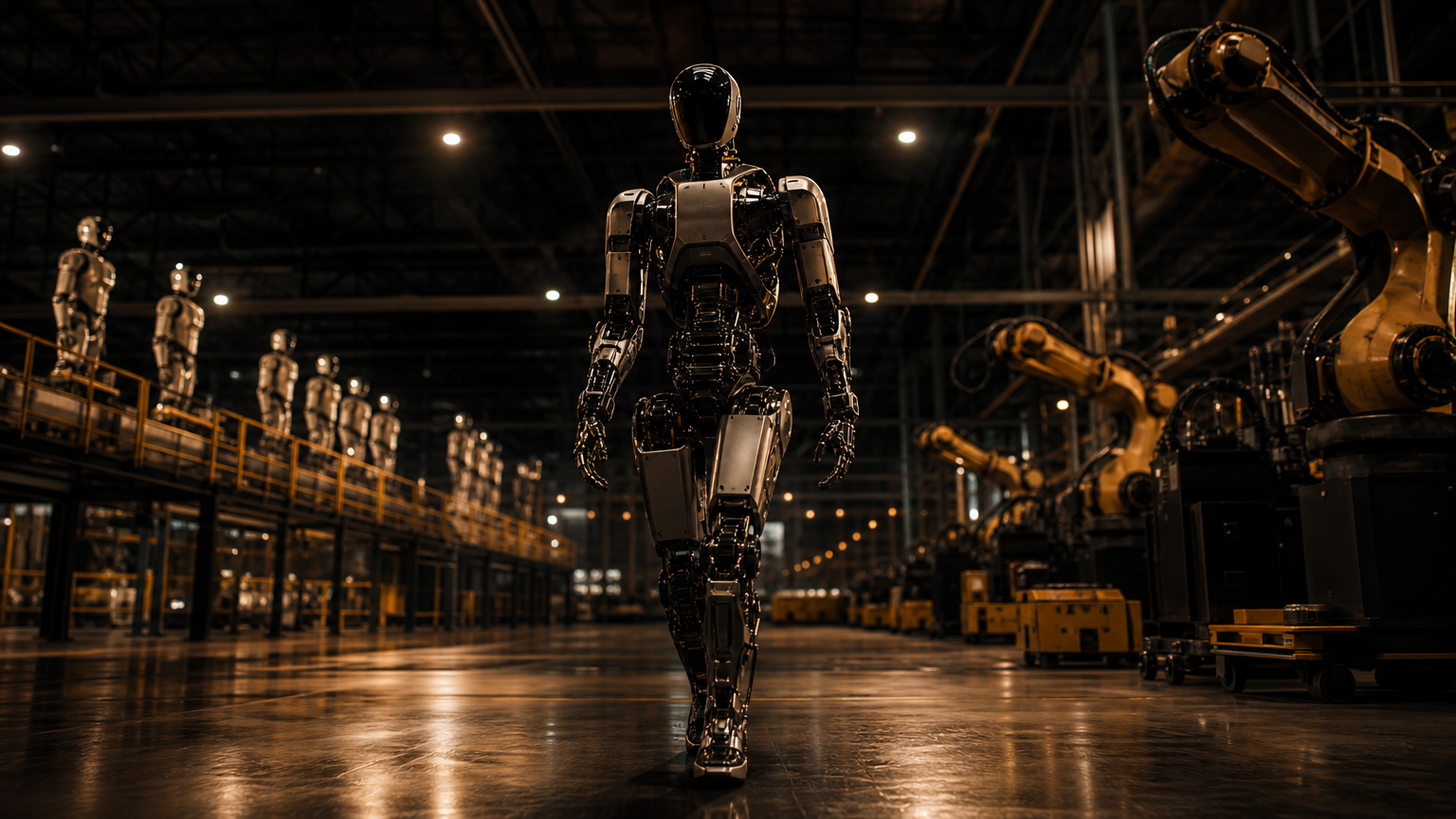
The weekend China made the robot race visible
The most revealing robotics story of the week was not a single startup valuation or a laboratory video. It was a stadium full of machines in Beijing. The second World Humanoid Robot Games opened at the National Speed Skating Oval with 666 teams and 2,056 robots from 16 countries competing across 51 events, according to organizers cited by CCTV . South China Morning Post reported that the program includes 1,301 matches and events ranging from running and football to table tennis, combat and scenario-based tasks in industrial production, hotels, homes and logistics .
That matters because the global “robot race” is often discussed as if it were a beauty contest among humanoid prototypes. China is reframing it as an operating system for an industry: public competitions, state-backed venues, commercial exhibitions, suppliers, developers, data collection, and repeated pressure to move from spectacle to deployment. The result is a robotics ecosystem that looks less like a handful of moonshots and more like an industrial mobilization.
The headline-grabbing results were designed to travel. At the Beijing games, Tiangong Ultra, developed by the Beijing Humanoid Robot Innovation Centre, ran 100 metres in 9.39 seconds in a preliminary heat, while Honor’s Lightning finished the same heat in 9.47 seconds, both faster than Usain Bolt’s human world record of 9.58 seconds, according to Reuters and SCMP . The comparison is partly theatrical, because a sprinting robot and a human athlete are not subject to the same biological limits. But as a signal of iteration speed, it is powerful: SCMP noted that last year’s inaugural 100-metre winning time was 21.50 seconds .
The real story is not the humanoid body
The sharper lesson from Beijing is that China is not betting only on the fantasy of a general-purpose biped that can do everything. At the World Robot Conference, humanoids remained crowd-pullers, with Unitree models playing table tennis and staging fighting demonstrations . But elsewhere in the halls, robots were sorting parcels, loading production lines and moving materials, often on wheels rather than legs .
That distinction is crucial. Western discussion often treats the humanoid body as the end point: a machine that resembles a person and can therefore inherit human environments. Chinese exhibitors are increasingly presenting a more pragmatic question: if wheels, arms, grippers and specialized end effectors solve the job, why insist on legs? Yang Li, a senior engineer at X Square Robot, put the point bluntly at the conference when he asked whether two legs are needed if wheels can get the task done .
This is where China’s advantage becomes less cinematic and more threatening to competitors. A robot that can backflip is impressive; a robot that can sort parcels, load lines, or work in a hotel scenario for less money and with easier maintenance is commercially dangerous. X Square Robot said its two-armed WALL-B embodied model sorted 1,816 packages in an hour-long controlled test, compared with an average of 1,248 parcels an hour for Figure AI’s bipedal Figure 03, according to SCMP . The comparison is not a final market verdict, but it captures the pivot from “who looks most human?” to “who produces the best return?”
Embodied AI is becoming an infrastructure problem
Physical AI is often described as artificial intelligence that can perceive, plan, act and verify in the real world. The Beijing events showed why that definition is not just about models. A tennis demonstration by Beijing-based Galbot required the robot to track a moving ball, predict its landing point, position itself, and coordinate torso and arm movements within seconds . The robot also fell while chasing a ball, then rolled over, stood up and resumed play . That failure was not an embarrassment; it was the point. Real-world intelligence is built in the gap between controlled performance and recovery from error.
The same applies to the synchronized formations at the opening ceremony. CCTV reported that marching humanoids independently calculated their paths and dynamically adjusted posture to stay in formation, while some performed high-difficulty acrobatic moves . Such displays can look like propaganda, and in part they are. But they also test fleet coordination, balance, local perception, latency and motion control in public conditions.
The Games’ organizers said the event is intended to promote technological exchange, industrial collaboration and the development of embodied intelligence . That phrasing is bureaucratic, but it points to the larger Chinese strategy: make robotics a platform industry. Competitions create benchmarks. Conferences create sales channels. Local governments create venues and demand. Media events create national confidence and international signaling. None of that guarantees profitable robots, but it accelerates learning.
Why “China has won” is both true and incomplete
The claim that China has already won the robot race needs qualification. China has not solved mass deployment of humanoids in every workplace or home. SCMP’s reporting from the Games stressed continuing weaknesses, including balance problems, limited autonomy, battery constraints and the need for faster networks . AP-style hype around record-breaking robot sprints should not obscure the fact that many machines are still best at demonstrations, not unsupervised work.
But if the race is about manufacturing depth, public mobilization and the speed of moving prototypes into repeated field-like tests, China is already setting the pace. The Beijing weekend put thousands of robots into a single public competition environment . It also linked sport-style performance with scenario-based events in logistics, homes, hotels and industrial production . That is exactly the bridge the industry needs: not a viral clip, but a pipeline from spectacle to use case.
The most important word in the current Chinese conversation is not “humanoid.” It is “practical.” SCMP reported that Chinese companies at the World Robot Conference are under growing pressure to produce applications that generate real-world returns . That pressure is healthy. It forces a sorting process between firms that can stage a demo and firms that can build a machine customers will operate.
The quiet risk for the rest of the world
For the United States, Europe and Japan, the danger is not that China has built a perfect robot. It has not. The danger is that China is building the conditions under which imperfect robots improve quickly: large events, dense supply chains, low-cost hardware iteration, government coordination, and public tolerance for visible trial and error.
The world may remember the 9.39-second sprint because it makes a clean headline . Industry leaders should pay closer attention to the less glamorous details: 1,301 matches, scenario tasks, wheeled alternatives, package sorting, tennis recovery, synchronized marching, and the use of a national venue to turn robotics into a mass industrial narrative , , . Those are signs of a country treating embodied AI not as a side bet, but as the next manufacturing frontier.
So has China “won”? In the narrow sense of building the most commercially mature universal robot, no one has. In the broader race to make robotics a scalable national industry, China is much closer to the finish line than many competitors admit. The robots still stumble. The strategy does not.
Sources from the last 72 hours
- [1]Chinese robots tackle tennis, smash track records at World Humanoid Robot GamesAug 23, 2026, 10:52 AM UTC
- [2]Are humanoid robots the future? Chinese makers instead highlight practical designAug 23, 2026, 3:00 AM UTC
- [3]Ultra quick: Chinese robots beat Usain Bolt’s 100m world record at Beijing gamesAug 23, 2026, 9:30 AM UTC
- [4]2026 World Humanoid Robot Games opens in BeijingAug 23, 2026, 7:40 AM UTC
- [5]Opening ceremony of 2nd World Humanoid Robot Games held in BeijingAug 23, 2026, 7:28 AM UTC
- [6]Chinese robot maker capitalises on Niu Lai craze at Beijing’s World Robot ConferenceAug 21, 2026, 10:55 AM UTC
AI-generated article based on recent web research, then preserved as a dated editorial snapshot.
Comments
Be the first to comment.