
Daily Podcast full article
Google Quantum warning turns Bitcoin’s quantum risk into an engineering deadline
Fresh reporting on Google Quantum AI’s crypto-risk estimates and a U.S. free-space quantum networking milestone point in opposite directions but tell the same security story: quantum physics can strengthen future communications while compressing the planning window for today’s public-key cryptography.
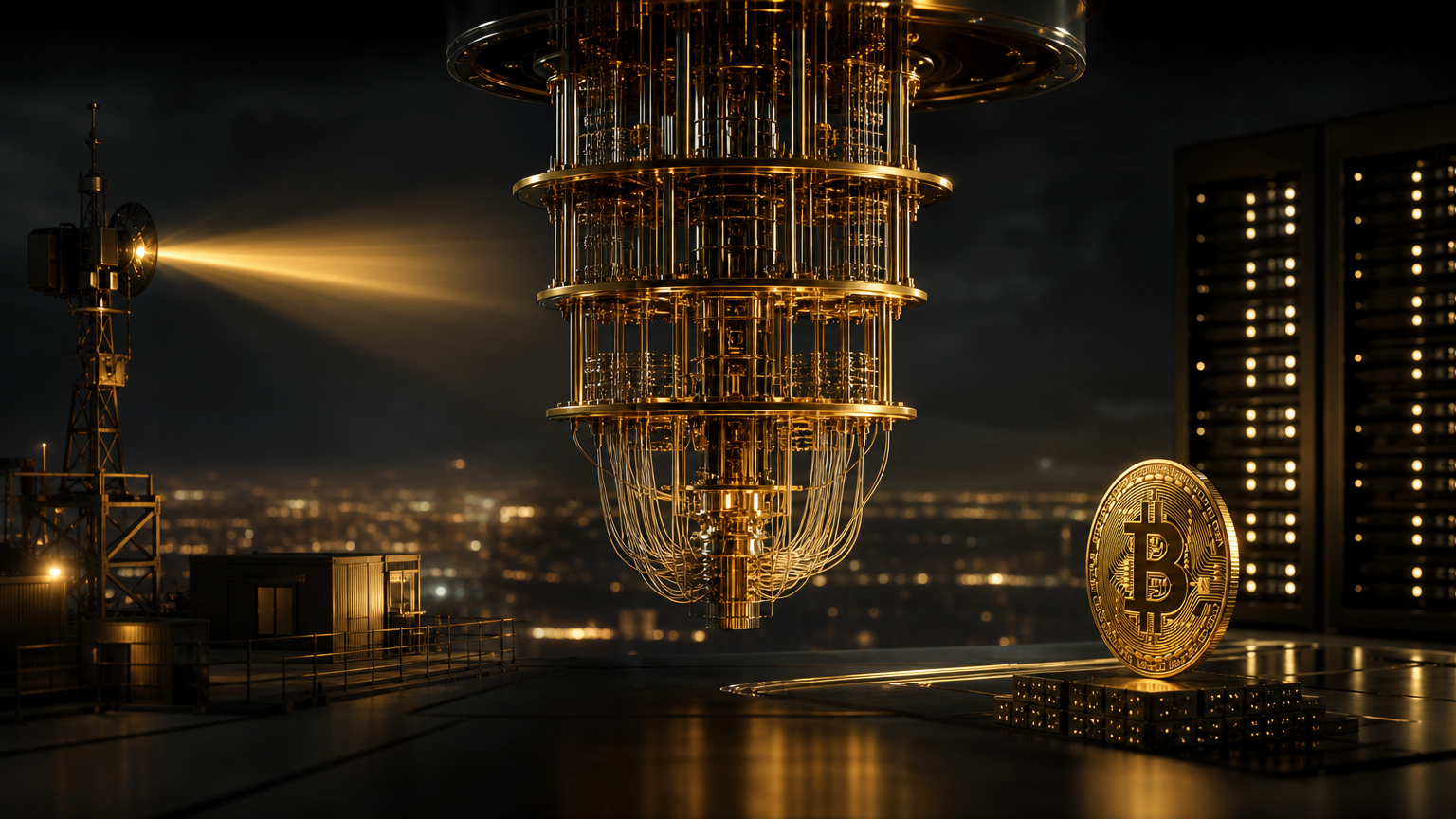
The weekend’s signal: quantum is leaving the slide deck
The current quantum-security discussion is no longer only about distant laboratory promise. It is now about two practical questions: how fast secure quantum links can be built, and how quickly existing cryptographic systems can be retired before fault-tolerant quantum computers become useful to attackers. Fresh reporting on Aug. 22 said Google Quantum AI researchers estimate that attacks on cryptocurrencies relying on the secp256k1 elliptic curve could require as few as 1,200 logical qubits and 90 million Toffoli gates, far below what many security planners had treated as the comfortable outer edge of the threat model . The same report said the researchers used a zero-knowledge proof to validate the result without publishing attack-enabling circuit details, a choice that puts the work in the category of security disclosure rather than pure academic openness .
That matters because Bitcoin, Ethereum and many other blockchain systems rely on elliptic-curve signatures to prove ownership and authorize spending. The current warning is not that Bitcoin has been broken this weekend. It is that the number of fault-tolerant resources needed to run Shor’s algorithm against the curve used by major cryptocurrencies is being revised downward, and that the relevant race is shifting from “whether” to “how soon” cryptographically relevant quantum computers can be engineered .
What Google’s estimate changes
The headline figure in the new reporting is the low-qubit variant: 1,200 logical qubits and 90 million Toffoli gates for a secp256k1 attack path . A second variant cited in the same report trades more logical qubits for fewer gates, at up to 1,450 logical qubits and 70 million Toffoli gates . In ordinary security language, that is not a consumer-device forecast; logical qubits are error-corrected units built from many physical qubits, and Toffoli gates are expensive operations in fault-tolerant quantum computing. But the reduction is significant because the expected machine is no longer a science-fiction object with unbounded requirements; it is becoming an engineering target with numbers that can be placed on roadmaps, budgets and risk registers.
The most sensitive scenario described in the fresh reporting is the “on-spend” attack. In that model, an attacker waits until a transaction exposes a public key in the public mempool, uses a fast-clock quantum computer to derive the private key, and attempts to redirect or double-spend before the transaction is confirmed . The concern is therefore not limited to long-abandoned coins or old address types, although those remain part of the policy problem. It includes live transaction flows, exchange custody systems, wallet behavior and any blockchain design that assumes the time between public-key exposure and finality is too short to exploit.
The report also distinguishes between fast-clock systems, such as superconducting or photonic architectures, and slower-clock systems such as neutral-atom or ion-trap designs . That distinction is important for markets and infrastructure planners because a machine with the right qubit count but slow operations may not be useful for a mempool race, while a smaller but faster architecture could be more threatening once it crosses the fault-tolerance threshold .
The other side of quantum security: wireless entanglement
At almost the same moment, Brookhaven National Laboratory and Stony Brook University reported a successful U.S. demonstration of quantum information sent through open air between the two institutions . The Aug. 21 release described it as the first demonstration of its kind in the United States and a milestone toward extending the nation’s longest quantum network beyond fiber-optic cable . During a daytime demonstration, photons carrying quantum states were generated at Stony Brook’s Quantum Watchtower and transmitted 13 miles, or 21 kilometers, to Brookhaven’s Quantum Lighthouse in Upton, New York .
The team also reported nighttime tests in which entangled photons were sent from a Stony Brook physics laboratory to the Quantum Watchtower by fiber, distributed across the new free-space optical link, and then received and measured at the Quantum Lighthouse . Brookhaven’s companion technical feature says the permanent free-space optical link adds a wireless component to a 161-mile quantum network across Long Island and the New York metropolitan area . The system is designed to send entangled photons 13 miles through the air between Brookhaven and Stony Brook, with a third facility at Yale expected to support a 30-mile, or 48-kilometer, link across Long Island Sound .
That is the constructive face of quantum physics. Free-space quantum links could eventually help connect quantum processors, sensors and communication nodes without requiring every route to be dug into fiber. Brookhaven’s feature explains that the link uses telescope and adaptive-optics techniques to correct for atmospheric turbulence, expanding a tiny fiber output into a 25-inch beam and then focusing it back down at the receiving end . The same article notes practical limits: line of sight is required, fog blocks transmission, sunlight increases turbulence and background light, and the early system is expected to operate mainly at night in clear weather .
Why the two stories belong together
The crypto-risk estimate and the open-air network milestone are not contradictory. They are the same transition viewed from opposite ends. Quantum communication aims to make some links more tamper-evident and more naturally suited to quantum devices. Quantum computation threatens cryptographic systems whose security rests on mathematical problems, including the elliptic-curve discrete logarithm problem behind secp256k1 . In one case, physics is used to distribute or preserve quantum information. In the other, physics is used to solve a problem that classical computers cannot solve efficiently at scale.
For cloud providers, exchanges, chip companies and standards bodies, the practical conclusion is sober rather than sensational. The latest reporting does not justify panic claims that crypto is already dead. It does justify treating post-quantum migration as an engineering program with dependencies: signature scheme selection, wallet support, custody procedures, smart-contract compatibility, transaction-size costs, user migration and governance for dormant assets. The Google-related report says the researchers urge vulnerable cryptocurrency communities to prioritize post-quantum cryptography, while also recognizing that abandoned assets create a policy problem that pure technical migration cannot fully solve .
What comes next
The near-term watch list is now clear. First, crypto developers will be judged on whether post-quantum signature options move from proposals and testbeds into credible deployment plans. Second, exchanges and custodians will need to reduce avoidable public-key exposure, review address-reuse practices and model the confirmation-window risk described in the latest Google Quantum AI reporting . Third, quantum-network builders will need to show that free-space links can graduate from carefully staged demonstrations to repeatable operations in ordinary weather and daylight conditions; Brookhaven’s own feature identifies those environmental constraints as part of the next engineering challenge .
The deeper lesson is that quantum risk has become bidirectional. The same scientific frontier is producing tools for more secure networks and sharper estimates of how today’s cryptography can fail. That makes “wait and see” less attractive. Even if the first cryptographically relevant quantum computer arrives later than aggressive forecasts suggest, the migration work is broad enough that starting only after the hardware exists would be a security failure. The clock has not struck midnight for Bitcoin or public-key cryptography. But the clock is now visible, and it is being measured in engineering milestones rather than metaphors.
Sources from the last 72 hours
- [1]New estimates From Google Quantum AI show quantum attack on Bitcoin is closer than thoughtAug 22, 2026, 12:00 AM UTC
- [2]Brookhaven and Stony Brook Researchers Demonstrate Wireless Capability for Quantum NetworkAug 21, 2026, 11:15 PM UTC
- [3]The Quantum Lighthouse: Extending Quantum Networks Beyond FiberAug 21, 2026, 11:20 PM UTC
AI-generated article based on recent web research, then preserved as a dated editorial snapshot.
Comments
Be the first to comment.