
Daily Podcast full article
Elon Musk’s Terafab: Texas chip megaproject is less “finished factory” than live supply-chain bet
Fresh reporting and job-posting evidence show Terafab is moving from headline spectacle toward procurement, construction planning and investor scrutiny, but the public record still describes a proposed semiconductor complex rather than a completed “largest building on Earth.”
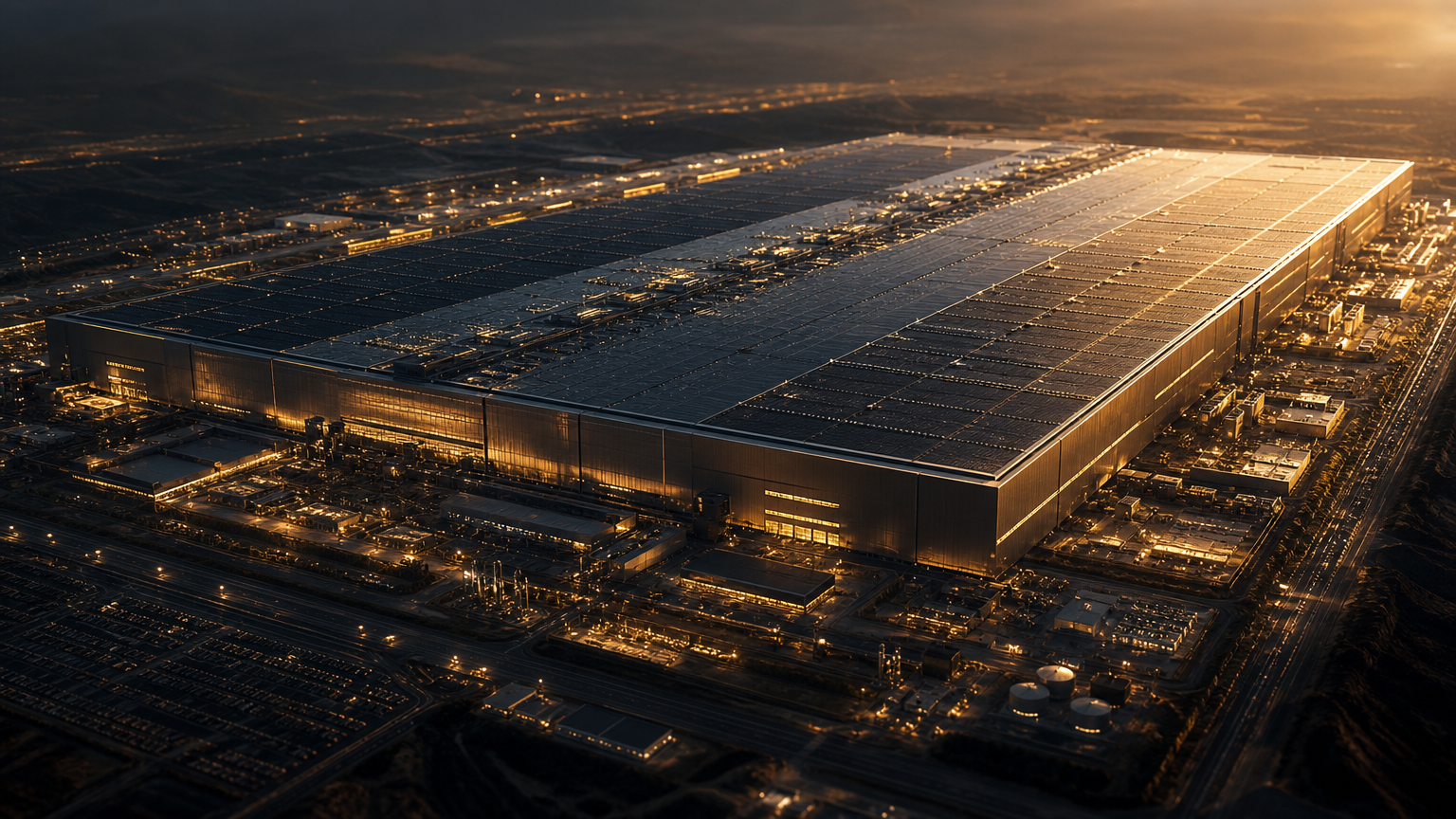
The headline is huge. The current reality is more precise.
The latest public snapshot of Elon Musk’s Terafab is not a tour through a finished 100-million-square-foot interior. It is a picture of a megaproject entering the hard, early phase: land, construction sequencing, capital-equipment sourcing, local impacts and investor debate. A fresh investor-facing article described the plan as a 16.8 billion dollar chip factory tied to Tesla, SpaceX and Intel, and framed its scale as roughly five times larger than the current largest building on Earth . Another fresh portfolio digest said the Texas plant is starting construction with an initial 16.8 billion dollar investment, while the full project could cost as much as 119 billion dollars .
That distinction matters. “119 billion dollars” is the upper-end megaproject narrative; “16.8 billion dollars” is the nearer-term construction and first-phase figure now appearing in fresh market coverage , . Treating those two numbers as the same thing exaggerates what has been committed today. Treating the project as vapor ignores the evidence that companies around Musk’s ecosystem are already recruiting for the machinery, procurement and supplier work needed to turn a semiconductor concept into a plant .
What Terafab is supposed to solve
Terafab’s strategic purpose is straightforward: reduce dependence on outside chip supply for a cluster of Musk projects that all need enormous compute. The fresh Raison digest says the Texas site is intended to produce processors for Optimus robots, Cybercab self-driving taxis and space-based data centers . Yahoo Finance’s market article similarly presents Terafab as integral to the investment case for Tesla and SpaceX because successful execution could reduce supply-chain risk .
That is why Terafab should be read less as a real-estate stunt and more as a supply-chain argument. Tesla’s autonomy and robotics ambitions require specialized inference hardware. SpaceX’s satellite and data-center concepts would need processors built for harsh environments and large-scale deployment. If external foundries cannot guarantee the volume, cost, timing or customization Musk wants, the logic becomes vertically integrated manufacturing: build the chips, not just the products that use them , .
The risk is that semiconductor manufacturing is one of the hardest industrial disciplines on the planet. A factory shell is not a fab. A fab also needs process technology, cleanroom discipline, defect control, yield learning, metrology, chemicals, gases, water systems, power stability and a mature supplier base. The fresh SpaceX job posting does not solve those problems, but it shows where the next bottleneck sits: capital equipment, supplier development, total-cost tracking and schedule risk .
The strongest fresh signal: hiring for capital equipment
The most concrete 72-hour signal is not a promotional video. It is a SpaceX role posted through The Muse for a “Senior Global Supply Manager, Capital Equipment, Terafab,” dated August 20, 2026 . The listing says the role will support a major semiconductor manufacturing initiative through the management and execution of capital-equipment purchases . It also calls for sourcing strategies, budget ownership, funding requests, market benchmarking, supplier onboarding, installation support and reporting to leadership on equipment status, schedules, risks and mitigations .
That wording is important because it sounds like a project leaving the announcement stage and entering the procurement stage. Semiconductor capital equipment is not ordinary factory gear. Tooling decisions can lock in process assumptions, facility layouts, utility needs, delivery schedules and billions of dollars of follow-on commitments. The posting’s emphasis on total cost of ownership, risk management and timeline adherence suggests SpaceX is preparing for the long-lead items that usually decide whether a fab schedule is realistic .
The location language is also revealing. The listing appears under Lockhart, Texas, but says the position is based in Bastrop, Texas and requires onsite work, with up to 25 percent travel, including international travel . That suggests Terafab planning is not confined to the Grimes County site narrative. It is being organized through SpaceX’s broader Texas operating footprint, with supplier and equipment work likely spanning multiple locations .
Construction is not the same as production
Fresh sources describe Terafab as starting construction, not producing chips . That difference should guide every interpretation of the project. A semiconductor campus can look dramatic from the outside long before it proves that it can manufacture advanced chips at usable yields. The next milestones should therefore be practical: site preparation, power and water plans, environmental and county documentation, construction contracts, tool orders, process-technology disclosures and hiring depth across process engineering, facilities, EHS, yield, lithography, packaging and supply chain.
The August 20 job posting points to one of those milestones: capital-equipment procurement . The August 21 investor coverage points to why the market cares: if Terafab works, Tesla and SpaceX could reduce a key bottleneck in AI, robotics and space-compute growth . The August 21 Raison digest adds the broader product map: Optimus, Cybercab and space-based data centers are the named downstream users .
But there is still no fresh public evidence in these sources that the plant has disclosed a production node, a yield target, a first-wafer date or a volume ramp schedule. Without those, the “largest building” claim remains less important than the execution plan. Size can impress; yield pays the bills.
Why the “largest building on Earth” framing can mislead
A 100-million-square-foot industrial target naturally dominates headlines, and Yahoo Finance’s headline framed the planned factory as five times larger than Earth’s largest current building . Yet the more useful question is not whether Terafab would be the largest building. It is whether a single vertically integrated campus can outperform the global semiconductor supply chain that normally spreads logic, memory and packaging across specialized companies, regions and decades of accumulated expertise.
There are potential advantages. A co-located chip strategy could shorten feedback loops between Tesla vehicles, Optimus robots, SpaceX satellites and AI data-center designs. It could also let Musk’s companies tune hardware around their own workloads rather than wait for general-purpose supplier roadmaps , . If Terafab reaches scale, it could become a rare U.S.-based manufacturing asset aimed directly at physical AI and space compute .
There are also obvious dangers. Vertical integration can reduce supplier dependency, but it can also concentrate risk. If a single internal project misses schedule, overruns budget or fails to achieve competitive yields, the dependent products suffer together. The current job posting’s focus on budgetary risk, schedule changes and mitigation actions is a quiet reminder that the project’s difficulty is already operational, not just visionary .
What to watch next
The next credible Terafab updates should look boring compared with the “largest building” headline. Watch for more capital-equipment roles, process-engineering hires, environmental filings, utility agreements, construction permits, water sourcing details and named tool vendors. Those signals would tell us more than another rendering.
For now, the current state is this: Terafab is a live Texas semiconductor megaproject with a 16.8 billion dollar first-phase figure in fresh market coverage, a possible 119 billion dollar full-buildout figure in fresh portfolio coverage, and active SpaceX hiring for capital-equipment procurement , , . It is tied strategically to Tesla and SpaceX demand for AI, robotics, autonomy and space-based computing hardware , . But it is not yet a proven chip factory, and the public evidence does not support treating it as one.
The shock, then, is not what is “inside” Terafab today. The shock is the ambition of what Musk wants to put inside it: a semiconductor supply chain big enough to feed cars, robots, satellites and orbital compute from one Texas manufacturing system. Whether that becomes the most valuable building on Earth or the most expensive bottleneck in Musk’s empire will depend on execution, not square footage.
Sources from the last 72 hours
- [1]Senior Global Supply Manager, Capital Equipment, Terafab at SpaceX | The MuseAug 20, 2026, 11:57 PM UTC
- [2]Elon Musk's SpaceX and Tesla Are Building a $16.8 Billion Chip Factory 5 Times Bigger Than Earth's Largest Building. What Does That Mean for Both Stocks?Aug 21, 2026, 8:57 PM UTC
- [3]Raison Venture DigestAug 21, 2026, 12:00 AM UTC
AI-generated article based on recent web research, then preserved as a dated editorial snapshot.
Comments
Be the first to comment.